
Session Information
Session Type: Abstract Session
Session Time: 3:00PM-4:30PM
Background/Purpose: Only 20% of those with hyperuricemia develop clinically evident gout, suggesting that other, likely inflammatory, factors influence NLRP3 inflammasome activation and progression to gout. Prior work has found that a proinflammatory diet is associated with an approximate doubling of female gout risk (between extreme quintiles);1 however, specific mechanisms are unknown. Metabolomics may provide novel insights into the role of metabolites in mediating the associations between a proinflammatory diet and gout. We prospectively examined the relation between three novel plasma metabolomic signatures of inflammation and female gout risk in the Nurses’ Health Study over 26 years.
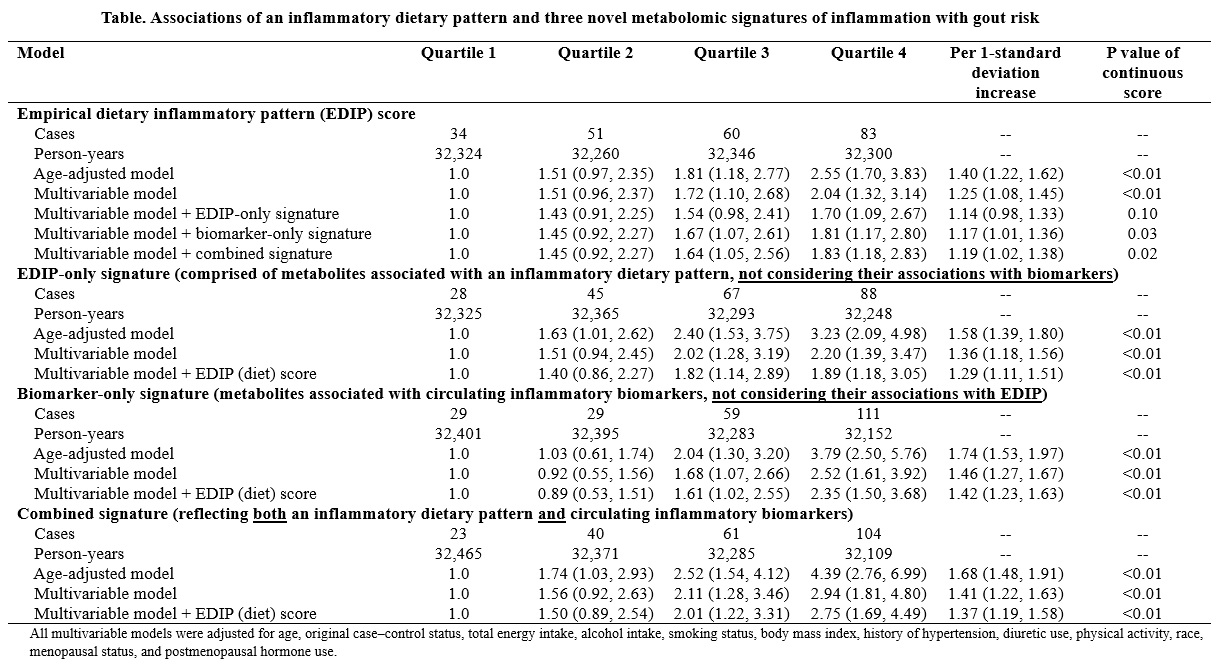
Methods: We analyzed data from 5,936 women with complete metabolite data who were free of gout at baseline. Diet, covariates, and new cases of physician-diagnosed gout were ascertained by validated questionnaires every 2-4 years. We calculated an empirical dietary inflammatory pattern (EDIP) score2 for all participants, with higher scores reflecting a habitual proinflammatory diet. To evaluate the interplay between the EDIP, plasma metabolome, and gout, we examined 3 novel metabolomic signatures constructed using elastic net regression.3 These 3 signatures included metabolites that were predominantly associated with: (1) the EDIP dietary score, regardless of the metabolites’ association with any inflammatory biomarkers (i.e., EDIP-only signature); (2) a panel of 4 inflammatory biomarkers, regardless of the metabolites’ association with diet (i.e., CRP, IL-6, TNF-α-R2, and adiponectin; biomarker-only signature); and (3) a combination of both the EDIP and 4 biomarkers (i.e., combined signature). We used multivariable Cox models to evaluate the associations between each metabolomic signature and incident gout.
Results: We ascertained 228 cases of incident gout over 26 years. In our multivariable models, women in the highest EDIP quartile (most proinflammatory diet) had 2.04-times (95% CI 1.32, 3.14) greater gout risk compared with the lowest quartile (Table). We observed strong positive associations with gout for the EDIP-only (HR for extreme quartiles 2.20 [1.39, 3.47]) and biomarker-only (2.52 [1.61, 3.92]) metabolomic signatures. Greater scores for the combined signature were associated with the highest gout risk among all 3 signatures (HR for extreme quartiles 2.94 [1.81, 4.80]). The association between the EDIP (dietary intake) and gout was attenuated with further adjustment for each metabolomic signature, although it remained significant (HR for extreme quartiles 1.70 [1.09, 2.67], 1.81 [1.17, 2.80], and 1.83 [1.18, 2.83] after adjusting for the EDIP-only, biomarker-only, and combined signatures, respectively), suggesting diet’s effect on gout may be partly mediated by these metabolomic profiles.
Conclusion: Three novel metabolomic signatures of inflammation were each strongly associated with gout risk, suggesting that both adherence and intrinsic metabolic response to a proinflammatory dietary pattern may modulate gout risk.
References:
- McCormick et al. A&R 2021 [abstract].
- Lee et al. Diabetes Care 2020 [PMID: 32873589].
- Lee et al. Diabetologia 2024 [PMID: 37816982].
To cite this abstract in AMA style:
Rai S, Choi H, Yokose C, McCormick N. Three Novel Metabolomic Signatures of Inflammation for Female Gout Risk: A Prospective Cohort Study over 26 Years [abstract]. Arthritis Rheumatol. 2024; 76 (suppl 9). https://acrabstracts.org/abstract/three-novel-metabolomic-signatures-of-inflammation-for-female-gout-risk-a-prospective-cohort-study-over-26-years/. Accessed .« Back to ACR Convergence 2024
ACR Meeting Abstracts - https://acrabstracts.org/abstract/three-novel-metabolomic-signatures-of-inflammation-for-female-gout-risk-a-prospective-cohort-study-over-26-years/