
Session Information
Session Type: Poster Session A
Session Time: 1:00PM-3:00PM
Background/Purpose: We previously reported on themes in patients’ treatment goals and their association with rheumatoid arthritis (RA) disease activity (DA) and aspects of rheumatology care, such as presence of a treatment plan or a shared goal discussion. This study aimed to gain insight into the reasons for discordance between patient and provider goals and to identify factors relating to the differences.
Methods: An anonymous online questionnaire was presented in 2019 on a secure survey system. U.S. residents ≥18 years of age with a self-reported RA diagnosis by a medical professional answered questions on demographics, DA, diagnosis and DMARD history, and RA treatment goals. Participants were asked how their providers’ RA treatment goals differed from their own.
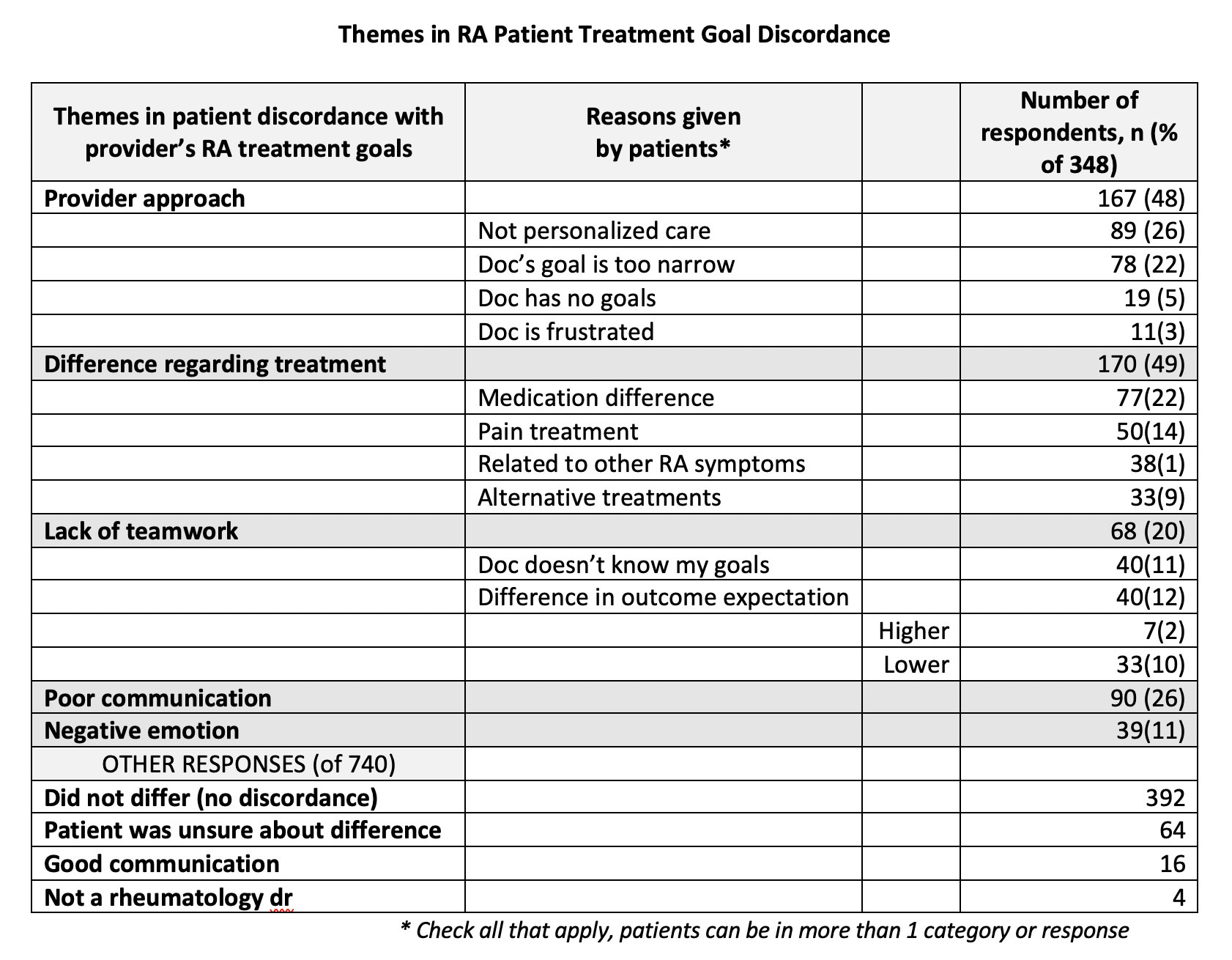
Responses were assessed and coded thematically by a team using qualitative content analysis to identify how their goals differed from their providers’. Responses were also coded for strong emotion, poor communication, and difference in outcome expectation (high or low). Relationships between patient demographics and discordance with provider treatment goals were assessed using Chi-square tests for categorical variables and Kruskal-Wallis tests for continuous variables.
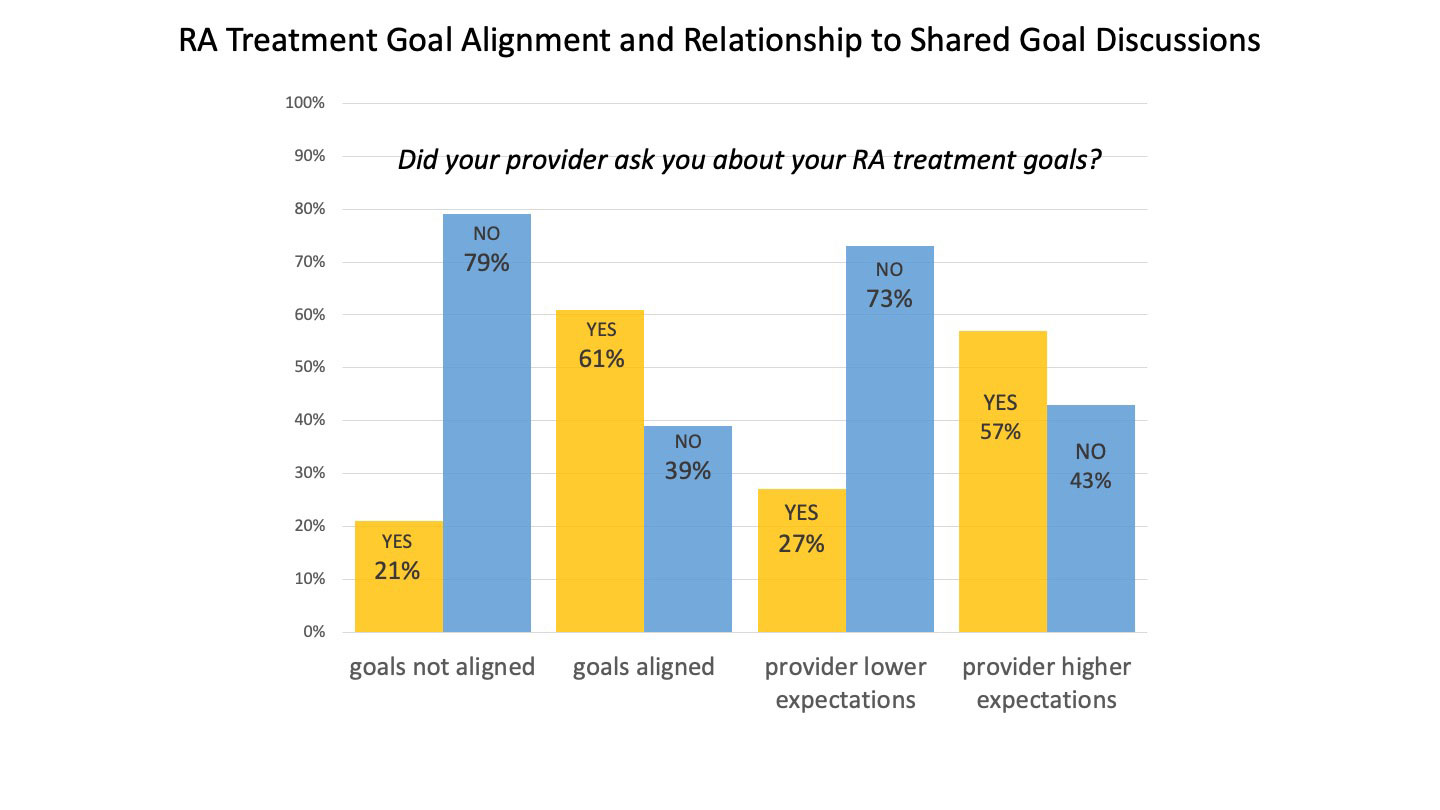
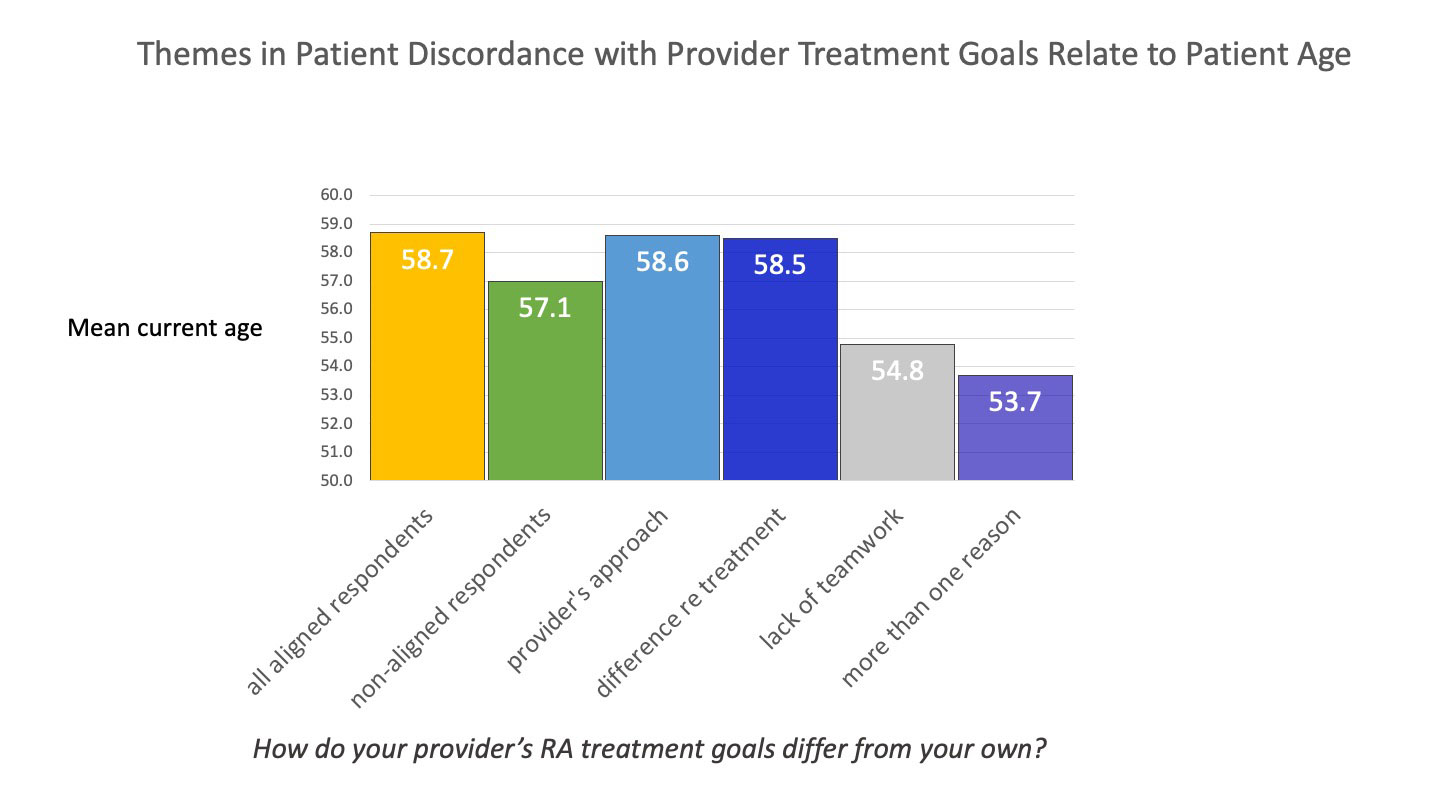
Results: The survey was completed by 907 RA patients (90% women) with 58 (11) yrs mean (SD) age and 11 (10) yrs since diagnosis. 82% (n=740) responded to the question “How do you think your healthcare provider’s treatment goals differ from your own goals?”. Of those, 53% (n=392) did not differ (“aligned” with their providers’ goals); 47% (n=348) reported one or more reasons they differed with respect to treatment goals (“non-aligned”). 14 reasons were identified, of which 7 were present in ≥10% of respondents. 10 reasons were grouped into 3 major themes: provider’s approach (PA), difference about treatment (DT), and lack of teamwork (LT). Overall patient-clinician discordance was higher in female patients (94% vs 87%, p< 0.001). Patients whose reason for discordance was LT were on average younger (p< 0.001), with an earlier mean age of diagnosis (p=0.001) and more likely to be Hispanic or Latino (10% vs 2%, p=0.002) compared to those who selected other reasons. Among non-aligned pairs, only 21% recall a shared goal discussion compared to 61% (p< 0.001).
Conclusion: This survey found a previously unreported rate of patient discordance with providers’ treatment goals and themes within patient accounts of that discordance which associate with patient age, gender, age at diagnosis, and other aspects of rheumatology care. Our study is unique in that reasons for patient discordance with provider’s goals are coded by common themes. Further research should seek greater insight to RA patient goals and their discordance with providers’ goals to investigate their significance in RA management.
To cite this abstract in AMA style:
O'Neill K, Sinicrope P, Crowson C, Marks K, Giblon R, Myasoedova E, Davis J. Themes in Patients’ Discordance with Provider’s Rheumatoid Arthritis Treatment Goals Relate to Patient Age, Gender, and Ethnicity [abstract]. Arthritis Rheumatol. 2022; 74 (suppl 9). https://acrabstracts.org/abstract/themes-in-patients-discordance-with-providers-rheumatoid-arthritis-treatment-goals-relate-to-patient-age-gender-and-ethnicity/. Accessed .« Back to ACR Convergence 2022
ACR Meeting Abstracts - https://acrabstracts.org/abstract/themes-in-patients-discordance-with-providers-rheumatoid-arthritis-treatment-goals-relate-to-patient-age-gender-and-ethnicity/