
Session Information
Session Type: Poster Session B
Session Time: 10:30AM-12:30PM
Background/Purpose: Neutrophils drive local pathology of rheumatoid arthritis (RA) in the synovial tissue (ST) through local production inflammatory mediators, cytokines, and extracellular traps. However, despite these roles, the relevance of their infiltration into the ST with regards to disease activity and response to treatment remain poorly understood. Thus, this project sought to assess the relationship between neutrophil infiltration into the early RA ST and clinical outcomes.
Methods: Arthroscopic ST samples preserved in FFPE from n=32 patients with treatment-naïve RA (< 12 months of onset, fulfilling 2010 ACR/EULAR criteria) were routinely stained with hematoxylin and eosin, and neutrophils judged by morphology by two independent observers. Six field of views (20x) from each section were manually assessed for neutrophil infiltration. Raw counts were reported for (1) marginating neutrophils in blood vessels, (2) tissue-infiltrating neutrophils, (3) combined total counts, and (4) total counts converted into a semiquantitative (SQA) score: 0=< 3 observed; 1=3-10 observed; 2=11-22 observed; 3=23-54 observed; 4=55-85 observed; 5= >85 observed. Manual scoring was validated by immunohistochemistry for CD15, and by comparison with matched bulk RNA sequencing data from the ST of the same patients which had previously been deconvoluted using CIBERSORT.
Results: Data was visualized by heatmap (Figure 1). Neutrophil infiltration measured by CIBERSORT was moderately positively correlated with DAS28CRP (r=0.1952, p=0.0145). Manual scores had a stronger positive correlation with DAS28CRP of higher significance (total: r=0.5409, p=0.0020; tissue infiltrating: r=0.4771, p=0.0077; marginating: r=0.6139, p=0.0003; SQA: r=0.6444, p=0.0001). All manual scores positively correlated with CRP (total: r=0.4775, p=0.0057; tissue infiltrating: r=0.3939, p=0.0257; marginating: r=0.6135, p=0.0002; SQA: r=0.5881, p=0.0004). Margination and SQA scores were positively correlated with RF titre (p=0.0123 and 0.0302, respectively). No association between neutrophil scores were observed with disease duration, tender or swollen joint counts or CCP status or titre. Finally, patients who reached early remission (DAS28CRP< 2.4 at 3 months) had lower manual neutrophil infiltration scores at baseline than those who did not (total: p=0.0189; tissue infiltrating: p=0.0155; SQA: p=0.0102).
Conclusion: RA ST neutrophil content prior to treatment initiation was associated with baseline disease activity, CRP levels and RF titres; patients who achieved early remission had lower neutrophil counts at baseline. Together, these outcomes suggest that ST neutrophil content may prove useful as an objective, predictive measure of disease activity, and has the potential to identify patients less likely to achieve early remission.
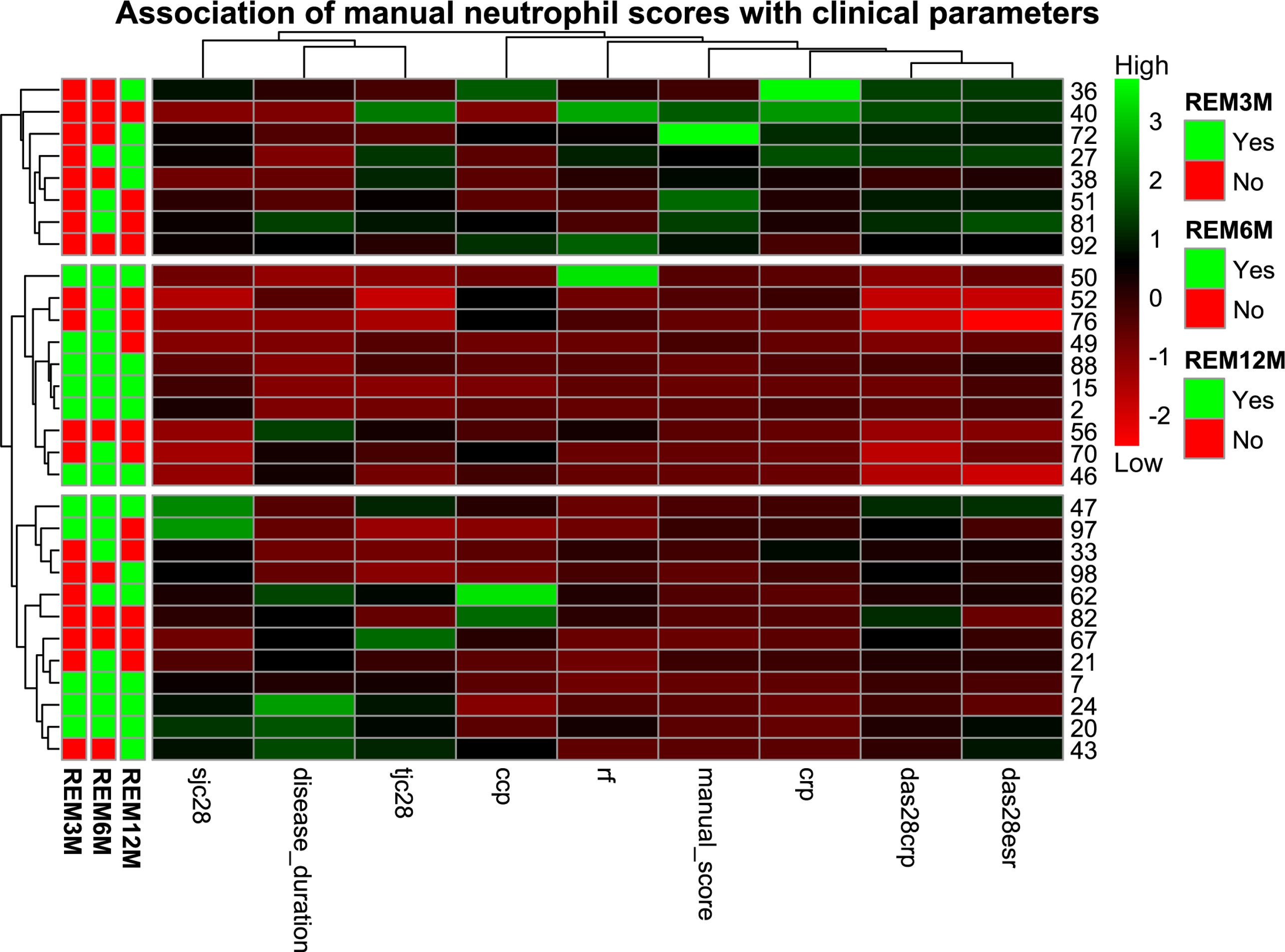 Figure 1. Heatmap of baseline characteristics and total manually determined neutrophil scores of our cohort (n=32), annotated with remission status at 3, 6, and 12 months (judged as DAS28CRP < 2.4).
To cite this abstract in AMA style:
Small A, Wong V, Altmann C, Weedon H, Smith M, Proudman S, Wechalekar M. Synovial Tissue Neutrophils are Associated with Disease Activity and Early Remission in Rheumatoid Arthritis [abstract]. Arthritis Rheumatol. 2025; 77 (suppl 9). https://acrabstracts.org/abstract/synovial-tissue-neutrophils-are-associated-with-disease-activity-and-early-remission-in-rheumatoid-arthritis/. Accessed .« Back to ACR Convergence 2025
ACR Meeting Abstracts - https://acrabstracts.org/abstract/synovial-tissue-neutrophils-are-associated-with-disease-activity-and-early-remission-in-rheumatoid-arthritis/