
Session Information
Date: Saturday, November 6, 2021
Title: Abstracts: Muscle Biology, Myositis & Myopathies (0441–0444)
Session Type: Abstract Session
Session Time: 9:15AM-9:30AM
Background/Purpose: Extracellular vesicles (EVs), including exosomes and microvesicles, are small membrane vesicles released by almost all cell types and are found circulating in blood and other body fluids. Circulating EVs are promising as a novel type of systemic biomarker for various different diseases because their cargoes (miRNAs, mRNAs, and proteins) reflect their cellular origin and function. Increasing evidence suggests that surface proteins (e.g. membrane proteins) on EVs, especially exosomes, are altered in pathological conditions and useful as non-invasive biomarkers for cancer diagnosis and prognosis. However, they have rarely been employed as serum biomarkers for autoimmune diseases. The aim of this study is to identify disease-specific surface proteins on EVs as novel serum biomarkers of polymyositis and dermatomyositis (PM/DM).
Methods: Serum EVs were purified by size exclusion chromatography using sera of 10 PM/DM, 23 patients with other autoimmune diseases and 10 healthy controls (HC). Comprehensive proteomic analysis of serum EVs was performed by liquid chromatography-tandem mass spectrometry (LC/MS). We identified membrane proteins preferentially present in serum EVs of PM/DM patients by bioinformatics and biostatistical analyses. We developed sandwich ELISA for directly detecting serum EVs expressing disease-specific membrane proteins and measured their expression levels using sera of 54 PM/DM, 24 rheumatoid arthritis (RA), 20 systemic lupus erythematosus (SLE), 13 systemic sclerosis patients, and 36 HC.
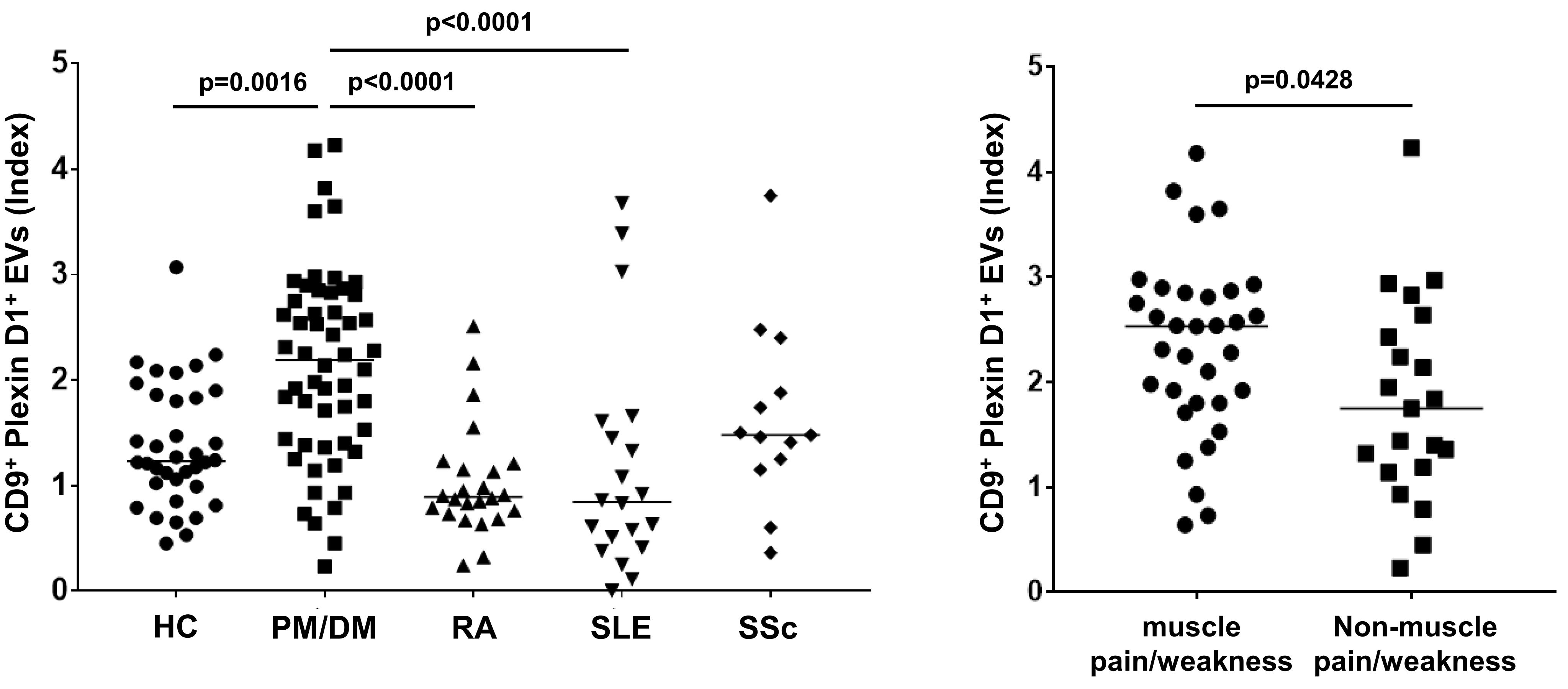
Results: LC/MS analysis identified 1,220 proteins in serum EVs. From the volcano plots combining different bioinformatics analyses (DAVID gene ontology and UniProtKB/Swiss-prot), we identified 5 membrane proteins as significantly up-regulated in serum EVs of PM/DM patients. Of these, Plexin D1 was enriched in those from PM/DM patients relative to HC (p=0.0237) or patients without PM/DM (p=0.0593). Using our sandwich ELISA, we found that levels of Plexin D1-positive EVs (Plexin D1+ EVs) in serum were significantly greater in PM/DM patients than in HC (p=0.0016), RA (p< 0.0001) or SLE patients (p< 0.0001). Serum levels of Plexin D1+ EVs were greater in those PM/DM patients with muscle pain or weakness (p=0.0428). Serum levels of Plexin D1+ EVs were correlated with levels of aldolase (rs=0.481, p=0.027), total blood cells (rs=0.381, p=0.046), neutrophils (rs=0.450, p=0.019), and platelets (rs=0.408, p=0.031) in PM/DM patients. Finally, serum levels of Plexin D1+ EVs decreased significantly in patients with PM/DM in clinical remission after treatment (p< 0.0001).
Conclusion: We have identified levels of circulating Plexin D1+ EVs as a novel serum biomarker for PM/DM.
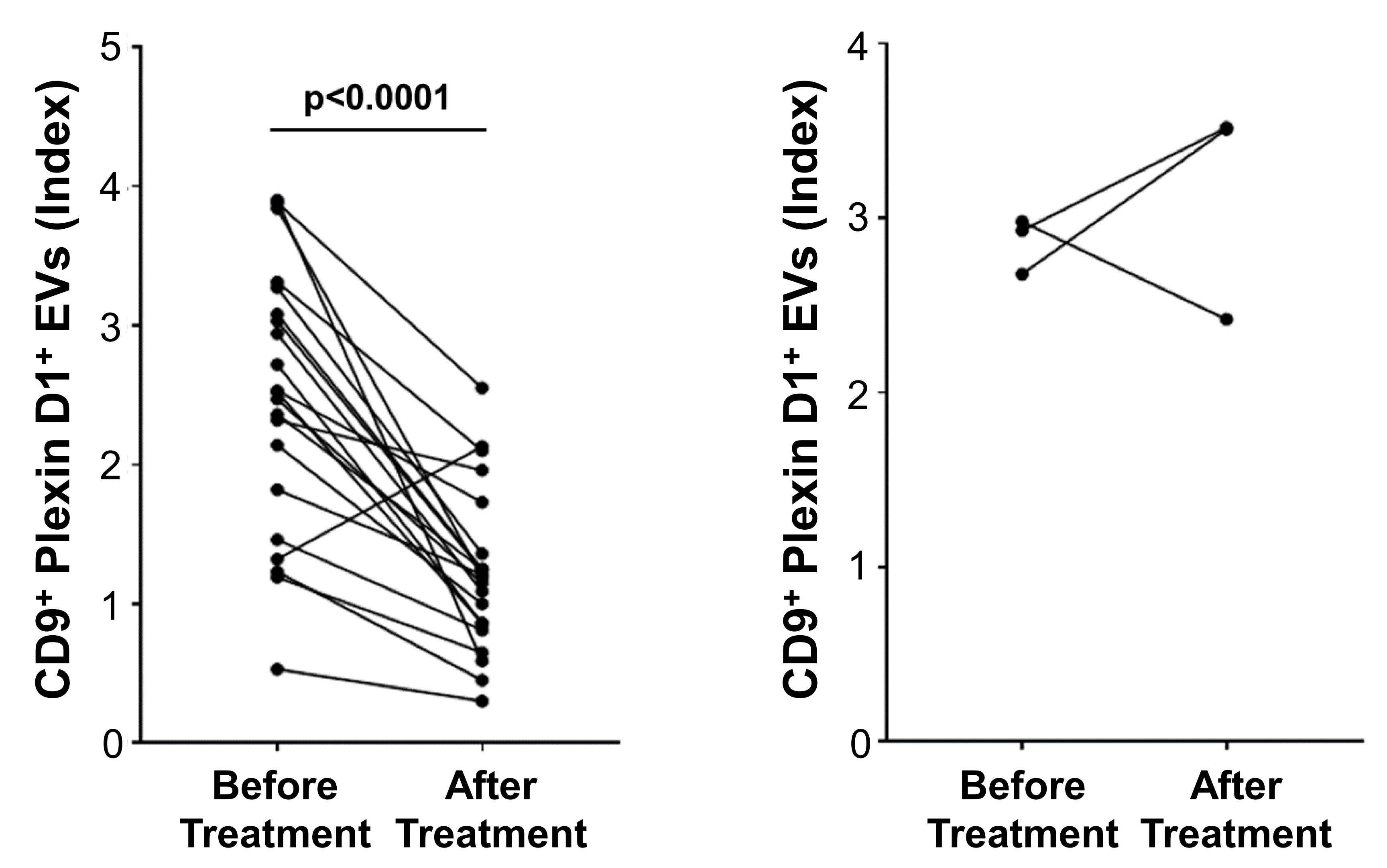
Change of serum levels of CD9+ Plexin D1+ EVs in PM/DM patients after treatment in 21 PM/DM patients who achieved clinical remission (left) and 3 PM/DM patients who did not (right).
To cite this abstract in AMA style:
Uto K, Ueda K, Okano T, Akashi K, Takahashi S, Nakamachi Y, Imanishi T, Kawano S, Yano Y, Saegusa J. Identification of Plexin D1 on Circulating Extracellular Vesicles as a Potential Biomarker of Polymyositis and Dermatomyositis [abstract]. Arthritis Rheumatol. 2021; 73 (suppl 9). https://acrabstracts.org/abstract/identification-of-plexin-d1-on-circulating-extracellular-vesicles-as-a-potential-biomarker-of-polymyositis-and-dermatomyositis/. Accessed .« Back to ACR Convergence 2021
ACR Meeting Abstracts - https://acrabstracts.org/abstract/identification-of-plexin-d1-on-circulating-extracellular-vesicles-as-a-potential-biomarker-of-polymyositis-and-dermatomyositis/