
Session Information
Date: Tuesday, November 19, 2024
Title: Abstracts: Muscle Biology, Myositis & Myopathies – Basic & Clinical Science II
Session Type: Abstract Session
Session Time: 11:00AM-12:30PM
Background/Purpose: Idiopathic immune myopathies (IIMs) are a group of autoimmune diseases that produce chronic inflammation and degeneration of skeletal muscle structure and function. One process that maintains the integrity of muscle fibers is the plasma membrane repair process, which uses various cellular processes to reseal disruptions in sarcolemma and allow the cell to survive various insults. We have previously reported a sarcolemmal membrane repair defect in an IIM mouse model (AT mice) where RAG1-/- mice receive an adoptive transfer from SytVII-/-/FoxP3-/Y mice. One contributor to this repair defect was autoantibodies targeting TRIM72/MG53, an essential membrane repair protein, we found in the AT mouse sera and also in IIM patient sera. However, in that IIM patient population we identified additional sera samples with low levels of TRIM72/MG53 autoantibodies that still compromise repair capacity. Here we tested if autoantibodies against other proteins involved in membrane repair appear in IIM patients and if these could also compromise membrane repair.
Methods: Autoantibodies targeting membrane repair proteins (dysferlin, annexins A5 and A6) in patient sera was measured using custom ELISAs. Membrane repair capacity was measured with a microscopic assay where mouse flexor digitorum brevis (FDB) muscles were bathed in 10.5mM FM4-64, a lipophilic dye, during laser damage to the sarcolemma. The fluorescent intensity of the dye entering the injury site was used as a proxy for membrane repair. Lastly, AT mice were injected with a commercial dysferlin antibody, 0.05mg/kg weekly for 8 weeks, and muscle inflammation and serum creatine kinase (CK) concentrations were measured by histology or ELISA, respectively.
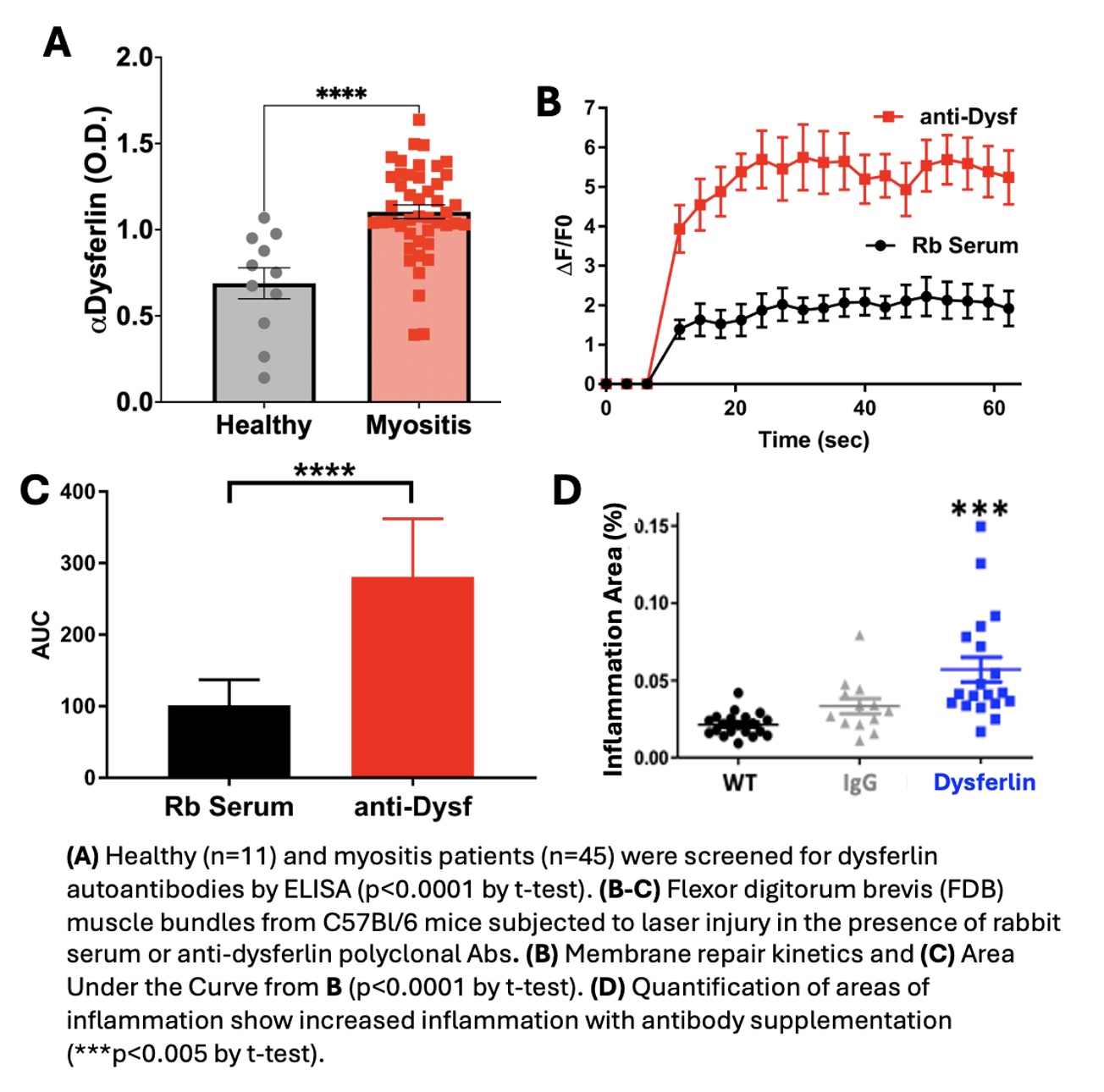
Results: We observed a significant increase in autoantibodies targeting dysferlin in IIM patient sera, with 77.78% one standard deviation and 26.67% of samples two standard deviations greater than the mean of healthy subjects. No such an increase in dysferlin autoantibodies was observed in systemic lupus systemic lupus erythematosus (SLE) patient serum samples. There was a positive correlation between dysferlin autoantibody levels and serum CK concentrations. This is likely caused by dysferlin antibodies compromising membrane repair as application of aDysferlin commercial antibodies (1:100 dilution) to wild type C57Bl/6 FDB muscles compromises sarcolemma repair when compared to a rabbit serum control. To test if these effects could accelerate IIM progression, we injected AT mice with control IgG or aDysferlin commercial antibodies and observed a significant increase in the extent of inflammation and the concentration of CK in the serum of the antibody injected mice.
Conclusion: Our results reveal dysferlin autoantibodies may serve as a novel biomarker specific to IIM that can contribute to muscle degeneration in the disease by decreasing sarcolemmal membrane repair capacity.
To cite this abstract in AMA style:
Bulgart H, Banford K, Bruckner S, McElhanon K, Young N, Paleo B, Beck E, Aggarwal R, Oddis C, Zeno B, Jarjour W, Weisleder N. Dysferlin Autoantibodies Compromise Sarcolemmal Repair Capacity and Contribute to the Pathogenesis of Idiopathic Immune Myopathies [abstract]. Arthritis Rheumatol. 2024; 76 (suppl 9). https://acrabstracts.org/abstract/dysferlin-autoantibodies-compromise-sarcolemmal-repair-capacity-and-contribute-to-the-pathogenesis-of-idiopathic-immune-myopathies/. Accessed .« Back to ACR Convergence 2024
ACR Meeting Abstracts - https://acrabstracts.org/abstract/dysferlin-autoantibodies-compromise-sarcolemmal-repair-capacity-and-contribute-to-the-pathogenesis-of-idiopathic-immune-myopathies/