ACR Meeting Abstracts

ACR Meeting Abstracts

  • Meeting Abstracts
    • All Meetings
    • PRSYM 2026
    • ACR Convergence 2025
    • Download Abstract Supplements
  • Keyword Index
  • My Favorites
    • View & print my favorites
  • Search

Home » Meeting Abstracts » ACR Convergence 2024

Abstract Number: 1794

Biobehavioral Basis and Outcomes of Cognitive Dysfunction in Childhood Systemic Lupus Erythematosus

Hanne van der Heijden1, Andrea Knight2, Itamar Ronen3, Gabrielle Alonzi4, Kyle McBrearty4, Aditi Deokar4, Joseph Gonzalez-Heydrich4, Joyce Chang4 and Jaymin Upadhyay5, 1Boston Children's Hospital Harvard Medical School, Boston, MA, 2Division of Rheumatology, The Hospital for Sick Children; Neurosciences and Mental Health, SickKids Research Institute; Department of Paediatrics, University of Toronto, Toronto, ON, Canada, 3Brighton and Sussex Medical School, University of Sussex, Brighton, UK, Brighton, United Kingdom, 4Boston Children's Hospital, Boston, MA, 5Boston Children's Hospital, Harvard Medical School, Boston, MA

Share on X (Twitter) Share on Facebook Share on LinkedIn Share on Email
Print

Meeting: ACR Convergence 2024

Keywords: Cognitive dysfunction, Inflammation, Neuroimaging, Pediatric rheumatology, Systemic lupus erythematosus (SLE)

Session Information

Date: Monday, November 18, 2024

Title: SLE – Etiology & Pathogenesis Poster

Session Type: Poster Session C

Session Time: 10:30AM-12:30PM

Background/Purpose: Cognitive dysfunction (CD) in childhood-onset SLE (cSLE) is undertreated yet profoundly impacts lifelong health-related quality of life. Investigating CD in cSLE is crucial, given the vulnerability of neurodevelopmentally immature systems. This preliminary study cross-sectionally characterized neurocognitive functioning and structural and functional neuroimaging and investigates how neuroinflammatory processes, reflected by choroid plexus (CP) and brain metabolites, contribute to CD in cSLE.

Methods: Patients aged 12-23 years old, meeting 1997 ACR or 2019 ACR-EULAR classification criteria for SLE, with onset prior to 18 years of age were recruited from a single pediatric rheumatology clinic. We also recruited age and sex-matched controls without cSLE or other chronic conditions. Functional near-infrared spectroscopy (fNIRS) examined prefrontal cortex functionality, structural MRI measured CP volume, and inflammatory metabolites were quantified using magnetic resonance spectroscopy (MRS). Neurocognitive function was evaluated with the self-report Patient-Reported Outcomes Measurement Information System (PROMIS) Cognitive Function short form and performance-based testing on the computerized Pediatric Automated Neuropsychological Assessment Metrics (PedANAM) battery. Statistical analyses included two-tailed t-test and Pearson’s correlations.

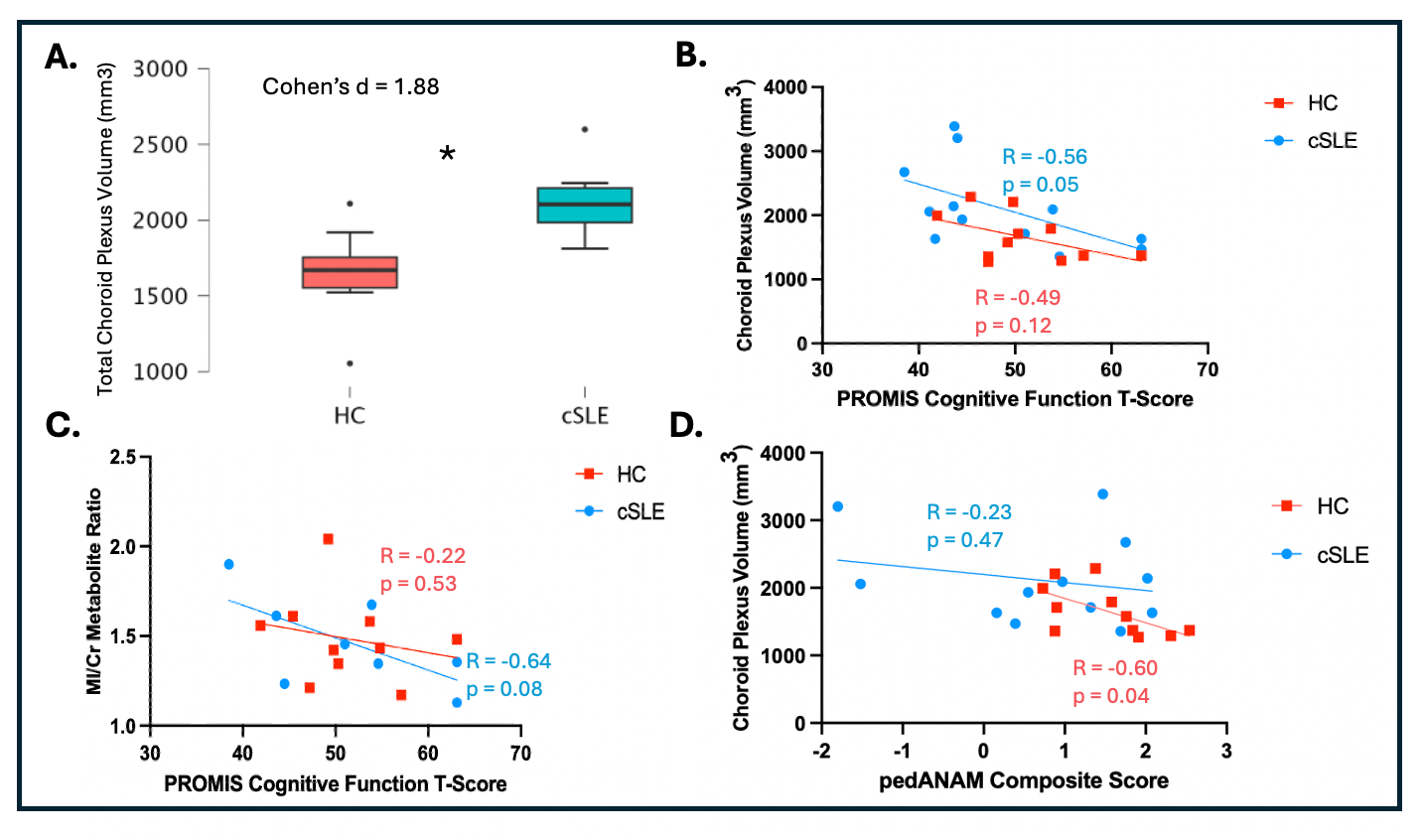
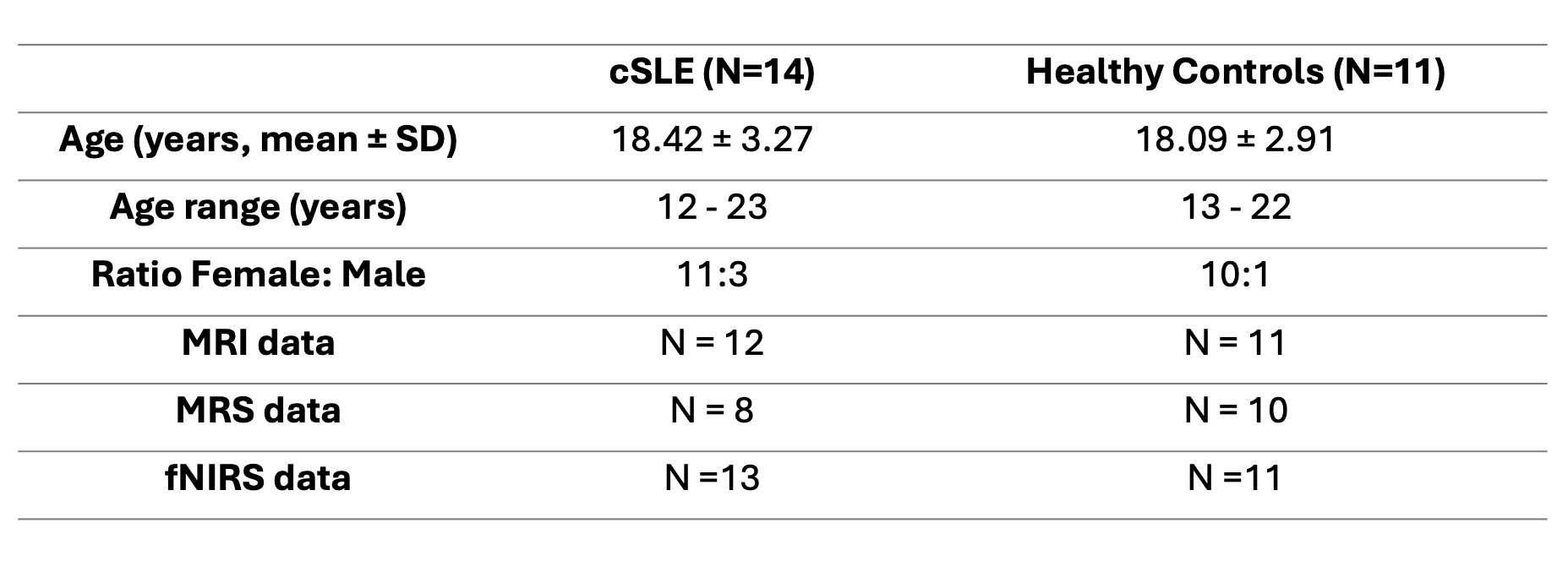
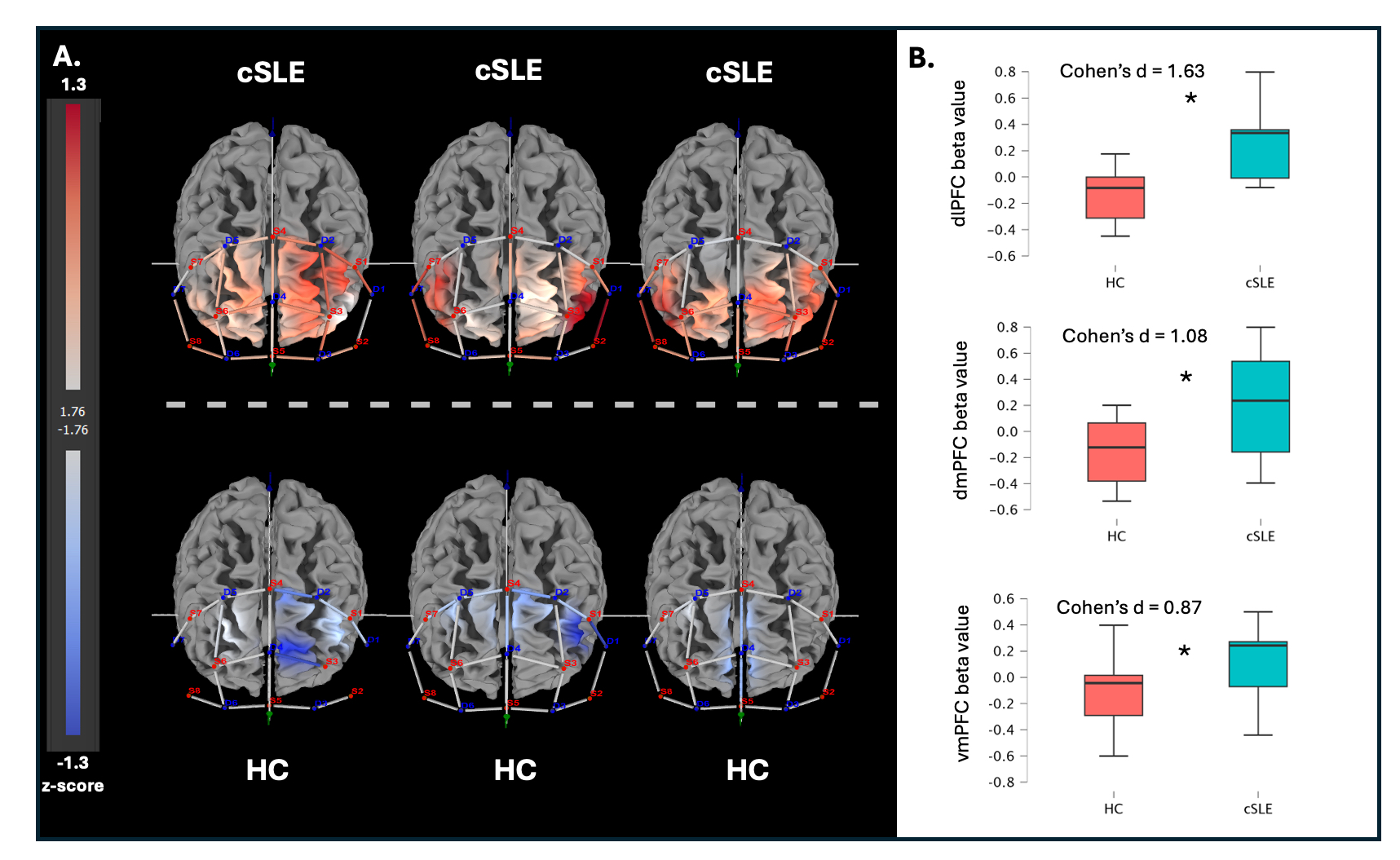
Results: Fourteen patients with cSLE and 11 healthy controls were recruited (Table 1). Compared to controls, patients with cSLE demonstrated impaired performance on the PedANAM Stroop task (p< 0.01, t=3.29), altered task-based prefrontal cortex functionality on fNIRS compared to healthy controls (Fig. 1), and larger CP volumes (p< 0.01, t=3.06) controls (Fig. 2). Lower scores on the PROMIS cognitive functioning scale corresponded with larger CP volumes and with lower Myo-Inositol/ Creatine (MI/Cr) metabolite ratios and lower PedANAM scores with higher CP volumes were observed.

Conclusion: These preliminary findings suggest that CD in cSLE is characterized by a combination of prefrontal cortex functional alterations alongside morphological changes in the choroid plexus that may be indicative of brain-cerebrospinal fluid barrier dysfunction. Understanding these mechanisms is crucial for developing targeted interventions to improve outcomes for children with SLE.
Supporting image 1

Table 1. Study sample characteristics of current cohort. Data collection is ongoing.

Supporting image 2

Figure 1. A) Representative examples of fNIRS activation or incongruent vs congruent conditions of the Stroop task in cSLE patients and healthy controls. B) cSLE patients (N=13) show higher activation (oxygenation bèta values) during the incongruent vs the congruent task in various regions of the prefrontal cortex compared to HCs (N=11) including dlPFC (p < 0.001), dmPFC (p = 0.017) and vmPFC (p = 0.045)

Supporting image 3

Figure 2. A) Larger choroid plexus volumes are observed in patients with cSLE than in healthy controls after correcting for age, gender and total intracranial volume (N=23, p<0.001, t=4.527). B) Negative trends for lower scores on the PROMIS cognitive function scale with choroid plexus volume C) Myo-Inositol to Creatine Ratio are plotted for both patients with cSLE and healthy controls. D) Negative trends are plotted for the pedANAM composite scores and choroid plexus volume.


Disclosures: H. van der Heijden: None; A. Knight: Pfizer, 6; I. Ronen: None; G. Alonzi: None; K. McBrearty: None; A. Deokar: None; J. Gonzalez-Heydrich: Mightier/Neuromotion Labs, 1, 8, 10; J. Chang: Century Therapeutics, 2; J. Upadhyay: None.

To cite this abstract in AMA style:

van der Heijden H, Knight A, Ronen I, Alonzi G, McBrearty K, Deokar A, Gonzalez-Heydrich J, Chang J, Upadhyay J. Biobehavioral Basis and Outcomes of Cognitive Dysfunction in Childhood Systemic Lupus Erythematosus [abstract]. Arthritis Rheumatol. 2024; 76 (suppl 9). https://acrabstracts.org/abstract/biobehavioral-basis-and-outcomes-of-cognitive-dysfunction-in-childhood-systemic-lupus-erythematosus/. Accessed .

ACR Meeting Abstracts - https://acrabstracts.org/abstract/biobehavioral-basis-and-outcomes-of-cognitive-dysfunction-in-childhood-systemic-lupus-erythematosus/

My Favorites

Save and print abstracts during your browser session by clicking the “Favorite” button at the bottom of any abstract (must have cookies enabled in browser). See saved favorites.

Abstract Policies

  • ACR Convergence Abstract Embargo Policies
  • ACR Convergence Abstract Permissions & Reprints
  • PRSYM Abstract Policies

ACR Convergence. Where Rheumatology Meets

ACR Convergence 2026

Join us November 6-11 in Orlando, Florida.
See Registration Information

  • Contact ACR
  • Privacy Policy
  • ACR Policies
  • Cookie Preferences

© Copyright 2026 American College of Rheumatology