
Session Information
Date: Monday, November 9, 2020
Title: Pediatric Rheumatology – Clinical Poster III: SLE, Vasculitis, & JDM
Session Type: Poster Session D
Session Time: 9:00AM-11:00AM
Background/Purpose: Kawasaki Disease (KD), a systemic vasculitis of unknown etiology, is now the leading cause of acquired heart disease in children in North America. Its reported incidence varies widely around the world. A recent pan-Canadian study utilizing hospital discharge data reported an unexpectedly high incidence of KD in Atlantic Canada. The primary goal of this study was to validate the finding of a high incidence of KD in an Atlantic Canadian province and review factors contributing to the frequency in our population.
Methods: Our study was a retrospective review of all patients less than 16 years of age from the province of Nova Scotia (NS) diagnosed with KD between July 2007 and June 2018. All children with KD in NS undergo echocardiography evaluated in one central location. We used the cardiology and discharge databases of the pediatric tertiary care center, and the provincial Medical Examiner database to identify patients with KD. Clinical information was collected by health record review using a standardized form following local ethics approval. The 2011 Canadian census population data were used to calculate incidence rates and determine the proportion of the population of Asian descent.
Results:
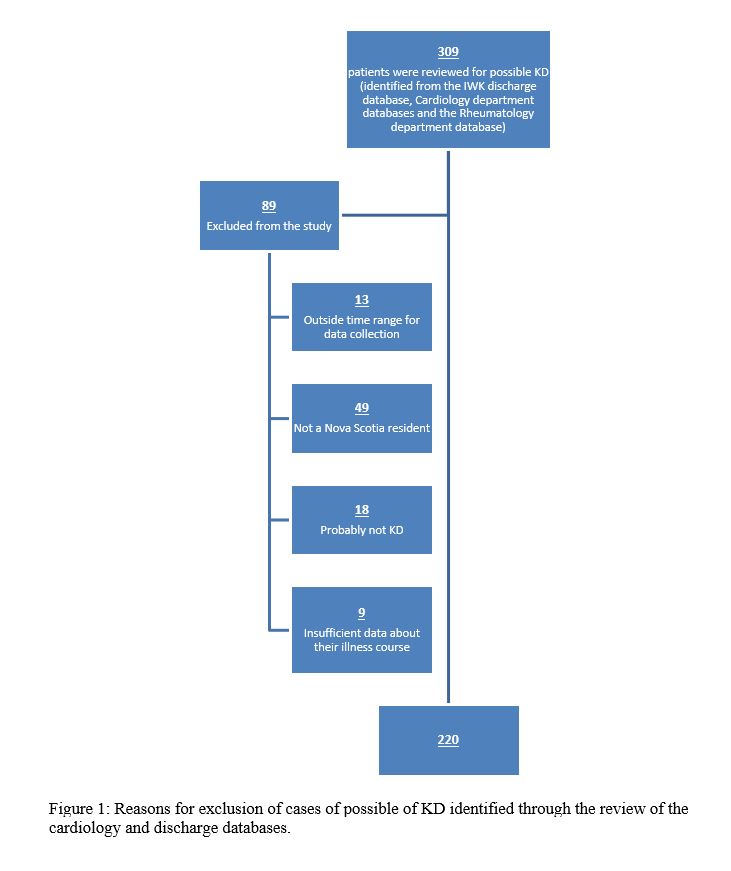
Out of the 309 possible KD cases that we identified, 220 residents of the province were diagnosed with KD during the study period. Exclusions are shown in Figure 1. Patients were included if they were treated for KD with IVIG (87%) or, if untreated, the physician diagnosed KD and obtained echo follow-up (13%). Cases where the physician subsequently doubted the diagnosis of KD were recorded. The annual incidence was 29.6, 13.9 and 1.6 per 100,000 children < 5 years, 5 to less than 10 years and 10 to less than 15 years, respectively (recurrence rate 1.8%). The male to female ratio was 1.3:1; the median age was 3.6 years (range 18 days-14.6 years). 61.4% and 23.2% met American Heart Association criteria for complete and incomplete KD, respectively. All patients diagnosed in the acute phase received IVIG; 12% of patients were refractory to the initial IVIG dose; 8% of treated patients received steroid and or biologic therapy. 14 (6%) developed a coronary artery aneurysm (CAA) during the disease course. One death from cardiac arrest occurred in a child with a large CAA with thrombosis. The proportion of our population of Asian descent was 1.25%.
Conclusion: We have confirmed a high incidence of KD in the specified Atlantic province. Other features of KD (age, sex, recurrence rate, IVIG resistance and CAA) are similar to previous studies. The incidence is higher than that reported in Europe and the United States (4.5-15 and 19 per 100,000 children < 5 years, respectively), similar to Canadian provinces with significantly higher proportions of the population of Asian descent (20-26 per 100,000 children < 5 years), and among the highest reported outside of Asia. Local population ethnicity does not explain our findings. Our comprehensive method to capture KD patients may have contributed to the detection of the higher than expected incidence, raising the possibility that the incidence of KD has been underestimated in other populations. The role of environmental and genetic factors also deserves further study.
To cite this abstract in AMA style:
Alkanhal A, Saunders J, Altammar F, Huber A, Lynk A, MacLeod A, Ortiz-Alvarez O, Adams M, Ramsey S, Stringer E, Warren A, Lang B. Unexpectedly High Incidence of Kawasaki Disease in a Well-Characterized Population in Atlantic Canada [abstract]. Arthritis Rheumatol. 2020; 72 (suppl 10). https://acrabstracts.org/abstract/unexpectedly-high-incidence-of-kawasaki-disease-in-a-well-characterized-population-in-atlantic-canada-2/. Accessed .« Back to ACR Convergence 2020
ACR Meeting Abstracts - https://acrabstracts.org/abstract/unexpectedly-high-incidence-of-kawasaki-disease-in-a-well-characterized-population-in-atlantic-canada-2/