ACR Meeting Abstracts

ACR Meeting Abstracts

  • Meeting Abstracts
    • All Meetings
    • PRSYM 2026
    • ACR Convergence 2025
    • Download Abstract Supplements
  • Keyword Index
  • My Favorites
    • View & print my favorites
  • Search

Home » Meeting Abstracts » ACR Convergence 2025

Abstract Number: 1685

The Sjögren’s Tool for Assessing Response (STAR) demonstrates its ability to accurately detect treatment efficacy in 11 recent RCTs in Sjögren’s disease

Raphaele Seror1, Gabriel Baron2, Elodie Perrodeau3, Alena Piatrova4, Hendrika Bootsma5, Simon Bowman6, Jacques-eric GOTTENBERG7, Divi Cornec8, michele Bombardieri9, Suzanne Arends10, Benjamin A. Fisher11, Wolfgang Hueber12, Antoine Sreih13, Antonia Christodoulou14, Andre van Maurik15, Joel van Roon16, Valerie Devauchelle17, Peter Gergely18, Xavier Mariette19 and Raphael Porcher20, 1Department of Rheumatology, National referral center for auto immune disease and Sjogren disease, Université Paris-Saclay, INSERM UMR1184: Centre for Immunology of Viral Infections and Autoimmune Diseases, Assistance Publique-Hôpitaux de Paris, Hôpital Bicêtre, Le Kremlin Bicêtre, Paris, France., le kremlin bicetre, France, 2Hôtel-Dieu, Université Paris Cité,, Paris, France, 3Université Paris Descartes Sorbonne Paris Cité, Paris, France, 4Department of Rheumatology, National referral center for auto immune disease and Sjogren disease, Université Paris-Saclay, INSERM UMR1184: Centre for Immunology of Viral Infections and Autoimmune Diseases, Assistance Publique-Hôpitaux de Paris, Hôpital Bicêtre, Le Kremlin Bicêtre, Paris, France., Paris, Ile-de-France, France, 5UMCG, Groningen, Netherlands, 6University Hospitals Birmingham, Birmingham, United Kingdom, 7Hautepierre Hospital, STRASBOURG, Alsace, France, 8Departement of Rhumatology, CHU Brest, Université de Brest, INSERM UMR1227: LBAI, Brest, France, Brest, France, 9Experimental Medicine and Rheumatology, William Harvey Research Institute, Queen Mary University of London, UK, London, United Kingdom, 10University Medical Center Groningen, Groningen, Netherlands, 11King’s College London, London, UK; Institute of Inflammation and Ageing, University of Birmingham, Birmingham, UK, Birmingham, United Kingdom, 12Novartis Pharmaceuticals, Basel, Switzerland, 13Cullinan Therapeutics, New York, NY, 14BMS, Princeton, NJ, 15GlaxoSmithKline, Stevenage, United Kingdom, 16Center of Translational Immunology, Department of Immunology and Department of Rheumatology & Clinical Immunology, University Medical Center Utrecht, Utrecht University, Utrecht PO BOX 85500, 3508 GA, Netherlands, Utrecht, Netherlands, 17UBO, Brest, France, 18Novartis Biomedical Research, Basel, Switzerland, 19Université Paris-Saclay, Le Kremlin Bicetre, France, 20Université Paris Cité and Université Sorbonne Paris Nord, INSERM, INRAE, Center for Research in Epidemiology and StatisticS (CRESS), Paris, France, Paris, France

Share on X (Twitter) Share on Facebook Share on LinkedIn Share on Email
Print

Meeting: ACR Convergence 2025

Keywords: meta-analysis, Outcome measures, Psychometrics, Response Criteria, Sjögren's syndrome

Session Information

Date: Monday, October 27, 2025

Title: Abstracts: Sjögren’s Disease – Basic & Clinical Science (1680–1685)

Session Type: Abstract Session

Session Time: 2:15PM-2:30PM

Background/Purpose: Performance of the recently developed composite responder index STAR is highly awaited. We conduscted this study to evaluate the performance of STAR in previously completed clinical trials shared within the NECESSITY consortium.

Methods: Data from 9 trials used for STAR development (Abatacept (ASAP-III), leflunomide+hydroxychloroquine (REPURP-SS) and rituximab (TEARS and TRACTISS), the iscalimab and ianalumab phase 2 trials, Baminercept, hydroxychloroquine (JOQUER), tocilizumab (ETAP)) and two other independent clinical trials (GSK (NCT02631538), Belimumab + Rituximab, Belimumab, Rituximab versus placebo and BMS Abatacept (NCT02915159). Trials were classified, by an expert panel, as positive, negative or “in between”, in regards to primary and key secondary endpoints. The STAR candidate, and its 14 alternate binary option (including the recently developed CRESS) responses were calculated retrospectively at the timing of the primary endpoint of the corresponding trial.To better appraise sensitivity to change of the STAR options, meta-analyses of the 11 RCTs were run for each option, separately for positive and “in between” trials together, where positive results were expected, and negative trials, where no difference between groups was expected. Meta-analyses were run using the Mantel-Haenszel method with Paule-Mandel estimator for τ2, Q-profile method for confidence interval of τ2and τ and continuity correction of 0.5 in studies with zero cell frequencies. Treatment effect was expressed as an odds ratio (OR): 1 or below indicates the absence of any effect, above 1 favors the experimental treatment. Consequently, a STAR option that is sensitive and specific to change should have a treatment effect close to the null effect for the negative trials, and as far from the null effect for the positive trials.

Results: Of the 11 trials, 7 were classified as positive by the expert panel. Among these positive trials, when using STAR candidate and the 14 alternate binary options, OR ranged from 2.85 to 3.75, and the number of trials actually positive (ie, having significant between arm difference with the STAR option) ranged from 2 to 4 (figure 1 in red). Among the 4 negative trials, when using the STAR candidate and the 14 alternate binary options, OR ranged from 0.69 to 2.11. OR was statistically significant (in favor of an effect of the treatment) in 3 STAR alternate option, which wrongly detect a difference in trial were no efficacy was observed (figure 1 in blue). The STAR candidate displays an OR of 3.01 (1.85 – 4.91) in positive trials and 1.30 (0.82 – 2.05) in negative trials and detects significant differences in 4 of the 7 positive trials (figure 2). The CRESS displays an OR of 3.12 (1.60 – 6.07) in positive trials and 2.11 (1.32 – 3.37) in negative trials and detects significant differences in 4 of the 7 positive trials, and one of the negative trials.

Conclusion: In this analysis based on 11 trials, the STAR appears to detect treatment response accurately, with a high sensitivity to change for treatments showing a beneficial effect. Additionally, it exhibits specificity to change by not falsely detecting improvement in negative trials.
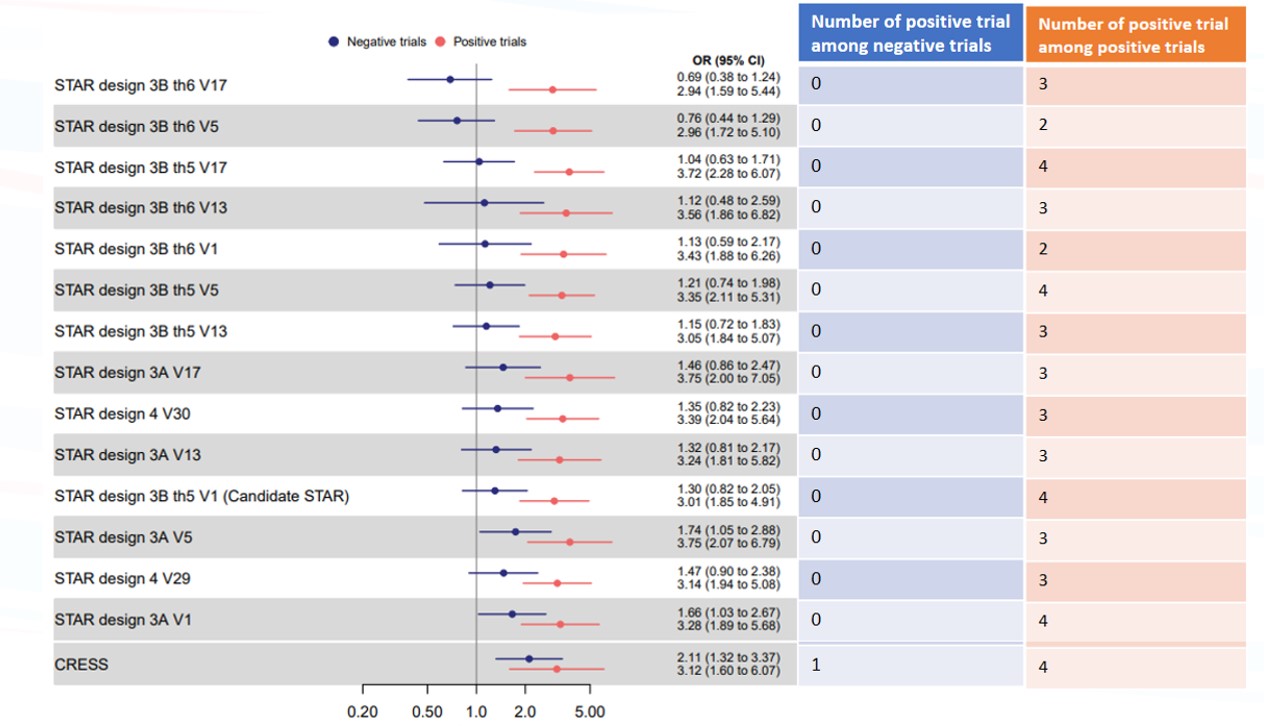
Supporting image 1Summary of results of the meta-analyses of negative and positive trials, using as endpoint, the STAR candidate and alternate binary options

Supporting image 2Meta-analyses of the 4 negative and 7 positive trials using the STAR candidate as endpoint


Disclosures: R. Seror: Amgen, 6, Boehringer-Ingelheim, 2, Bristol-Myers Squibb(BMS), 2, GlaxoSmithKlein(GSK), 2, 6, Janssen, 2, Kiniska, 2, Novartis, 2, 6; G. Baron: None; E. Perrodeau: None; A. Piatrova: None; H. Bootsma: Bristol-Myers Squibb(BMS), 2, 5, Medimmune, 2, Novartis, 2, Roche, 2, 5, Union Chimique Belge, 2; S. Bowman: AbbVie/Abbott, 2, 4, Aera, 2, 4, Amgen, 2, 4, Argenx, 2, 4, AstraZeneca, 2, Aurinia, 2, 4, Bain, 2, Birmingham NIHR Biomedical Research Centre, 3, Bristol-Myers Squibb(BMS), 2, 4, EcoR1, 2, Galapagos, 2, IQVIA, 2, 4, Johnson and Johnson, 2, 4, Kiniksa, 2, 4, Novartis, 2, Royal College of Physicians (Medical Charity) and related entities, 4, Scitaris, 2; J. GOTTENBERG: AbbVie/Abbott, 6, Bristol-Myers Squibb(BMS), 5, 6, CSL Behring, 6, Eli Lilly, 6, Galapagos, 6, Genzyme, 6, Gilead, 6, Merck/MSD, 6, Novartis, 6, Pfizer, 6, Roche, 6, Sanofi, 6; D. Cornec: Amgen, 2, Bristol-Myers Squibb(BMS), 2, GlaxoSmithKlein(GSK), 2, Janssen, 2, Pfizer, 2, Roche, 2; m. Bombardieri: Amgen, 5, 12, Personal fees, GlaxoSmithKlein(GSK), 5, 12, Personal fees, Janssen, 5, 12, Personal fees, Ono Pharmaceuticals Co. Ltd, 1, 2, UCB, 12, Personal fees; S. Arends: argenx, 2, BMS, 2, Novartis, 2; B. Fisher: Bristol-Myers Squibb(BMS), 2, Galapagos, 5, Janssen, 2, 5, Novartis, 2, Servier, 2, 5; W. Hueber: Novartis, 3, 11; A. Sreih: Bristol-Myers Squibb(BMS), 3, 11; A. Christodoulou: Bristol-Myers Squibb, 3, 11; A. van Maurik: GlaxoSmithKlein(GSK), 3, 11; J. van Roon: None; V. Devauchelle: None; P. Gergely: Novartis, 3, 11; X. Mariette: Galapagos, 2, GlaxoSmithKlein(GSK), 2, Janssen, 2, Novartis, 2, Ose Pharmaceuticals, 5, Pfizer, 2, UCB, 2; R. Porcher: None.

To cite this abstract in AMA style:

Seror R, Baron G, Perrodeau E, Piatrova A, Bootsma H, Bowman S, GOTTENBERG J, Cornec D, Bombardieri m, Arends S, Fisher B, Hueber W, Sreih A, Christodoulou A, van Maurik A, van Roon J, Devauchelle V, Gergely P, Mariette X, Porcher R. The Sjögren’s Tool for Assessing Response (STAR) demonstrates its ability to accurately detect treatment efficacy in 11 recent RCTs in Sjögren’s disease [abstract]. Arthritis Rheumatol. 2025; 77 (suppl 9). https://acrabstracts.org/abstract/the-sjogrens-tool-for-assessing-response-star-demonstrates-its-ability-to-accurately-detect-treatment-efficacy-in-11-recent-rcts-in-sjogrens-disease/. Accessed .

ACR Meeting Abstracts - https://acrabstracts.org/abstract/the-sjogrens-tool-for-assessing-response-star-demonstrates-its-ability-to-accurately-detect-treatment-efficacy-in-11-recent-rcts-in-sjogrens-disease/

My Favorites

Save and print abstracts during your browser session by clicking the “Favorite” button at the bottom of any abstract (must have cookies enabled in browser). See saved favorites.

Abstract Policies

  • ACR Convergence Abstract Embargo Policies
  • ACR Convergence Abstract Permissions & Reprints
  • PRSYM Abstract Policies

ACR Convergence. Where Rheumatology Meets

ACR Convergence 2026

Join us November 6-11 in Orlando, Florida.
See Registration Information

  • Contact ACR
  • Privacy Policy
  • ACR Policies
  • Cookie Preferences

© Copyright 2026 American College of Rheumatology