
Session Information
Date: Sunday, November 10, 2019
Title: Education Poster
Session Type: Poster Session (Sunday)
Session Time: 9:00AM-11:00AM
Background/Purpose: Spaced education (SE) and reciprocal peer teaching (RPT) are known to promote knowledge retention and learner engagement. We wanted to understand the educational impact of SE and RPT elements in our rheumatology fellowship core curriculum (CC) but were limited by a small number of learners, insufficient time for test question validation, and difficulty isolating the curricular elements of interest from concurrent educational activities. We developed a novel free recall assessment to analyze knowledge retention from CC sessions in our program to evaluate the impact of SE and RPT.
Methods: The SE intervention involved emailing fellows “rheuminder” multiple choice quizzes about key topics covered in CC sessions. There were 19 CC sessions during the pre-SE period. The SE intervention included 11 CC sessions: unique rheuminders were sent about 1 one week after each CC session; 8 rheuminders were re-sent about 1 month later. Pre- and post-SE free recall assessments asked fellows to list every concept they could remember from each CC session over 1 minute. We tallied the total number of concepts listed and scored the quality of each statement according to the following scale: 1 = incorrect or irrelevant; 2 = a general topic that was covered, not an individual learning point; 3 = an individual learning point that is vague or of poor quality; 4 = an individual learning point that is specific and of good quality. Concept quality was independently scored by 2 raters (DL, JG) with discrepancies arbitrated by a third rater (LCS). We defined RPT CC sessions as those in which fellows were required to prepare in advance and teach each other during the session. Non-RPT sessions did not require prep-work and depended on an instructor for content delivery. Both types of sessions occurred throughout the pre and post-SE period. We used student’s t-test and Fisher’s exact test to analyze the impact of SE (primary analysis) and RPT (secondary analysis) on the average number of concepts recalled and proportions of concept quality.
Results: Metrics on fellow engagement with SE rheuminders are shown in table 1. Data on the number and quality of concepts recalled for each CC topic are shown in table 2. The average number of concepts recalled per session pre- vs. post-SE was 4.21 vs. 3.93 (p = 0.338). The quality scores of concepts pre-SE was 1 = 4.9%, 2 = 49.8%, 3 = 32.6%, 4 = 12.7%; post-SE quality was 1 = 5.6%, 2 = 46.5%, 3 = 34.2%, 4 = 13.7% (p = 0.913). The average number of concepts recalled per session non-RPT vs. RPT was 4.07 vs. 4.13 (p = 0.824). The quality scores of concepts for non-RPT sessions was 1 = 5.4%, 2 = 57.4%, 3 = 27.9%, 4 = 9.3%; quality for RPT sessions was 1 = 4.9%, 2 = 43.2%, 3 = 36.5%, 4 = 15.4% (p = 0.0148).
Conclusion: Using a unique free recall assessment, we found that numbers of concepts remembered did not change when analyzed by SE or RPT. However, the quality of concept recall significantly improved for CC sessions employing RPT, and did not change after the SE intervention. These findings suggest that RPT may be more impactful than SE using multiple choice quizzes and offers a unique perspective on the impact of curricular elements within a rheumatology training program.
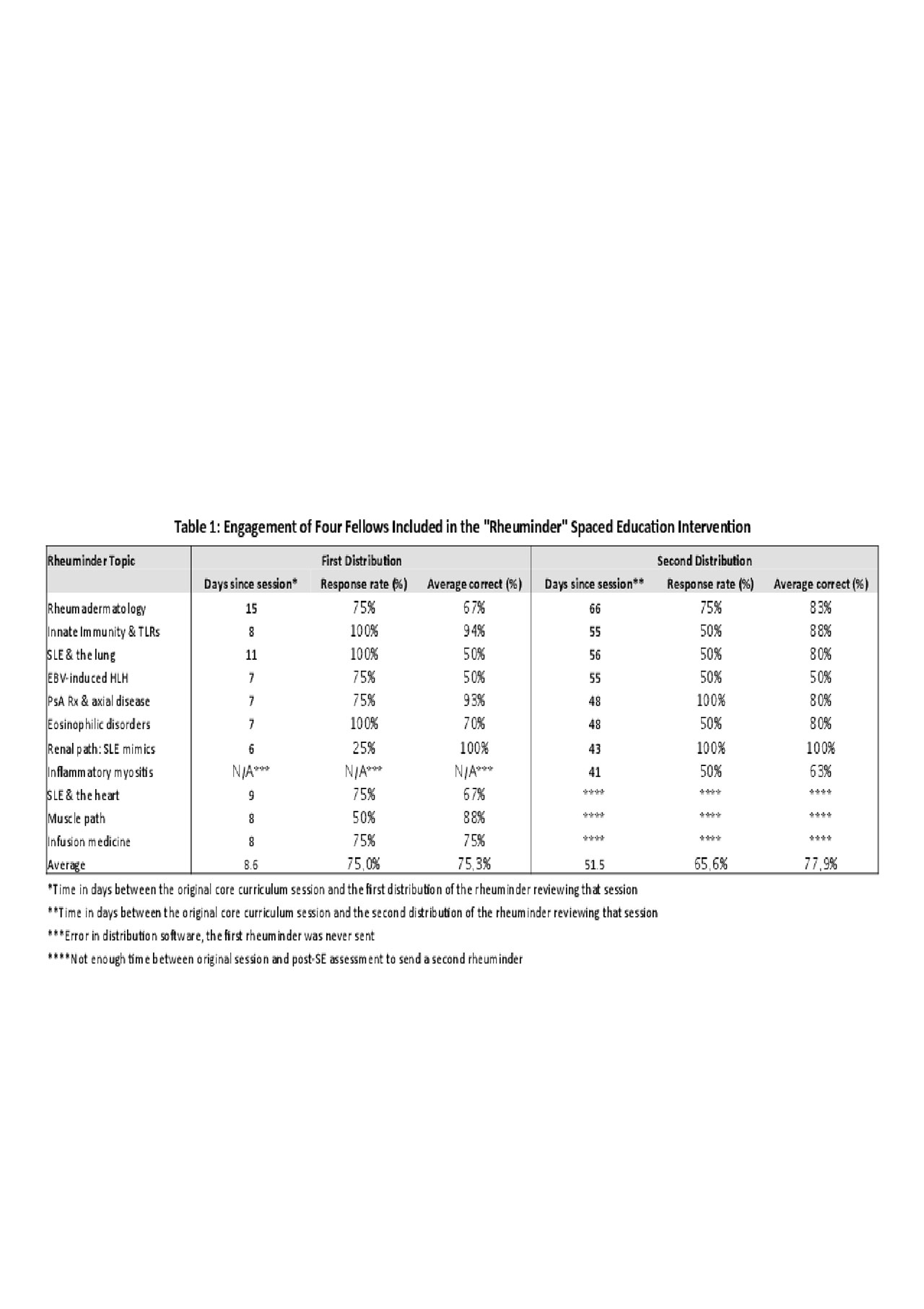
SE Table 1 FINAL

SE Table 2 FINAL
To cite this abstract in AMA style:
Leverenz D, Golenbiewski J, Criscione-Schreiber L. The Impact of Spaced Education and Reciprocal Peer Teaching on Rheumatology Fellows’ Long-term Recall from Core Curriculum [abstract]. Arthritis Rheumatol. 2019; 71 (suppl 10). https://acrabstracts.org/abstract/the-impact-of-spaced-education-and-reciprocal-peer-teaching-on-rheumatology-fellows-long-term-recall-from-core-curriculum/. Accessed .« Back to 2019 ACR/ARP Annual Meeting
ACR Meeting Abstracts - https://acrabstracts.org/abstract/the-impact-of-spaced-education-and-reciprocal-peer-teaching-on-rheumatology-fellows-long-term-recall-from-core-curriculum/