
Session Information
Session Type: Abstract Session
Session Time: 4:30PM-6:00PM
Background/Purpose: Knee osteoarthritis (OA) is a leading cause of functional limitation in older adults, and difficulty with climbing stairs is often the first-reported limitation. As stair climbing is a high-demand functional task that taxes multiple body systems (e.g., cardiovascular, muscular), changes to stair climbing behaviors, such as greater difficulty, may reflect early declines in these body systems. However, it is unknown if said changes signal soon-to-follow functional decline in other less demanding tasks like walking speed and self-reported physical function. Therefore, the purpose of this study was to examine the relationship of stair climbing difficulty with risk of developing functional limitation in adults with or at high risk for knee OA over 8 years.
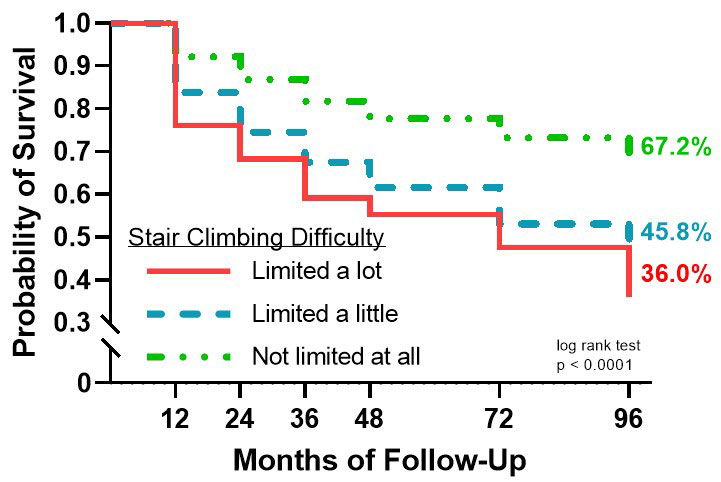
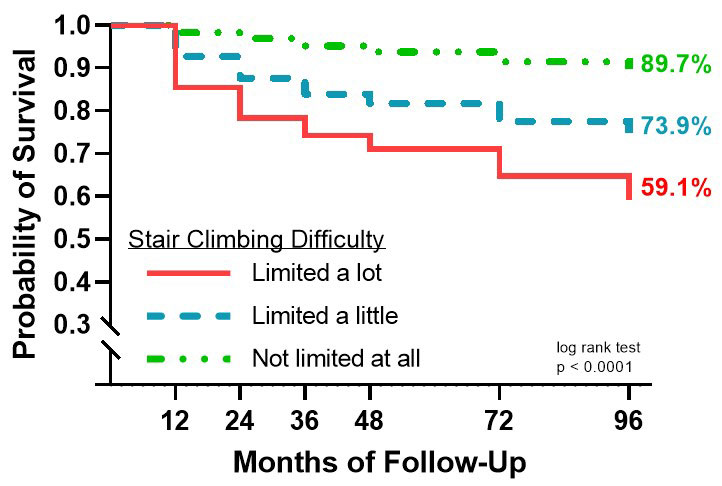
Methods: We used data from the Osteoarthritis Initiative (OAI). Stair climbing difficulty was assessed at baseline (BL) with the question: Does your health now limit you in climbing several flights of stairs? Choices included: limited a lot, limited a little, and not limited at all. Functional limitation was defined in two ways: (1) walking speed < 1.22 m/s over 20 meters and (2) WOMAC Physical Function (PF) score of ≥ 28/68. Each were measured at BL and 12-, 24-, 36-, 48-, 72-, 96-month follow-up visits. 1.22 m/s represents the speed needed to safely cross a timed intersection and has been previously used to represent poor function. 28/68 WOMAC-PF score has been previously used to define low functioning. Separate analytic samples were used for each functional outcome and only included those who were free of functional limitation at BL. We produced Kaplan-Meier survival curves for cumulative incidence of functional limitation and used Cox proportional hazards regression to calculate discrete-time hazard ratios (HR) and 95% confidence intervals (CI), adjusted for age, sex, BMI, race, radiographic knee OA, VAS pain, and presence of comorbidity.
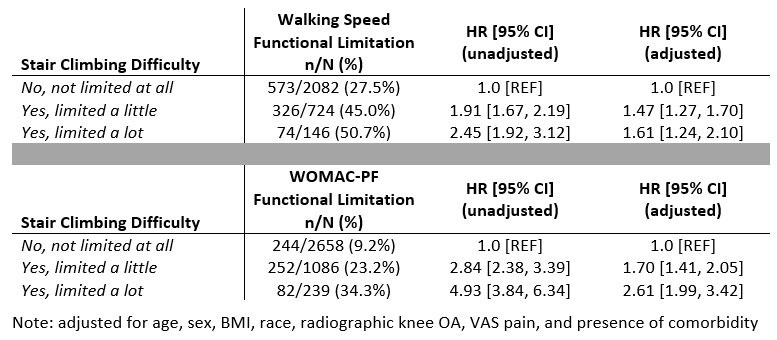
Results: 2952 participants (mean age = 60.1 years old, 54% female, mean BMI = 27.9 kg/m2) were included in the walking speed sample and 3983 participants (mean age = 61.2 years old, 57% female, mean BMI = 28.2 kg/m2) were included in the WOMAC-PF sample. 973 participants in the walking speed sample and 578 participants in the WOMAC-PF sample developed functional limitation over 8 years of follow-up. Compared to those not limited at all in their stair climbing, those who were limited a little and those who were limited a lot had 47% and 61% greater risk of gait speed functional limitation, respectively (Table 1). Compared to those not limited at all in their stair climbing, those who were limited a little and those who were limited a lot had 70% and 161% greater risk of WOMAC-PF functional limitation, respectively (Table 1).
Conclusion: Adults with knee OA who have any difficulty with climbing stairs are at greater risk of developing both walking speed and WOMAC-PF functional limitation compared to those with no difficulty. Survival probability decreased as stair climbing difficulty increased for both outcomes. This suggests that stair climbing difficulty may be a useful functional vital sign for identifying those at early risk for functional limitation and in need of further evaluation and treatment.
To cite this abstract in AMA style:
Jakiela J, Voinier D, Golightly Y, Horney J, Bye T, Aily J, White D. Stair Climbing Difficulty and Risk of Functional Limitation in Knee Osteoarthritis: A Simple Functional Vital Sign? [abstract]. Arthritis Rheumatol. 2022; 74 (suppl 9). https://acrabstracts.org/abstract/stair-climbing-difficulty-and-risk-of-functional-limitation-in-knee-osteoarthritis-a-simple-functional-vital-sign/. Accessed .« Back to ACR Convergence 2022
ACR Meeting Abstracts - https://acrabstracts.org/abstract/stair-climbing-difficulty-and-risk-of-functional-limitation-in-knee-osteoarthritis-a-simple-functional-vital-sign/