ACR Meeting Abstracts

ACR Meeting Abstracts

  • Meeting Abstracts
    • All Meetings
    • PRSYM 2026
    • ACR Convergence 2025
    • Download Abstract Supplements
  • Keyword Index
  • My Favorites
    • View & print my favorites
  • Search

Home » Meeting Abstracts » ACR Convergence 2024

Abstract Number: 0784

RUNX1 Is Expressed in a Subpopulation of Dermal Fibroblasts and Is Increased with Systemic Sclerosis Disease Severity

Rezvan Parvizi1, Zhiyun Gong2, Helen Jarnagin2, Tamar Abel2, Dillon Popovich3, Madeline Morrisson4, Tammara Wood5, Sasha Shenk6, Monique Hinchcliff7, jonathan Garlick6, Patricia Pioli8 and Michael Whitfield1, 1Geisel School of Medicine at Dartmouth, Hanover, NH, 2Dartmouth College, Lebanon, NH, 3Dartmouth College, West Lebanon, NH, 4Geisel School of Medicine at Dartmouth College, Hanover, NH, 5Dartmouth, Hanover, NH, 6Tufts University, Boston, MA, 7Yale School of Medicine, Westport, CT, 8Geisel School of Medicine at Dartmouth, Lebanon, NH

Share on X (Twitter) Share on Facebook Share on LinkedIn Share on Email
Print

Meeting: ACR Convergence 2024

Keywords: Epigenetics, Fibroblasts, Dermal, Gene Expression, Systemic sclerosis, transcription factor

Session Information

Date: Saturday, November 16, 2024

Title: Abstracts: Systemic Sclerosis & Related Disorders – Basic Science

Session Type: Abstract Session

Session Time: 1:00PM-2:30PM

Background/Purpose: Systemic Sclerosis (SSc) skin fibrosis results in complex changes in transcriptional and signaling pathways in the skin. Through transcription factor activity network analyses, the runt-related transcription factor 1 (RUNX1) has been identified as a key regulator in the skin of individuals with diffuse systemic sclerosis (dSSc). RUNX1 is overexpressed in various human cancers, autoimmune diseases, and other fibrotic conditions; however, the specific contribution of RUNX1 to the pathogenesis of SSc skin fibrosis and the involved signaling pathways remains unknown. We analyzed the specific contributions and function of RUNX1 in SSc.

Methods: RUNX1 expression was analyzed in bulk gene expression data of SSc skin biopsies from multiple cohorts, single-cell RNA sequencing (scRNA-seq) of SSc and control skin, and in sc-multiome data of 3D self-assembled skin equivalent (saSE) tissues. Genome-wide DNA methylation profiles and bulk ATAC-seq data were further generated and analyzed to evaluate the epigenetic state and genome chromatin accessibility of RUNX1 in fibroblasts isolated from dcSSc in 2D and 3D cultures. Fibroblasts in 2D and 3D skin-like tissues were treated with a selective RUNX1 inhibitor, Ro5-3335 or siRNA against RUNX1 followed by collagen contraction, proliferation assays and qRT-PCR for select target genes.


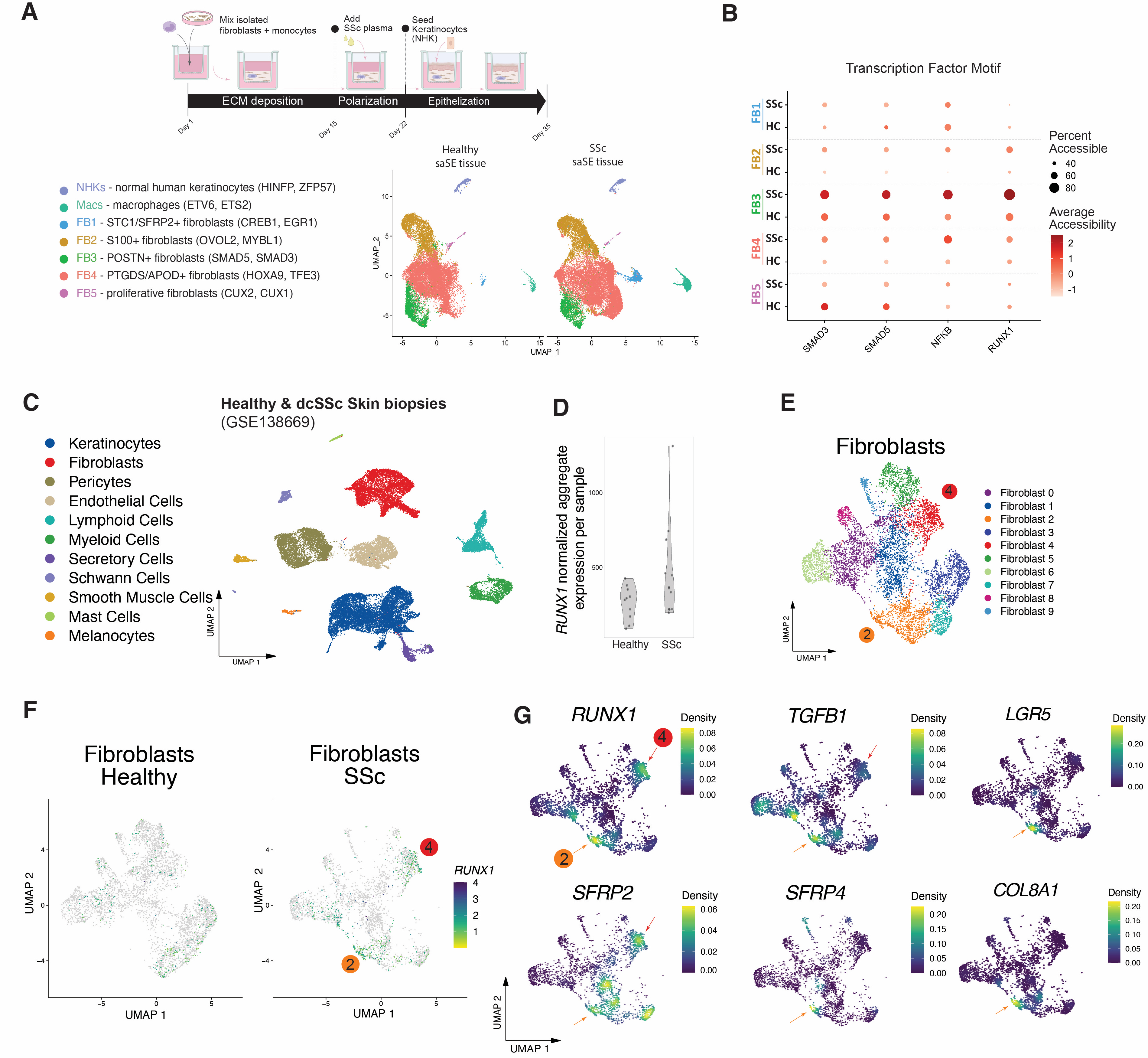
Results: Analysis of gene expression data from multiple cohorts revealed significant over-expression of RUNX1 in skin biopsies of individuals diagnosed with SSc. RUNX1 is also highly expressed in non-lesional skin of patients with SSc (Fig 1A,B). RUNX1 is highly expressed in early disease (Fig 1C), expression is correlated with modified Rodnan Skin Score (mRSS) (r2 = 0.31, p-value = 1.3e-06) (Fig 1D), and it is highly expressed in patients with interstitial lung disease (ILD). The gene set variation analysis (GSVA) scores of TGF-β-activated fibroblast gene signature had the strongest enrichment in RUNX1high SSc patients (Fig 1E). DNA methylation profiling shows RUNX1 hypomethylation in SSc fibroblasts relative to controls (Fig 1F,G). Bulk ATAC-seq of dcSSc fibroblasts showed increased accessibility of RUNX1 chromatin binding. Inhibition of RUNX1 activity by Ro5-3335 significantly reduced the ability of dermal fibroblasts to contract collagen gel matrices and reduced fibroblast proliferation rate (Fig 1H,I). RUNX1 knockdown by siRNA resulted in changes in aSMA, fibronectin (FN1) and COL1A1 expression. Analysis of scRNA-seq and scATAC-seq of in vitro saSE tissues showed increased expression and RUNX1 binding site accessibility in pro-fibrotic POSTN+ fibroblasts (Fig 2A,B). Analysis of scRNA-seq data from SSc and control skin showed enrichment of RUNX1 in profibrotic SSc-enriched fibroblast subpopulations expressing TGFB1, SFRP2, SFRP4, LGR5, LUM, POSTN, COMP, and COL8A1 (Fig 2C-G).

Conclusion: Our findings suggest a link between the extent of dermal fibrosis and the levels of expression of RUNX1. The identification of hypomethylated CpG sites in proximity to the RUNX1 gene implies their potential role in increasing the expression of RUNX1 in fibroblasts. These observations suggest that RUNX1 plays a crucial role in regulating fibroblasts specific to SSc.
Supporting image 1

Figure 1. A) RUNX1 expression in forearm (lesional) skin biopsies of healthy, diffuse cutaneous systemic sclerosis (dcSSc), and limited cutaneous systemic sclerosis (lcSSc) individuals. B) RUNX1 expression in flunk (non-lesional) skin biopsies. C) RUNX1 expression at early and late stage of the disease (Stage: Early, < 2 years; Late, >2 years of disease onset/diagnosis). D) Pearson correlation between RUNX1 expression and mRSS. E) GSVA enrichment scores of main tissue and cellular signatures in healthy, patients with RUNX1high and RUNX1low. Hedge’s g effect size of RUNX1high vs. RUNX1low is calculated and presented. F) Heatmap of top 592 methylated CpG sits of 2D and self-assembled (3D) fibroblasts that were isolated from dcSSc and healthy donors using Illumina’s Infinium Methylation EPIC array. G) The differentially methylated regions (DMRs) between SSc and healthy samples (in red) depicted at the RUNX1 locus on chromosome 21. The beta values corresponding to the CPGs at DMRs for SSc (in orange) and healthy (in green). H) Normal human dermal fibroblast proliferation curve in presence and absence of Ro5_3335. I) 3D collagen contraction assays, fixed (left) and floating (right) models, of normal human dermal fibroblasts treated with Ro5_3335 (RUNX1 inhibitor). SIS3 (SMAD3 inhibitor) was used as positive control. (Student t-test P value: ** 0.001 to 0.01, **** <0.0001 in GraphPad Prism v.9).

Supporting image 2

Figure 2. A) The schematic of self-assembled skin equivalent (saSE) tissue model constructs and scATAC-seq UMAP projections of the SSc- and healthy- derived saSE tissues. B) Relative transcription factor motif accessibility in fibroblast subpopulation of SSc and control saSE tissues. C) UMAP projection of cell types from Tabib et al., 2021’s scRNA-seq of forearm skin biopsies D) RUNX1-normalized aggregate expression of 10 samples from healthy donors and 12 from dcSSc patients. E) UMAP projection of 10 fibroblast subpopulations (clusters 0–9). Two fibroblast populations of 2 and 4 are marked, which are enriched in SSc skin. F) Feature plots of RUNX1 expression in healthy and SSc fibroblasts. G) Density plots of RUNX1 and major SSc-relevant genes within SSc fibroblast subpopulations. Arrows indicate the cluster 2 and 4 of SSc-specific subpopulations of fibroblasts.


Disclosures: R. Parvizi: None; Z. Gong: None; H. Jarnagin: None; T. Abel: None; D. Popovich: None; M. Morrisson: None; T. Wood: None; S. Shenk: None; M. Hinchcliff: AbbVie/Abbott, 2, Boehringer Ingelheim, 5, Kadmon, 5; j. Garlick: None; P. Pioli: Celdara Medical, 5; M. Whitfield: Abbvie, 6, Boehringer Ingelheim, 1, 2, Bristol-Myers Squibb, 2, 5, Celdara Medical, LLC, 5, 8, 9, 10, UCB Biopharma, 2, 5.

To cite this abstract in AMA style:

Parvizi R, Gong Z, Jarnagin H, Abel T, Popovich D, Morrisson M, Wood T, Shenk S, Hinchcliff M, Garlick j, Pioli P, Whitfield M. RUNX1 Is Expressed in a Subpopulation of Dermal Fibroblasts and Is Increased with Systemic Sclerosis Disease Severity [abstract]. Arthritis Rheumatol. 2024; 76 (suppl 9). https://acrabstracts.org/abstract/runx1-is-expressed-in-a-subpopulation-of-dermal-fibroblasts-and-is-increased-with-systemic-sclerosis-disease-severity/. Accessed .

ACR Meeting Abstracts - https://acrabstracts.org/abstract/runx1-is-expressed-in-a-subpopulation-of-dermal-fibroblasts-and-is-increased-with-systemic-sclerosis-disease-severity/

My Favorites

Save and print abstracts during your browser session by clicking the “Favorite” button at the bottom of any abstract (must have cookies enabled in browser). See saved favorites.

Abstract Policies

  • ACR Convergence Abstract Embargo Policies
  • ACR Convergence Abstract Permissions & Reprints
  • PRSYM Abstract Policies

ACR Convergence. Where Rheumatology Meets

ACR Convergence 2026

Join us November 6-11 in Orlando, Florida.
See Registration Information

  • Contact ACR
  • Privacy Policy
  • ACR Policies
  • Cookie Preferences

© Copyright 2026 American College of Rheumatology