
Session Information
Session Type: Poster Session B
Session Time: 10:30AM-12:30PM
Background/Purpose: Interstitial lung disease (ILD) is one of the complications of rheumatoid arthritis (RA) and has significant impact on morbidity and mortality. RA significantly reduces quality of life (QoL) and having ILD additionally further impacts their QoL. There are no studies on patient perceptions in RA-ILD and their needs. Understanding of patients’ level of knowledge and needs would help clinicians to develop integrated care service for these patients. This study aimed to shed light on patient perspectives, awareness, and impact on their life.
Methods: This is a prospective questionnaire study. There are no validated questionnaires, so we developed one based on Commissioning for Quality in RA Reported Experience Measure (CQRA-PREM) to assess patient understanding, experience, care co-ordination and impact of ILD on quality of life. This study was conducted at 5 sites following ethics approval. Subjects with RA-ILD were identified from routine clinics and database. Data was analysed using Microsoft Excel.
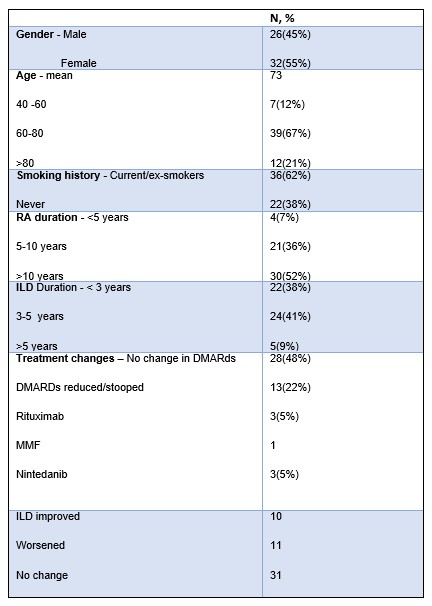
Results: Of the 64 responses, 58 were included for analysis. Table 1 describes the cohort characteristics and changes in treatment following diagnosis of ILD. 46 (79%) had ILD duration of less than 5 years.
Awareness of ILD: 37 (64%) responders said, they did not receive any or minimal information on ILD, whilst 10 (17%) received detailed information. 45(77%) were not provided any information on websites or patient organisations.
Treatment changes following diagnosis of ILD: Treatment changes following diagnosis of ILD were made for 30 (52%) subjects whilst in 28 (48%) subjects, no changes were made (see Table 1 for details)
Care Coordination: 29 (50%) subjects were attending respiratory clinics annually or more frequently with 22 (40%) at random intervals or infrequently. 26 (45%) had 6 to 12 monthly PFTs, 28 (48%) at random intervals and 2 never had any PFTs. Only 13 (22%) subjects felt involved with decisions involving their care, 43 (74%) did not.
Impact on Quality of Life: 31 (53%) stated that ILD affected their life as much as RA and 35 (60%) needed help from family members or carers. 31 (53%) managed to undertake low intensity exercise and 10 (17%) were able to do moderate exercise. Only 8 (14%) had received advice on chest physiotherapy.
Education and Self-Care: Only 13 (22%) subjects were provided information on self-management program and 26 (45%) had departmental contact for queries.
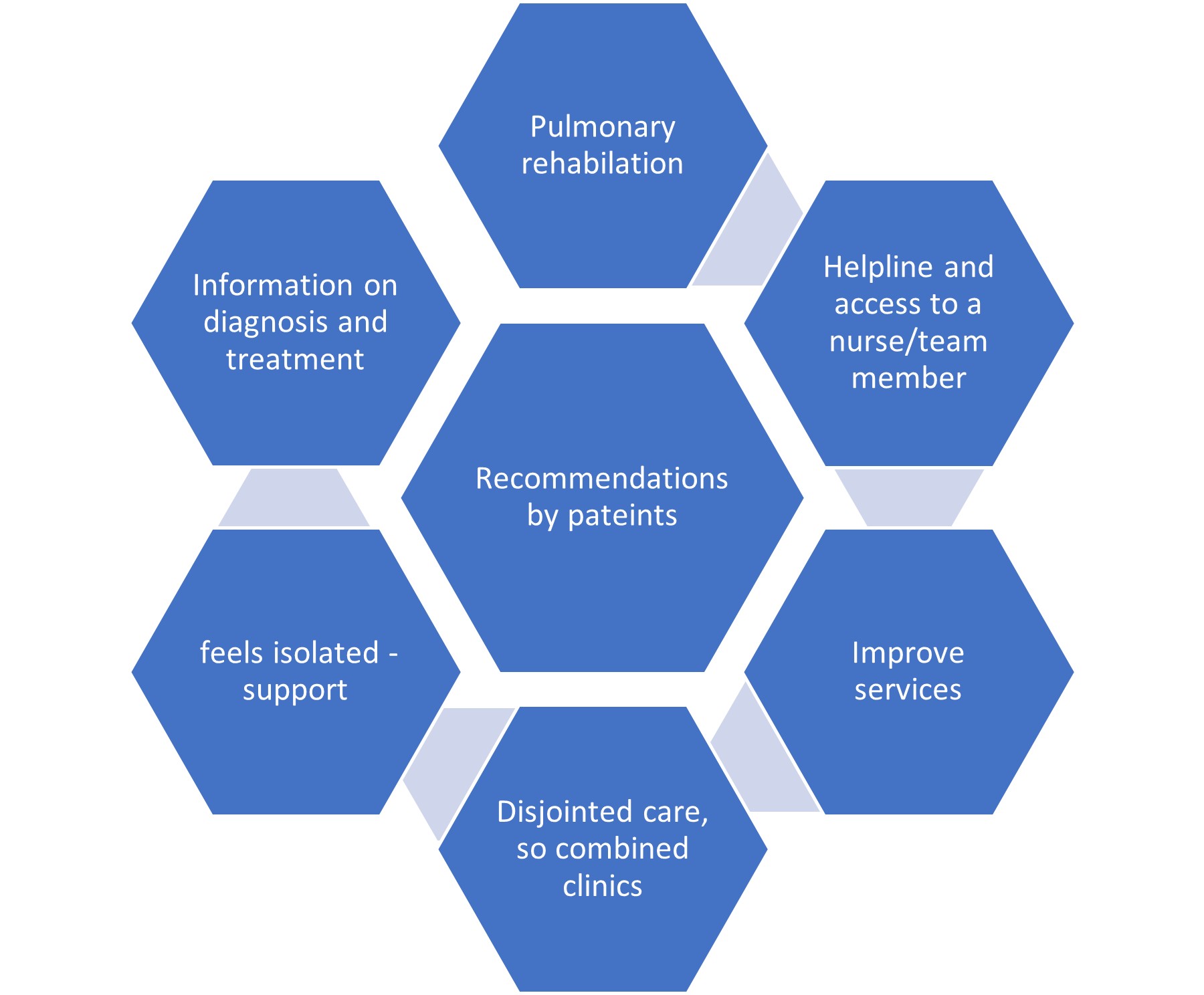
Patient recommendations for service optimisation: Subjects preferred more information on ILD, frequent appointments with a specialist, early referral to specialist centre and better communication between specialists -see Figure 1. 18 (31%) subjects stated that they did not have enough knowledge to make recommendations.
Conclusion: RA-ILD has significant effect on Quality of life. This survey emphasized the need for better education to aid patient’s awareness and understanding of ILD. Early referral and better communication between specialists are needed to optimize the care for ILD patients.
To cite this abstract in AMA style:
Dubey S, Peddasomayajula A, Makkuni D, Nandagudi A, Maw W, Koduri G. Rheumatoid Arthritis Associated Interstitial Lung Disease – Patient Perceptions and Recommendations [abstract]. Arthritis Rheumatol. 2024; 76 (suppl 9). https://acrabstracts.org/abstract/rheumatoid-arthritis-associated-interstitial-lung-disease-patient-perceptions-and-recommendations/. Accessed .« Back to ACR Convergence 2024
ACR Meeting Abstracts - https://acrabstracts.org/abstract/rheumatoid-arthritis-associated-interstitial-lung-disease-patient-perceptions-and-recommendations/