
Session Information
Date: Sunday, November 8, 2020
Title: Patient Outcomes, Preferences, & Attitudes Poster II: Miscellaneous Rheumatic Diseases
Session Type: Poster Session C
Session Time: 9:00AM-11:00AM
Background/Purpose: The causes of arthritis and autoimmune conditions remain unknown. A complex interplay of genetic and environmental factors is thought to underlie these diseases. Prospective collection of blood, saliva and stool samples from patients will be necessary for identifying biomarkers which may play critical roles in predicting, managing and preventing arthritis and autoimmune conditions.
Biobanking refers to the collection, storage and distribution of human biospecimens and linked health data for research. Engagement with patients and the public is required for the success of biobanking endeavours.
To our knowledge there are no qualitative studies investigating the attitudes of patients with rheumatic conditions towards biobanking and data-linkage. This is of importance for us as we, like a growing number of countries globally, develop a national biobank for rheumatic conditions in Australia. Our aim is to explore participants’ knowledge, attitudes, perspectives and beliefs regarding the process of biobanking and data-linkage to national health statistics in the context of their illness.
Methods: This qualitative study was conducted between October 2019 and April 2020. Ethics approval was granted by Northern Sydney Local Health District Ethics Committee (2019/ETH11659). Adult patients with rheumatic conditions were invited to participate in focus groups or semi-structured phone interviews. Patients were recruited via rheumatology clinics from a tertiary hospital in Sydney, Australia.
Focus groups and semi-structured interviews were moderated according to a question guide which was informed by current literature. Recruitment ceased when no new themes emerged.
The collection, analysis and interpretation of data was an iterative process using grounded theory underpinned by the health belief model. Data was entered into computerised data management program (NVivo 12) where further refinement occurred.
Results: There were fifteen participants, their characteristics are summarised in Table 1, nine of fifteen were women, the mean age was 55.7years (range 27 – 76), majority of patients had rheumatoid arthritis (11/15) and the average disease duration was 15.1years (range 0.33 – 62 years). Four main themes arose including knowledge of biobanking and data-linkage, perceived barriers, perceived benefits and attitudes towards biobanking. Table 2 shows illustrative quotes from the interviews and figure 1 provides a diagrammatic representation of the identified themes.
Conclusion: Knowledge of biobanking varied significantly amongst Australian patients with rheumatic conditions. Although there were many perceived risks to participation, the majority of participants in this study were willing to accept these risks and engage with biobanking research. We hypothesise that this willingness to participate was influenced by the relevance of the biobank’s objective to their own condition, perceived benefits in helping themselves, their families, future generations and their trusted clinicians. This study should inform patient information and frequently asked questions when developing recruitment strategies for rheumatic disease biobanks.
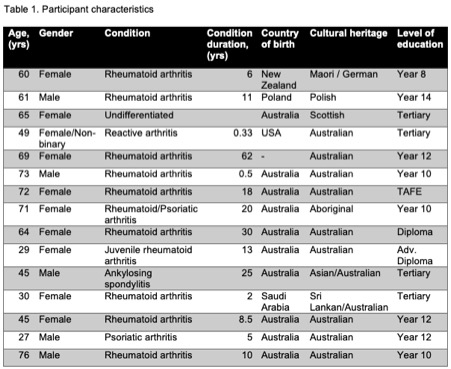 Table 1. Participant characteristics
 Table 2. Illustrative quotes for the identified themes
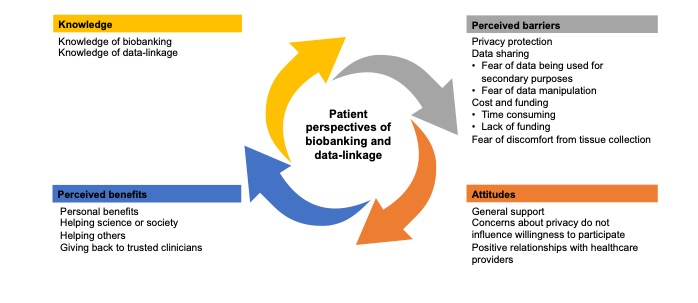 Figure 1. Thematic schema Our participants had varied knowledge of biobanking and data-linkage. Although there were many perceived barriers, as illustrated in the schema, participants’ attitudes towards participations were generally supportive and we hypothesise this is likely due to the perceived benefits of helping themselves, their families, society and giving back to their clinicians.
To cite this abstract in AMA style:
Dey A, Cross M, Lynch T, El-Haddad C, March L. Patient Perspectives on Biobanking and Data-linkage for Rheumatic Disease Research [abstract]. Arthritis Rheumatol. 2020; 72 (suppl 10). https://acrabstracts.org/abstract/patient-perspectives-on-biobanking-and-data-linkage-for-rheumatic-disease-research/. Accessed .« Back to ACR Convergence 2020
ACR Meeting Abstracts - https://acrabstracts.org/abstract/patient-perspectives-on-biobanking-and-data-linkage-for-rheumatic-disease-research/