
Session Information
Date: Monday, November 13, 2023
Title: (1264–1307) RA – Diagnosis, Manifestations, and Outcomes Poster II
Session Type: Poster Session B
Session Time: 9:00AM-11:00AM
Background/Purpose: Not withstanding modern treatment, some Rheumatoid Arthritis (RA) patients have severe disability due to persistently high disease activity, joint destruction/deformities and/or comorbidities. Insight into the severity and nature of their functional limitations is important to treat this subgroup adequately. The aim of this research was to describe the severity and nature of functional limitations in RA patients with severe functional limitations, according to the Health Assessment Questionnaire Disability Index (HAQ-DI).
Methods: Baseline data from RA patients with severe functional limitations participating in a randomized controlled trial on the (cost-)effectiveness of longstanding physical therapy compared to usual care were used (Netherlands Trial Register NL8238). Participants completed the HAQ-DI, a questionnaire reflecting problems in activities of daily living and consisting of 20 items divided over eight domains (Dressing and grooming, Arising, Eating, Walking, Personal hygiene, Reaching, Gripping and Usual activities). Each item is scored on a 4-point scale (0-3, no difficulty-unable to perform), with the total HAQ-DI score ranging from 0-3 (no disability-severe disability). Demographic characteristics were administered and the EuroQol 5-Dimensions 5-Levels (EQ-5D-5L, index score (-0.446-1.000), and Visual Analogue Scale (EQ-VAS, 0-100)) were used to estimate health-related quality of life.
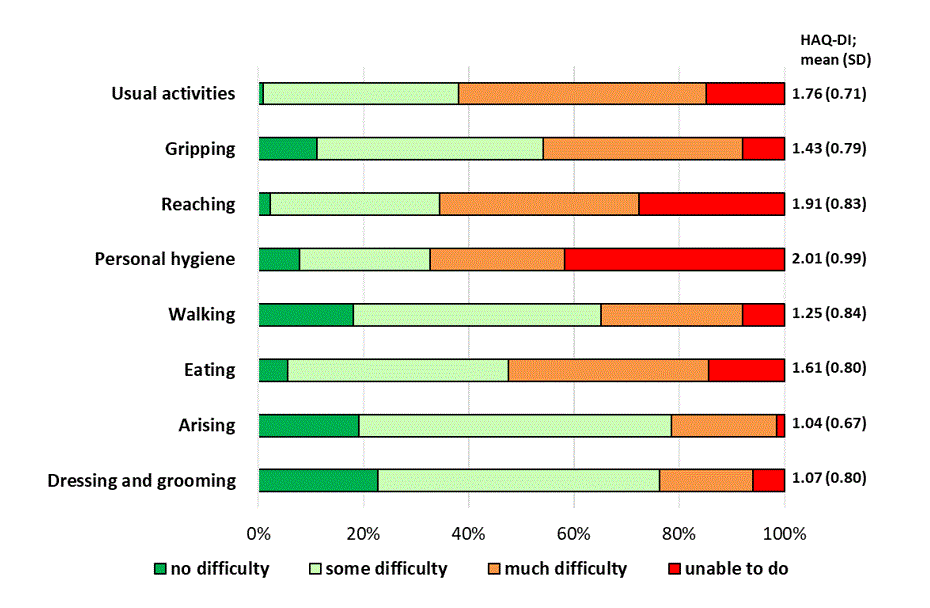
Results: 215 participants were included (n=194; 90% women, age 58.8 (SD 12.9) years, median disease duration 19 (IQR 9-27) years). The median EQ-5D-5L index and EQ-VAS were 0.6 (0.3-0.7) and 59 (41 -70). The median total HAQ-DI score was 1.5 (1.1-1.9) and the majority (83%, n=179) had a total HAQ-DI score ≥1, indicating moderate to severe functional limitations. Figure 1 shows the mean HAQ-DI scores per domain and the percentage of patients reporting no/some/much difficulty or inability to perform daily activities within each domain. More than half of the participants had a domain score ≥1 in all 8 domains (52%, n=111), 24% (n=52) in 7 domains, 13% (n=28) in 6 domains and 11% (n=24) in 5 or less domains. The domains Personal hygiene and Reaching had the highest percentage of participants with a maximum score of 3 (42% and 28%).
Conclusion: In this subgroup of RA patients with severe functional limitations, the majority had limitations in almost all domains of the HAQ-DI. Mostly, limitations were seen in Personal hygiene and Reaching. In clinical practice, a comprehensive assessment of all areas of daily activities might thus be warranted, as well as shared decision-making between patients and clinicians to prioritize functional limitations and set personalized treatment goals.
To cite this abstract in AMA style:
van Wissen M, gademan M, van den Ende C, Teuwen M, Peter W, van Schaardenburg D, den Broeder A, Vliet Vlieland T, van Weely S. Nature and Severity of Activity Limitations According to the Health Assessment Questionnaire Disability Index in Patients with Rheumatoid Arthritis and Functional Disability [abstract]. Arthritis Rheumatol. 2023; 75 (suppl 9). https://acrabstracts.org/abstract/nature-and-severity-of-activity-limitations-according-to-the-health-assessment-questionnaire-disability-index-in-patients-with-rheumatoid-arthritis-and-functional-disability/. Accessed .« Back to ACR Convergence 2023
ACR Meeting Abstracts - https://acrabstracts.org/abstract/nature-and-severity-of-activity-limitations-according-to-the-health-assessment-questionnaire-disability-index-in-patients-with-rheumatoid-arthritis-and-functional-disability/