
Session Information
Date: Sunday, November 8, 2020
Title: Epidemiology & Public Health II: Risk Factors & Outcomes (1467–1471)
Session Type: Abstract Session
Session Time: 4:00PM-4:50PM
Background/Purpose: Prior studies of predictors of knee replacement (KR) have often included only a limited set of risk factors, been conducted primarily in knees with radiographic OA (ROA), and with short follow-up. Further, it is uncertain if addition of MRI data would improve prediction. We therefore evaluated clinical and imaging features of OA for their ability to predict KR over a 7-year period, including knees with and without ROA, and assessed the utility of adding MRI data.
Methods: We included data from the Multicenter Osteoarthritis (MOST) Study, a NIH-funded cohort of persons with or at risk of knee OA. We first limited the model to baseline demographics, clinical (e.g., WOMAC, other symptom questionnaires) and radiographic (KL, JSN, OST grades) data. In the full model, WORMS knee MRI features were added. KRs were confirmed by medical records and/or radiographs up to year 7. We used a random 80% of the sample for model development and training, and the remaining 20% for testing. We used an ensemble stacking approach, i.e., super learning, to combine multiple machine learning algorithms to develop a predictive model, which selects the optimal combination of algorithms to achieve a minimum mean square error in a multi-fold cross-validation to provide the highest predictive accuracy. See tables for algorithms included. We also developed stacked predictive models for knees with and without ROA at baseline. We repeated the random split of data into training and testing sets 100 times, and for each run, we repeated model development and training, and evaluated performance in the independent 20% test set. We then listed the top 10 variables that contributed most to the prediction of KR across 100 runs by calculating a variable importance measure
Results: Our study sample included 2357 participants (mean age 61.6 [SD: 7.8] years, 62% female). The median area under the receive operating characteristic curves (AUCs) across 100 runs with and without MRI data were similar (Table 1). MRI features improved prediction of KR in knees without ROA. Prediction performance was higher in the sample as a whole as opposed to knees with and without ROA due in part to sample size (Table 1). Several variables were important contributors to KR prediction, even in knees free of ROA, including malalignment, race, and certain functional limitations. MRI features contributed to KR prediction based on the variable importance measures across 100 runs (Table 2).
Conclusion: Clinical and radiographic structural features as well as MRI features predict KR within 7 years with substantial accuracy, including in knees that had no ROA at baseline. The super learning-based predictive model development performed well and models that included MRI features did not substantially improve AUC over the models that included only clinical and radiographic data. Malalignment appeared to be an important target. Certain functional limitations were important contributors to the prediction of KR, while WOMAC pain symptoms (pain with stairs) only featured prominently in the clinical and radiographic model for ROA-free knees, suggesting that function may be a more important driver than previously recognized.
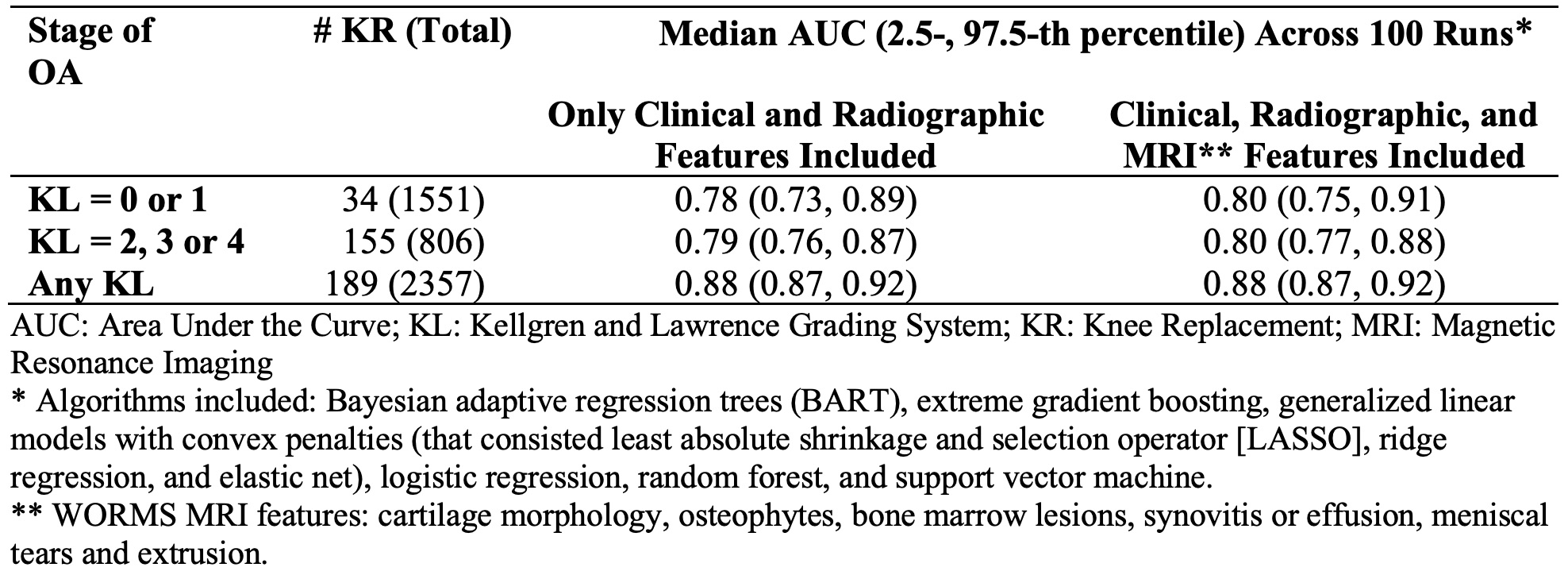 Table 1. Prediction accuracy of a stacked prediction model, expressed by the area under the curve across 100 runs, to predict knee replacement within 7 years.
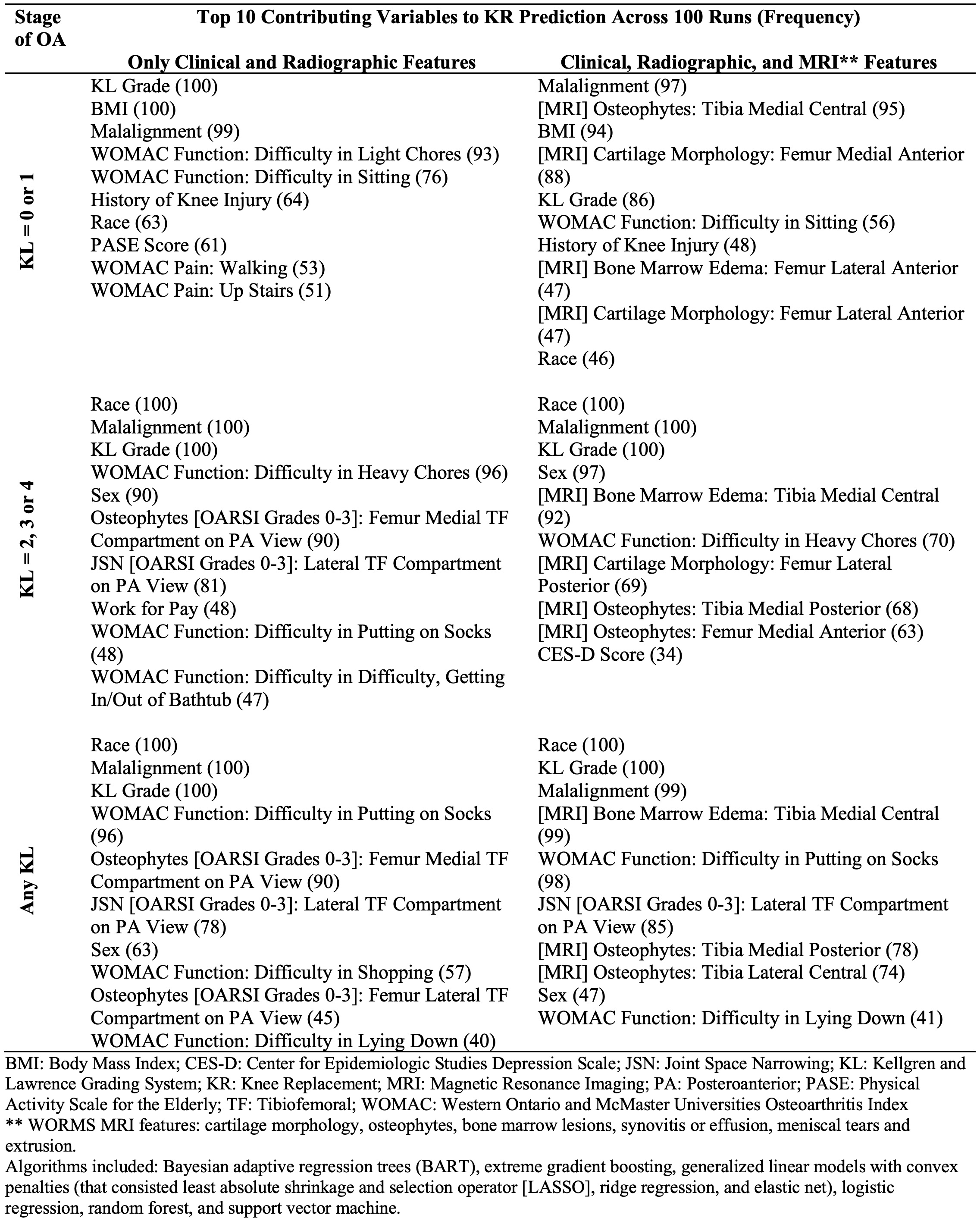 Table 2. Frequency of runs (out of 100) in which the listed variables were in the top 10 of contributors to the prediction of knee replacement within 7 years.
To cite this abstract in AMA style:
Jafarzadeh S, Felson D, Nevitt M, Torner J, Lewis C, Roemer F, Guermazi A, Neogi T. Machine Learning-Based Prediction of Knee Replacement in Persons with and Without Radiographic Osteoarthritis Using Clinical and Imaging Features of Osteoarthritis: The Multicenter Osteoarthritis Study [abstract]. Arthritis Rheumatol. 2020; 72 (suppl 10). https://acrabstracts.org/abstract/machine-learning-based-prediction-of-knee-replacement-in-persons-with-and-without-radiographic-osteoarthritis-using-clinical-and-imaging-features-of-osteoarthritis-the-multicenter-osteoarthritis-stud/. Accessed .« Back to ACR Convergence 2020
ACR Meeting Abstracts - https://acrabstracts.org/abstract/machine-learning-based-prediction-of-knee-replacement-in-persons-with-and-without-radiographic-osteoarthritis-using-clinical-and-imaging-features-of-osteoarthritis-the-multicenter-osteoarthritis-stud/