
Session Information
Session Type: Abstract Session
Session Time: 10:00AM-10:50AM
Background/Purpose: Bone shape changes, which may be an important feature of osteoarthritis (OA) development, have been observed to occur early in the knee after anterior cruciate ligament (ACL) injury. The association between co-existing meniscal damage and bone shape changes is unclear. To gain new knowledge of early joint changes post-trauma, we studied the association between meniscal status in the ACL-injured knee and differences in bone surface area.
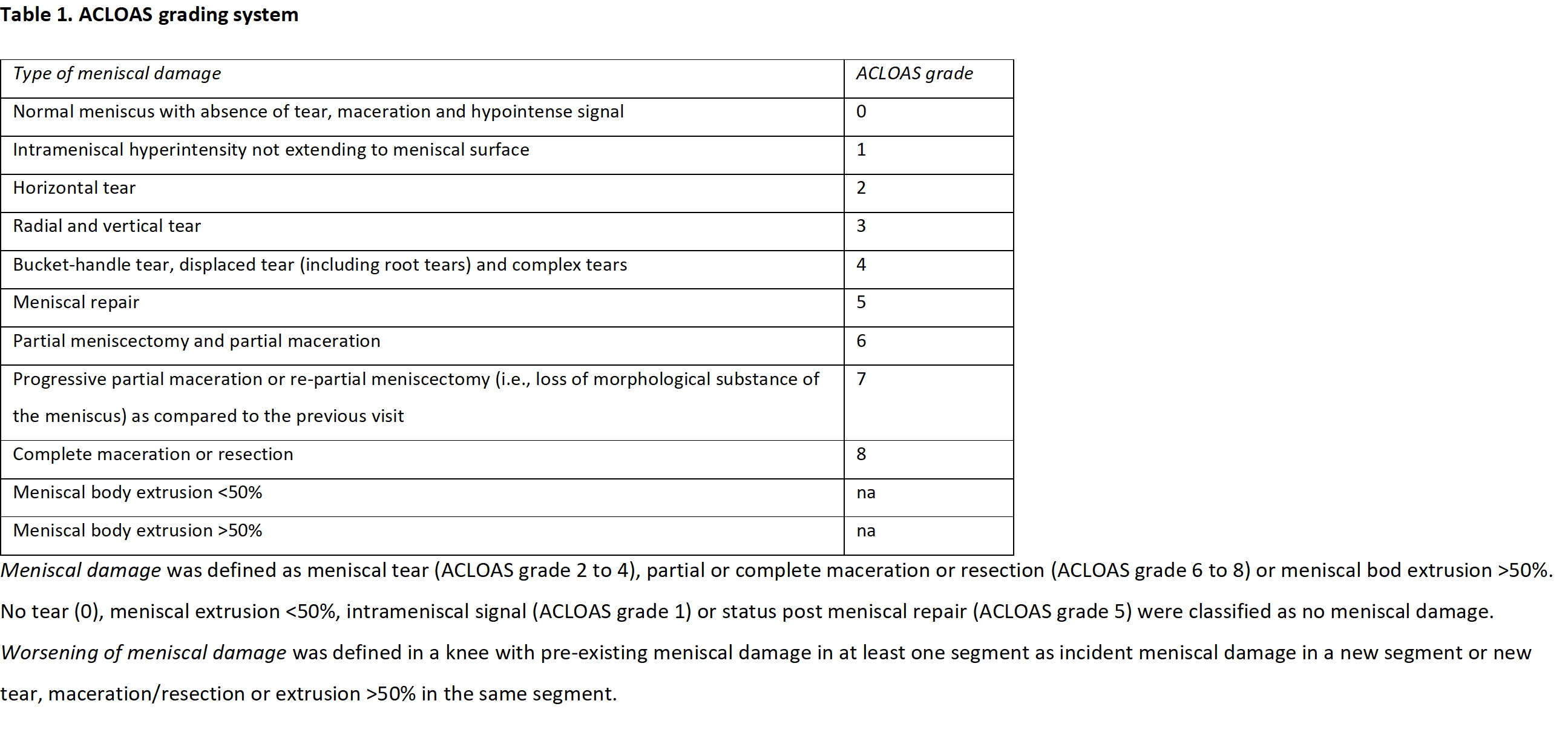
Methods: We used data from the KANON trial including 121 young ACL-injured adults. We obtained baseline and 2-year follow up knee MRIs read by one musculoskeletal radiologist. Our outcome was bone surface area at 2 years (mean mm2, log-transformed) in 4 regions (femur, tibia, patella, and trochlea femur) in the medial and lateral compartment. We used data as reported by Bowes et al, who determined bone surfaces of the different areas and their limits with the use of active appearance models, a form of statistical shape model.1 We defined meniscal damage based on Anterior Cruciate Ligament Osteoarthritis Score (ACLOAS).(Table 1) Meniscal damage was defined as both present at baseline and newly developed. Newly developed meniscal damage includes incident or worsening, i.e. pre-existing tears that expanded to another segment, or to extrusion or incident loss of meniscus substance.(Table 1) We used multilevel linear regression adjusted for baseline bone area, age, sex, body mass index, treatment arm (i.e. early and optional delayed ACL reconstruction), and location. We compared bone area changes in subjects with meniscal damage at baseline or newly developed to those without meniscal damage. We present results as percentage (%) difference in bone area between the groups with 95% confidence intervals (CI).
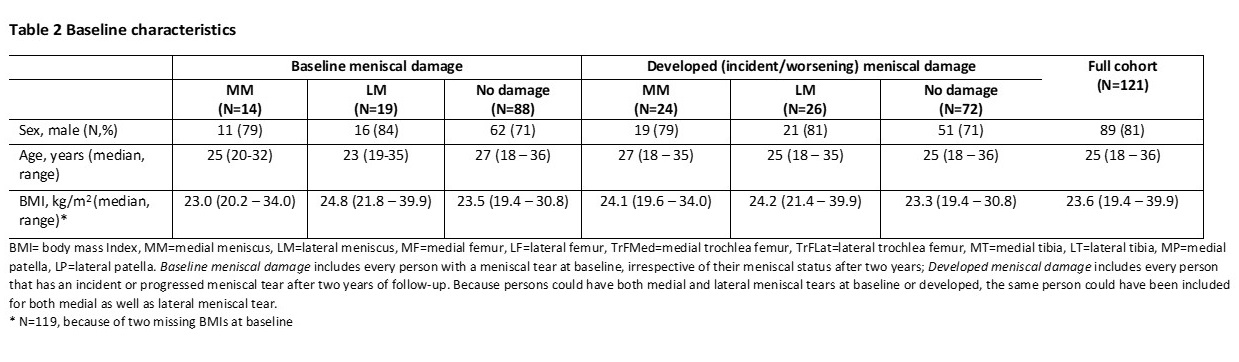
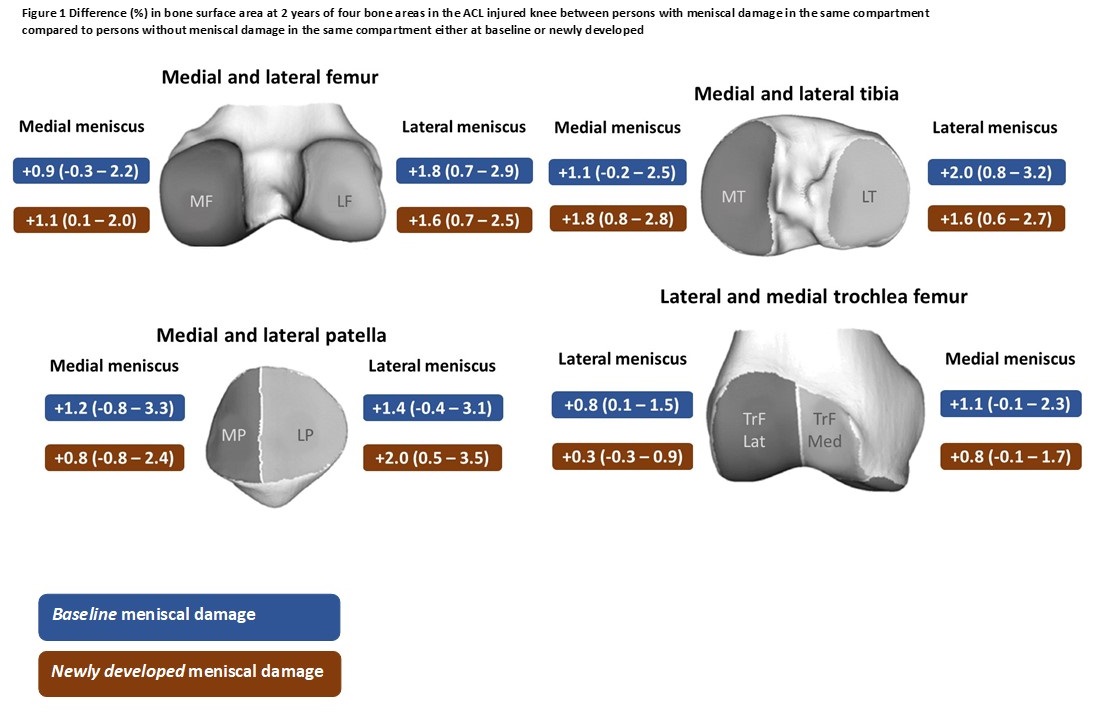
Results: We included 121 subjects (median age 25 (18-36) years, 81% men). Due to missing MRI information, 109 subjects were analyzed. Baseline bone area in mean mm2 were similar in those with and without meniscal damage for all four regions (Table 2). In the whole cohort, the bone surface area increased on average by ~2% over 2 years, with ~1% higher increase for both subjects with ipsicompartmental meniscal damage at baseline and with newly developed meniscal damage compared to those without meniscal damage during the 2-year follow-up (Figure 1).
Conclusion: In the ACL-injured knee, persons with baseline or newly developed meniscal damage had ~1% increased bone area in the affected compartment compared to persons without such meniscal damage. The clinical relevance of early bone shape changes for future structural and clinical outcomes needs further exploration.
To cite this abstract in AMA style:
Snoeker B, Turkiewicz A, Bowes M, Roemer F, Lohmander S, Frobell R, Englund M. Is Meniscal Status in the Anterior Cruciate Ligament Injured Knee Associated with Change in Bone Surface Area? An Exploratory Analysis of Data from the KANON Trial [abstract]. Arthritis Rheumatol. 2020; 72 (suppl 10). https://acrabstracts.org/abstract/is-meniscal-status-in-the-anterior-cruciate-ligament-injured-knee-associated-with-change-in-bone-surface-area-an-exploratory-analysis-of-data-from-the-kanon-trial/. Accessed .« Back to ACR Convergence 2020
ACR Meeting Abstracts - https://acrabstracts.org/abstract/is-meniscal-status-in-the-anterior-cruciate-ligament-injured-knee-associated-with-change-in-bone-surface-area-an-exploratory-analysis-of-data-from-the-kanon-trial/