
Session Information
Date: Saturday, November 16, 2024
Title: Abstracts: Miscellaneous Rheumatic & Inflammatory Diseases I
Session Type: Abstract Session
Session Time: 3:00PM-4:30PM
Background/Purpose: Autoimmune diseases (AIDs) increase the risk of cancer and impose a substantial socioeconomic burden worldwide. However, the biological characteristics of cancer as a comorbidity of AID remain poorly understood, necessitating descriptive and mechanistic investigations to improve patient management. Our study aimed to elucidate the metabolic and immunological profiles of patients with the five major AID (including SLE, RA, SS, SSc and IIM) and comorbid cancer (AID-CA) by utilizing a combination of metabolomics and multiplex assays for cytokines/chemokines and checkpoint proteins.
Methods: We enrolled 49 patients with AID-CA (12 IIM, 16 RA, 8 SLE, 7 SS, and 6 SSc), 47 demographically matched patients with AID (10 IIM, 16 RA, 9 SLE, 7 SS, and 5 SSc), and 15 healthy controls. Serum samples were analyzed using liquid chromatography-tandem mass spectrometry (LC-MS/MS) coupled with multiple reaction monitoring (MRM) for targeted metabolomic profiling. The LEGENDplex assay was employed to quantify selected cytokines, chemokines, and immune checkpoint proteins. We identified metabolites and multiplex factors with significant alterations due to cancer comorbidity in AIDs and conducted a KEGG pathway enrichment analysis. Additionally, we examined correlations between immune factors and metabolic pathways, and constructed networks to illustrate significant associations.
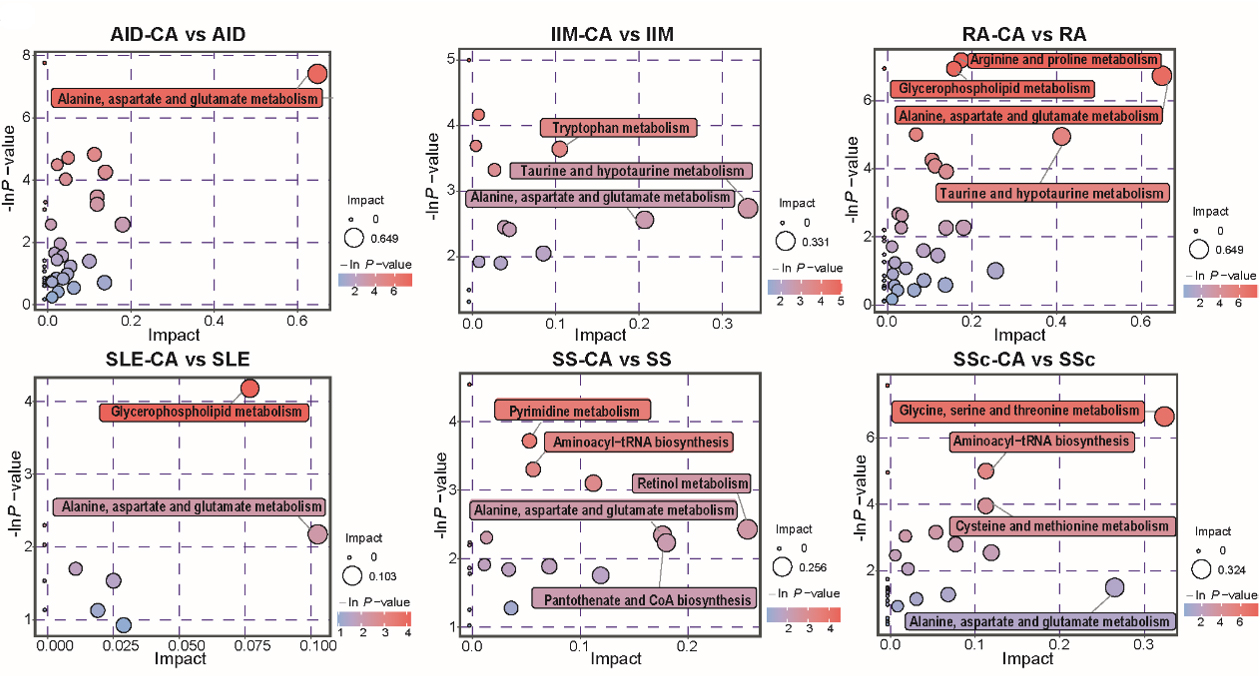
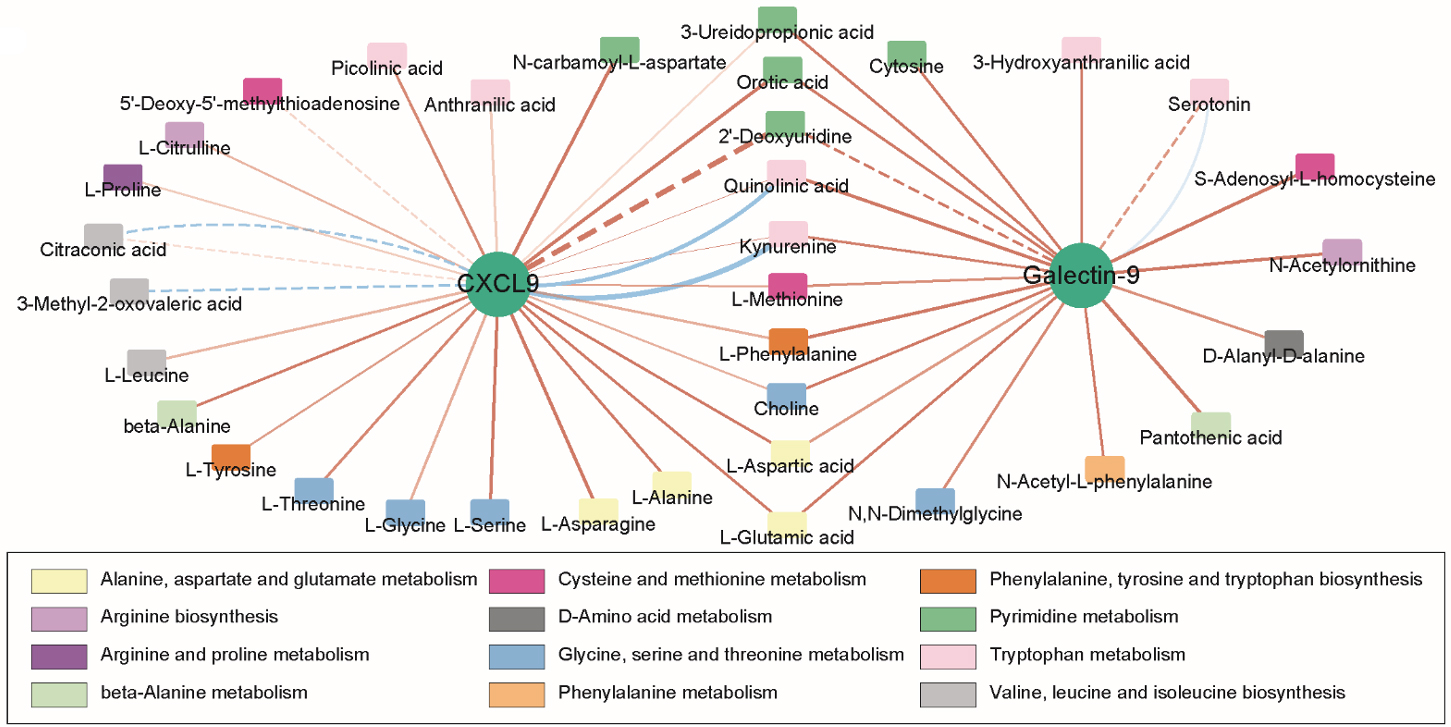
Results: Comparative metabolomic profiling of the AID-CA and AID groups identified 59 different metabolites, 55 of which were upregulated, including citramalic acid, γ-L-glutamyl-L-valine, and taurocholic acid. Specifically, upregulation of N-acetyl-(3-hydroxypropyl) cysteine and downregulation of 2′-deoxyuridine, O-phosphoethanolamine, and L-glutamine were linked to cancer comorbidity across multiple AIDs. The metabolic pathway most significantly disrupted in patients with AID-CA was alanine, aspartate, and glutamate metabolism (Fig. 1). In terms of immunologic aspects, cancer comorbidity in AID was associated with increased levels of CCL20, CXCL9, and Galectin-9 and decreased levels of IL-23, IL-33, 4-1BB, LAG-3, and CTLA-4. The AID-CA group exhibited more pronounced correlations between cytokines/chemokines or checkpoint proteins and metabolic pathways than the AID alone group. A distinctive network for AID-CA, centered on CXCL-9, Galectin-9, amino acid metabolism, and pyrimidine metabolism, was identified (Fig. 2).
Conclusion: Our study elucidates the specific metabolic and immunological characteristics of AID-CA. We have discovered a strong association between metabolic changes and immune reactions that are exclusive to AID-CA. These results may aid in the early detection and devising potential therapeutic target of comorbid cancer in individuals with AIDs.
To cite this abstract in AMA style:
Shen X, Jiang X, He Y, Yang H. Integrated Metabolic and Immunologic Analyses Reveal Distinctive Features of Comorbid Cancer in Patients with Autoimmune Diseases [abstract]. Arthritis Rheumatol. 2024; 76 (suppl 9). https://acrabstracts.org/abstract/integrated-metabolic-and-immunologic-analyses-reveal-distinctive-features-of-comorbid-cancer-in-patients-with-autoimmune-diseases/. Accessed .« Back to ACR Convergence 2024
ACR Meeting Abstracts - https://acrabstracts.org/abstract/integrated-metabolic-and-immunologic-analyses-reveal-distinctive-features-of-comorbid-cancer-in-patients-with-autoimmune-diseases/