
Session Information
Date: Monday, November 8, 2021
Session Type: Poster Session C
Session Time: 8:30AM-10:30AM
Background/Purpose: Arthrocentesis is critical for diagnosis and therapy of joint disease; however, it is very difficult to obtain diagnostic fluid from an arthritic but clinically non-effusive knee – the so-called “dry tap”. In the era of synovial fluid biomarker analysis to diagnose and classify diseases, obtaining at leastsome fluid is of increasing importance.
To use external pneumatic compression on the non-effusive knee to improve arthrocentesis success and synovial fluid yield.
Methods: As a Quality Improvement (QI) Initiative in the Rheumatology Injection Clinic, we instituted standard mechanical compression of the knee during arthrocentesis and determined quality measures before and after. In this IRB approved study conducted from 2018 to 2021, we instituted a modified Arthrocentesis QI program using a flexed knee approach and an inexpensive standard pneumatic thigh blood pressure cuff over the suprapatellar bursa and compared quality measures before and after the procedure.
103 consecutive patients with non-effusive osteoarthritic knees were included in the QI intervention.
Exclusion criteria:
The exclusion of a knee effusion was determined clinically by palpation for suprapatellar bursa distention, ballottement of a floating patella, and fluid shift with asymmetric compression.
Inclusion criteria
1) the presence of no clinically palpable knee effusive,
2) indications for therapeutic-diagnostic joint needle procedure,
3) formal signed consent of the patient to undergo the procedure,
4) knee osteoarthritis.
103 consecutive patients underwent arthrocentesis with the knee in the flexed position with an uninflated thigh blood pressure cuff over the suprapatellar bursa (Figure 1) until fluid return ceased, and then the cuff was inflated to 100 mm Hg and arthrocentesis quality measures were again determined.
Quality Measures:
1) Pain was measured with Visual Analogue Pain Scale,
2) Arthrocentesis success in obtaining at least 2 ml of diagnostic fluid and 0.5 ml for biomarker analysis,
3) Fluid yield in milliliters before and after compression.
Results: Pneumatic compression of the knee markedly improved clinical arthrocentesis success (≥ 2 ml) and sufficient fluid for biomarker analysis (≥ 0.5 ml) while increasing overall synovial fluid yield by 302% (Figure 1, Table 1).
Conclusion:
- This study demonstrates consistent improvement in arthrocentesis diagnostic success and synovial fluid yield using external pneumatic compression of the clinically non-effusive knee.
- Compression of the non-effusive knee with an inexpensive standard suprapatellar pneumatic leg blood pressure cuff markedly improves the success and fluid yield of arthrocentesis in the non-effusive knee.
- Arthrocentesis of the knee with pneumatic compression can be used in all patients who can sit and is especially useful in patients who wish to remain seated or who cannot extend their knee due to flexion contracture, wheelchair confinement, or with pain or severe arthritis.
- Improving synovial fluid yield from the clinically non-effusive knee will have increasing importance as synovial fluid biomarker analysis is further integrated into the classification schemes of various forms of noninflammatory and inflammatory arthritis.
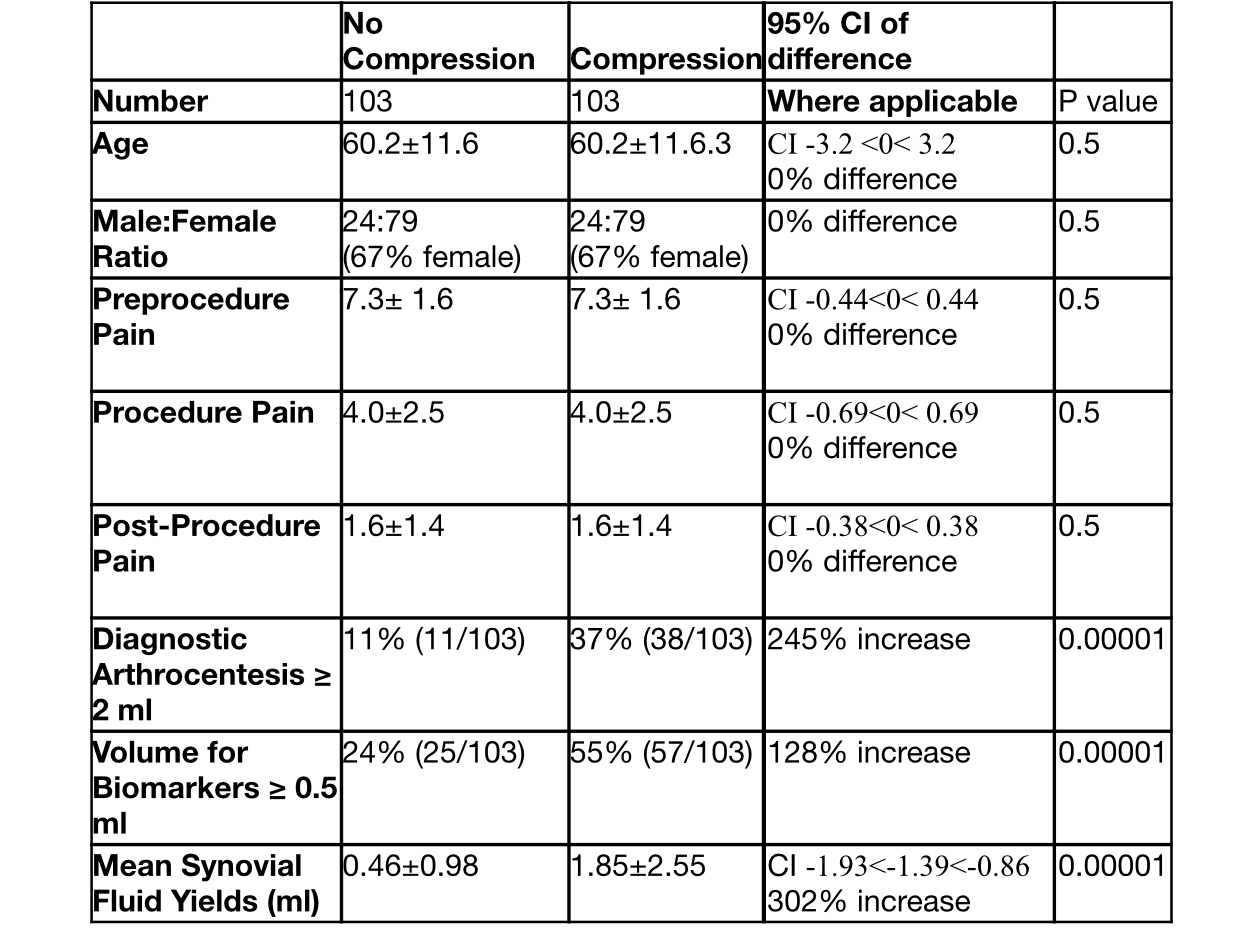 C596D607-F624_42F0-9261-64E1768C24DF.jpeg”Table 1
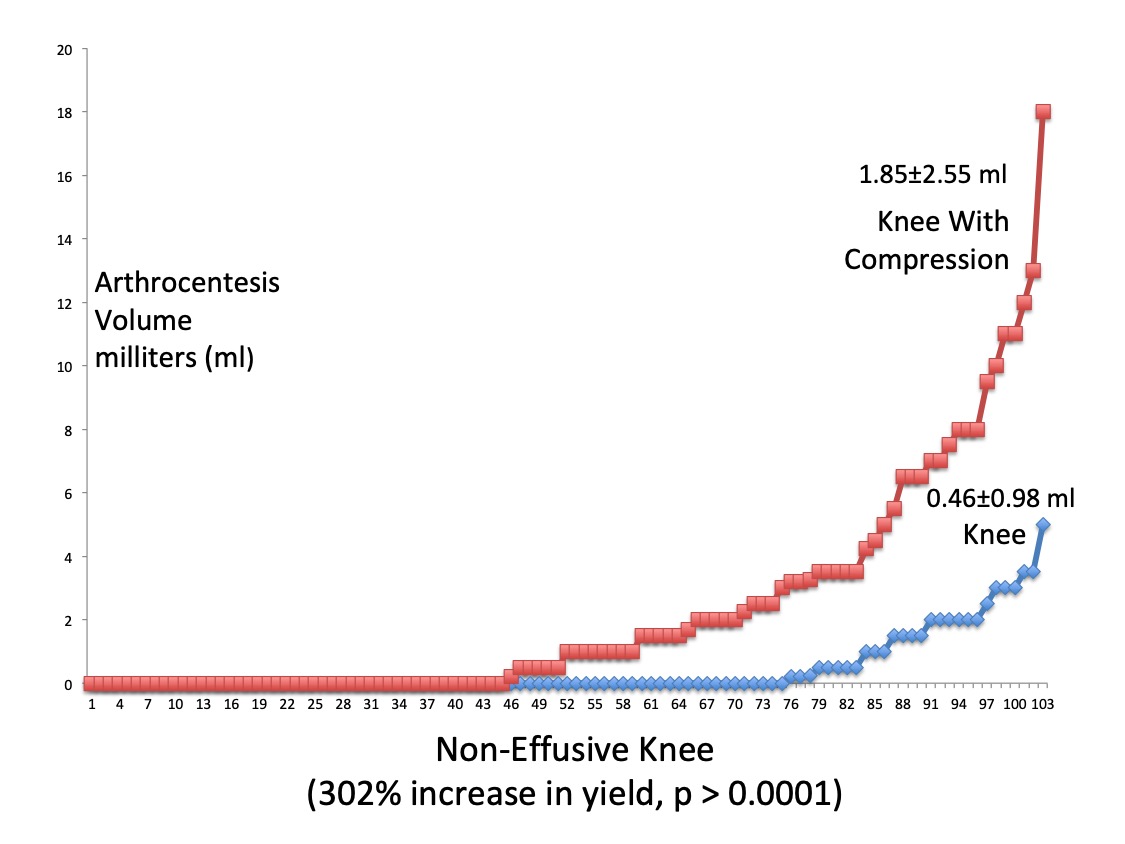 16FF6A0D-5544_428F-B045-6E98B03B595B.jpeg”Non-Effusive Knee arthrocentesis with and without pneumatic compression (302% increase in yield, p > 0.0001)
 BBDE691D_24FC_474E-A66D_3EFF91AA6AC7.jpeg”Knee aspiration with pneumatic external compression of non effusive knee
To cite this abstract in AMA style:
Iqbal A, Brahmbhatt S, Muruganandam M, Cisneros D, Kiani A, Farshami F, Trost J, Emil N, Nunez S, Sibbitt W. Improved Arthrocentesis and Fluid Yield of the Non-Effusive Knee Using Pneumatic Compression [abstract]. Arthritis Rheumatol. 2021; 73 (suppl 9). https://acrabstracts.org/abstract/improved-arthrocentesis-and-fluid-yield-of-the-non-effusive-knee-using-pneumatic-compression/. Accessed .ACR Meeting Abstracts - https://acrabstracts.org/abstract/improved-arthrocentesis-and-fluid-yield-of-the-non-effusive-knee-using-pneumatic-compression/