ACR Meeting Abstracts

ACR Meeting Abstracts

  • Meeting Abstracts
    • All Meetings
    • PRSYM 2026
    • ACR Convergence 2025
    • Download Abstract Supplements
  • Keyword Index
  • My Favorites
    • View & print my favorites
  • Search

Home » Meeting Abstracts » ACR Convergence 2022

Abstract Number: 0640

Immune Cell Heterogeneity in Lupus Nephritis Kidneys and Its Relation to Histopathological Features

Arnon Arazi1, Joseph Mears2, Thomas Eisenhaure3, Qian Xiao4, Paul Hoover4, Deepak Rao4, Celine Berthier5, Andrea Fava6, Siddarth Gurajala4, Michael Peters3, Tony Jones3, William Apruzzese4, Jennifer Barnas7, Richard Furie8, Anne Davidson9, David Hildeman10, Judith James11, Joel Guthridge11, Maria Dall'Era12, David Wofsy13, Peter Izmirly14, H Michael Belmont15, Robert Clancy14, Diane Kamen16, Chaim Putterman17, Thomas Tuschl18, Maureen McMahon19, Jennifer Grossman19, Kenneth Kalunian20, Michael Weisman21, Matthias Kretzler5, Michael Brenner22, Jennifer Anolik23, Michelle Petri24, Jill Buyon14, Soumya Raychaudhuri4, Nir Hacohen3, Betty Diamond9 and the Accelerating Medicines Partnership RA/SLE Network3, 1Feinstein Institutes for Medical Research, Melrose, MA, 2Michigan University, Ann Arbor, MI, 3Broad Institute, Cambridge, MA, 4Brigham and Women's Hospital, Boston, MA, 5University of Michigan, Ann Arbor, MI, 6Johns Hopkins University, Baltimore, MD, 7University of Rochester, Rochester, NY, 8Northwell Health, Great Neck, NY, 9Feinstein Institutes for Medical Research, Manhasset, NY, 10Cincinnati Children's Hospital, Cincinnati, OH, 11Oklahoma Medical Research Foundation, Oklahoma City, OK, 12University of California, Division of Rheumatology, San Francisco, CA, 13University of California San Francisco, SF, CA, 14NYU Grossman School of Medicine, New York, NY, 15NYU School of Medicine, New York, NY, 16Medical University of South Carolina, Charleston, SC, 17Albert Einstein College of Medicine, Bronx, NY, 18Rockefeller University, New York, NY, 19University of California Los Angeles, Los Angeles, CA, 20University of California San Diego, La Jolla, CA, 21Adjunct Professor of Medicine, Stanford University; Distinguished Professor of Medicine Emeritus, David Geffen School of Medicine at UCLA, Los Angeles, CA, 22Brigham and Women's Hospital, Harvard Medical School, Boston, MA, 23University of Rochester Medical Center, Rochester, NY, 24Johns Hopkins University School of Medicine, Division of Rheumatology, Baltimore, MD

Share on X (Twitter) Share on Facebook Share on LinkedIn Share on Email
Print

Meeting: ACR Convergence 2022

Keywords: autoimmune diseases, Bioinformatics, Lupus nephritis, Systemic lupus erythematosus (SLE), Systems-based Studies

Session Information

Date: Sunday, November 13, 2022

Title: SLE – Etiology and Pathogenesis Poster

Session Type: Poster Session B

Session Time: 9:00AM-10:30AM

Background/Purpose: Lupus nephritis (LN) is characterized by considerable variability in its clinical manifestations and histopathological findings. Understanding the cellular and molecular mechanisms underlying this heterogeneity is key for the development of personalized treatments for LN.

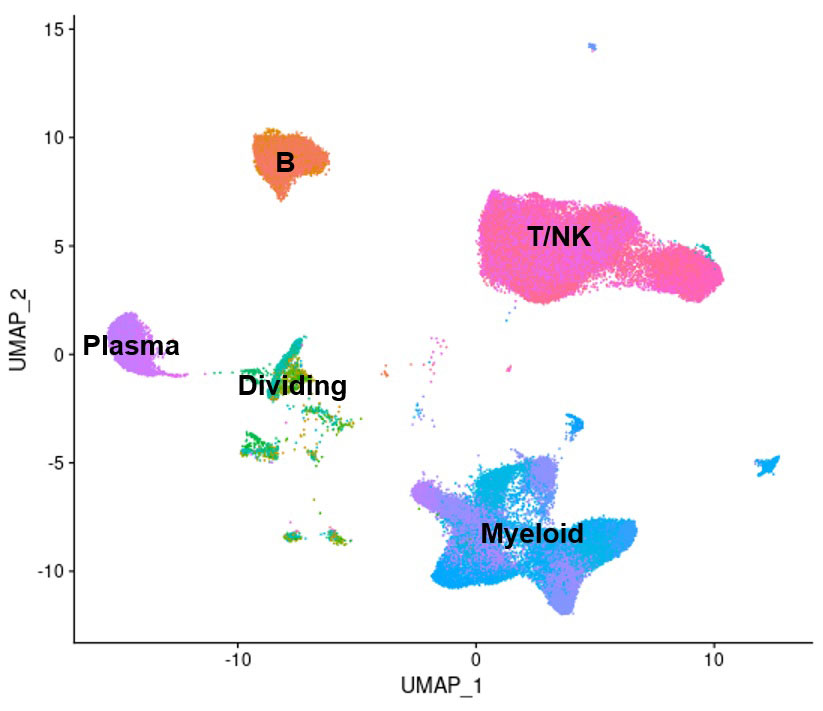
Methods: Droplet-based single-cell RNA-sequencing was applied to the analysis of dissociated kidney samples, collected from 155 LN patients with active kidney disease and 30 living donor controls as part of a large-scale, multi-center study. 73,440 immune cells passing quality control were identified, spanning 134 cell subsets, representing various populations of tissue-resident and infiltrating leukocytes, as well as the activation states these cells assume as part of their disease-related activation and differentiation (Fig. 1). Principal component analysis (PCA) was used to characterize the variability in cell subset frequencies across the LN patients. Relationships between the resulting principal components (PCs) and the demographic, clinical and histopathological features of the patients were then assessed.

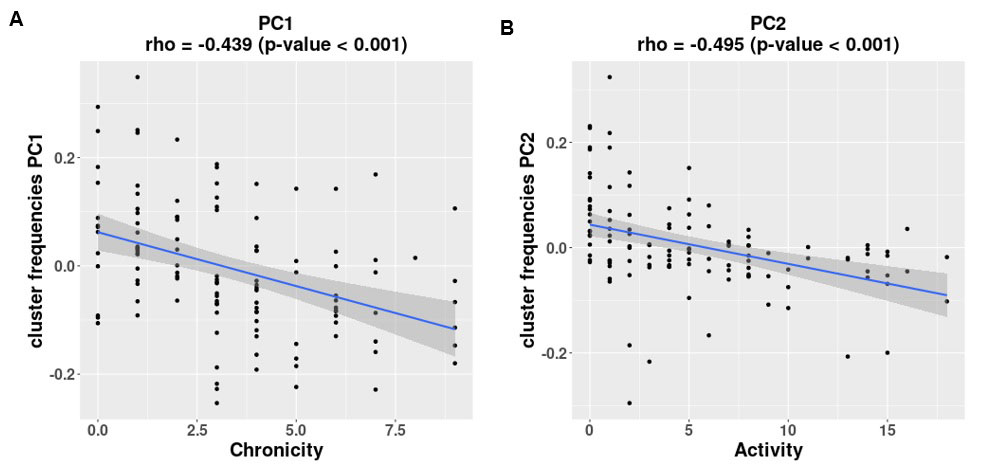
Results: The first PC (PC1), explaining 33% of the total variability in cell subset frequencies, reflected the balance between lymphocytes and monocytes/macrophages. The second PC (PC2), explaining an additional 21% of the total variability, represented the degree of macrophage differentiation to an alternatively activated phagocytic profile. The third and fourth PCs, bringing the total explained variability to 74%, were related to the balance between cell-mediated and humoral immune responses. PC1 was significantly correlated with the Chronicity index, such that patients with a higher percentage of lymphocytes compared to monocytes/macrophages had a higher Chronicity score (rho = -0.439, p-value < 0.001; Fig. 2A). A high degree of macrophage differentiation, as represented by PC2, was associated with a high Activity score (rho = -0.495, p-value < 0.001; Fig. 2B), and, in addition, with proliferative or mixed histology class, compared to pure membranous nephritis (p-value = 0.001, Kruskal–Wallis test). We further identified a significant correlation of these PCs with age; specifically, older patients had a higher relative frequency of lymphocytes compared to monocytes/macrophages, a lesser degree of macrophage differentiation, and a higher representation of cells putatively involved in a humoral immune response compared to a cell-mediated one.

Conclusion: These results identify distinct leukocyte populations active in different LN patients and, possibly, different stages of disease, and suggest potential therapeutic targets, that must be validated in mechanistic studies. This approach may pave the way to personalized treatment of LN.
Supporting image 1

Figure 1. Single-cell RNA-sequencing was used to profile immune cells isolated from the kidneys of LN patients and healthy controls. Five main lineages of cells were identified, as shown in a Uniform Manifold Approximation and Projection (UMAP) plot: myeloid cells, T/NK cells, B cells, plasma cells and dividing cells. The cells of each lineage were further split into finer subsets of cells (color-coded).

Supporting image 2

Figure 2. PCA was used to characterize the variability in cell subset frequencies across LN patients. (A) The first PC, representing the balance between lymphoid cells and monocytes/macrophages, was found to be significantly correlated with the Chronicity index. (B) The second PC, representing the degree of macrophage differentiation, was found to be significantly correlated with the Activity index. Shown in each case are the Spearman correlation and its associated p-value.


Disclosures: A. Arazi, None; J. Mears, None; T. Eisenhaure, None; Q. Xiao, None; P. Hoover, Sanofi, Third Rock Ventures; D. Rao, Janssen, Merck, Bristol-Myers Squibb, Scipher Medicine, HiFiBio, Inc., AstraZeneca, Pfizer; C. Berthier, None; A. Fava, Sanofi; S. Gurajala, None; M. Peters, None; T. Jones, None; W. Apruzzese, None; J. Barnas, None; R. Furie, AstraZeneca, Biogen; A. Davidson, None; D. Hildeman, None; J. James, Bristol-Myers Squibb(BMS), AstraZeneca, Novartis, Progentec Biosciences; J. Guthridge, None; M. Dall'Era, GlaxoSmithKline (GSK), AstraZeneca, Aurinia, BMS, Amgen; D. Wofsy, None; P. Izmirly, Momenta/Janssen; H. Belmont, None; R. Clancy, None; D. Kamen, None; C. Putterman, Equillium, Progentec, Kidneycure; T. Tuschl, None; M. McMahon, None; J. Grossman, None; K. Kalunian, AbbVie/Abbott, Amgen, AstraZeneca, Aurinia, Biogen, Bristol Myers Squibb (BMS), Eli Lilly, Equillium, Genentech, Gilead, Janssen, Roche, Lupus Research Alliance, Pfizer, Sanford Consortium, Viela, Nektar; M. Weisman, None; M. Kretzler, AstraZeneca, NovoNordisc, Eli Lilly, Gilead, Janssen, Boehringer Ingelheim, Moderna, Certa, Chinook, Angion, Travere, Regeneron, Ionis; M. Brenner, GSK, 4FO Ventures, Mestag Therapeutics; J. Anolik, None; M. Petri, Exagen, AstraZeneca, Alexion, Amgen, AnaptysBio, Argenx, Aurinia, Biogen, Caribou Biosciences, CVS Health, EMD Serono, Eli Lilly, Emergent Biosolutions, GlaxoSmithKline (GSK), IQVIA, Janssen, Kira Pharmaceuticals, MedShr, Sanofi, SinoMab, Thermofisher, BPR Scientific Advisory Committee; J. Buyon, None; S. Raychaudhuri, Mestag, Inc, Rheos Medicines, Janssen, Pfizer, Biogen; N. Hacohen, DangerBio/Related Sciences; B. Diamond, None; t. RA/SLE Network, None.

To cite this abstract in AMA style:

Arazi A, Mears J, Eisenhaure T, Xiao Q, Hoover P, Rao D, Berthier C, Fava A, Gurajala S, Peters M, Jones T, Apruzzese W, Barnas J, Furie R, Davidson A, Hildeman D, James J, Guthridge J, Dall'Era M, Wofsy D, Izmirly P, Belmont H, Clancy R, Kamen D, Putterman C, Tuschl T, McMahon M, Grossman J, Kalunian K, Weisman M, Kretzler M, Brenner M, Anolik J, Petri M, Buyon J, Raychaudhuri S, Hacohen N, Diamond B, RA/SLE Network t. Immune Cell Heterogeneity in Lupus Nephritis Kidneys and Its Relation to Histopathological Features [abstract]. Arthritis Rheumatol. 2022; 74 (suppl 9). https://acrabstracts.org/abstract/immune-cell-heterogeneity-in-lupus-nephritis-kidneys-and-its-relation-to-histopathological-features/. Accessed .

ACR Meeting Abstracts - https://acrabstracts.org/abstract/immune-cell-heterogeneity-in-lupus-nephritis-kidneys-and-its-relation-to-histopathological-features/

My Favorites

Save and print abstracts during your browser session by clicking the “Favorite” button at the bottom of any abstract (must have cookies enabled in browser). See saved favorites.

Abstract Policies

  • ACR Convergence Abstract Embargo Policies
  • ACR Convergence Abstract Permissions & Reprints
  • PRSYM Abstract Policies

ACR Convergence. Where Rheumatology Meets

ACR Convergence 2026

Join us November 6-11 in Orlando, Florida.
See Registration Information

  • Contact ACR
  • Privacy Policy
  • ACR Policies
  • Cookie Preferences

© Copyright 2026 American College of Rheumatology