
Session Information
Date: Monday, November 9, 2020
Title: RA – Treatments III: Predictors of Treatment Response (2003–2007)
Session Type: Abstract Session
Session Time: 4:00PM-4:50PM
Background/Purpose: The results of the R4RA trial, the first biopsy-based RCT in TNF-i inadequate responders patients with Rheumatoid Arthritis (RA), showed that molecular stratification of RA synovial tissue in B-cell poor/rich had stronger associations with clinical responses compared to histopathological classification at baseline demonstrating that, in patients with low/absent B-cell lineage signature in synovial-tissue, Tocilizumab (TCZ) is significantly superior to Rituximab (RTX). Here, we investigate the relationship of synovial immune cells in matched pre- and post-treatment synovial biopsies and treatment response.
Methods: 164 patients underwent pre-treatment US-guided or arthroscopic synovial biopsy prior to randomization 1:1 to RTX (83) or TCZ (81). 65 patients had a repeated biopsy at 16 weeks, primary end-point Clinical Disease Activity Index (CDAI) ≥50% improvement. A minimum of 6 synovial samples/patient were paraffin-embedded and sections stained by immunohistochemistry, followed by semi-quantitative scoring (0-4) for CD20+ total B-cells, CD79a+ B cells, CD3+ T cells, CD138+ plasma cells and CD68+ lining (L) and sub-lining (SL) macrophages, and classification into lympho-myeloid (LM), diffuse-myeloid (DS) and fibroid/pauci-immune (F/PI) pathotypes, as previously described (Humby et al Ann Rheum Dis. 2019 Jun;78(6):761-772).
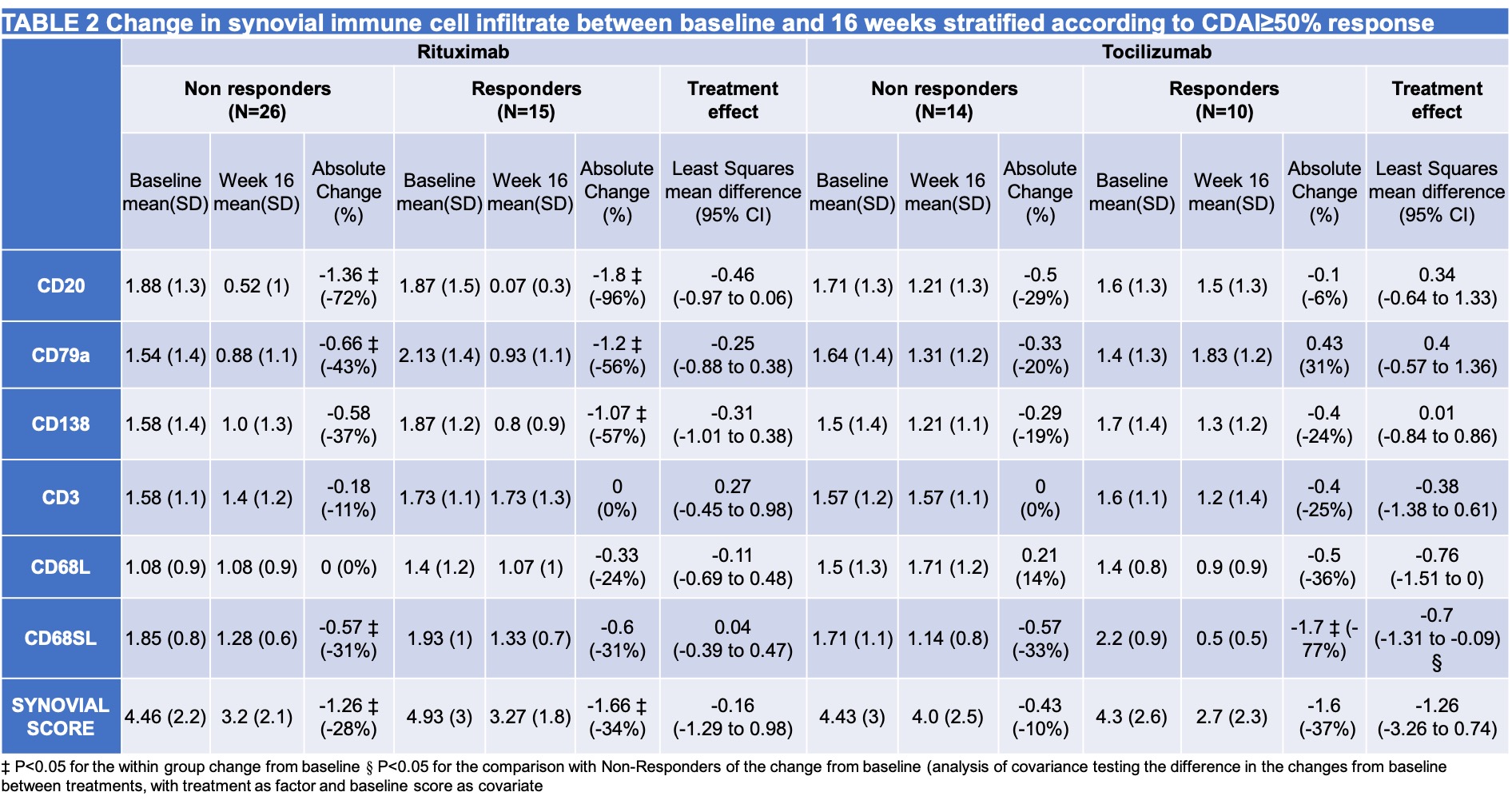
Results: At baseline, no significant differences were observed in semi-quantitative synovial immune scores in patients classified as CDAI≥50% responders and non-responders, both for RTX and TCZ. Looking at pathotypes, TCZ-treated patients with a DM pathotype had a significantly higher CDAI≥50% response compared to LM and F/PI (81% vs 48%, p=0.024), while no differences were found in RTX treated patients. When analysing matched pre and post-treatment biopsies (Table 1) RTX-treated patients showed a significant reduction of synovial CD20+ total B cells [-1.53 (-81%), p< 0.001], CD79a+ B cells [-0.87 (-49%) p< 0.001] and CD138+ plasma cells [- 0.76 ‡ (-45%) p< 0.05]. TCZ treated patients, on the other hand, showed a significant reduction of CD68+ sub-lining macrophages [-1.04 (-54%) p< 0.05] but not B-lineage cells. Finally, while CD20 and CD79a showed a significant reduction in all RTX-treated patients, including both responders and non-responders, a significant reduction of CD138 was only observed in responders. On the other hand, a significant reduction of CD68SL macrophages was only observed in responders to TCZ (Table 2).
Conclusion: Treatment of RA patients with RTX or TCZ has a different impact on synovial immune cells infiltration. In line with their mechanisms of action, RTX reduces synovial B cells, while TCZ affects sub-lining macrophages. Interestingly, the reduction of plasma cells and sub-lining macrophages identifies responders to RTX and TCZ, respectively. These results indicate that the analysis of immune cell infiltration in synovia helps to define a biological response to immunomodulatory agents in RA.
Acknowledgements: this abstract is on behalf of R4RA Investigators http://www.r4ra-nihr.whri.qmul.ac.uk/recruiting_centres.php
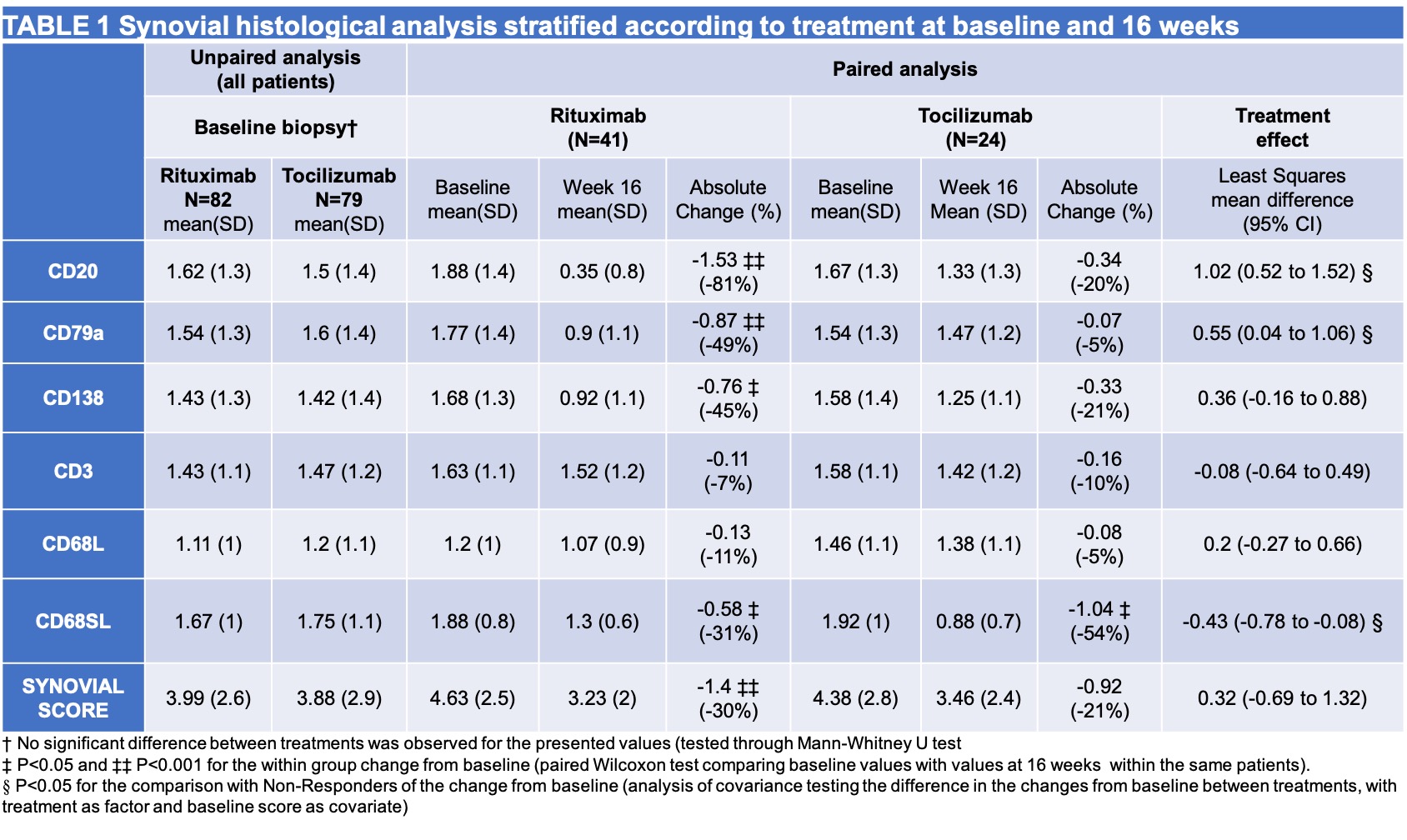 TABLE 1 Synovial histological analysis stratified according to treatment at baseline and 16 weeks
To cite this abstract in AMA style:
Rivellese F, Humby F, Giorli G, Nerviani A, Hands R, Fossati-Jimack L, Thorborn G, Lewis M, Pitzalis C. Histo-pathological Cellular Markers of Treatment Response to Rituximab and Tocilizumab in Matched Pre- and Post-treatment Synovial Biopsies from the R4RA Randomised Clinical Trial in Rheumatoid Arthritis [abstract]. Arthritis Rheumatol. 2020; 72 (suppl 10). https://acrabstracts.org/abstract/histo-pathological-cellular-markers-of-treatment-response-to-rituximab-and-tocilizumab-in-matched-pre-and-post-treatment-synovial-biopsies-from-the-r4ra-randomised-clinical-trial-in-rheumatoid-arthri/. Accessed .« Back to ACR Convergence 2020
ACR Meeting Abstracts - https://acrabstracts.org/abstract/histo-pathological-cellular-markers-of-treatment-response-to-rituximab-and-tocilizumab-in-matched-pre-and-post-treatment-synovial-biopsies-from-the-r4ra-randomised-clinical-trial-in-rheumatoid-arthri/