
Session Information
Session Type: Poster Session A
Session Time: 10:30AM-12:30PM
Background/Purpose: Symptoms of rheumatic diseases such as joint stiffness and pain are known to peak in the early morning hours. In the digital age, tracking online search behavior offers a novel way to gain insights into what people are thinking about at any given time. We hypothesize that internet search trends for related terms may have daily variations which show heightened patient awareness and interest in managing these symptoms.
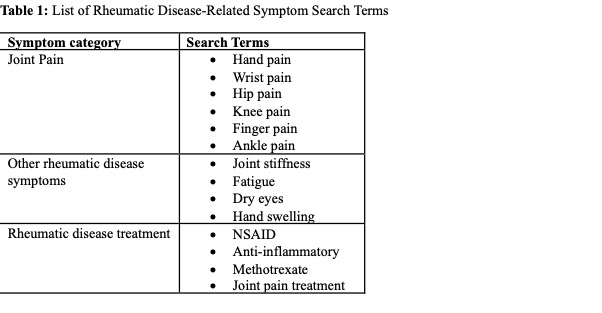
Methods: : We selected a range of keywords and topics related to symptoms and treatment of rheumatic diseases. Google search trends provide real-time data on relative search volume for specific terms, presented on a 0-100 scale. The initial selection of search terms was based on classic symptoms commonly associated with RA. We included only those symptoms with an average of >0 results over a 7-day period. The search terms were then categorized into three main groups: joint pain-related symptoms, other RA symptoms, and treatment-related terms (Table 1). Hourly changes in Google search trends in the United States were analyzed over a 7-day period to provide data on the temporal patterns of rheumatic disease symptoms and behaviors.
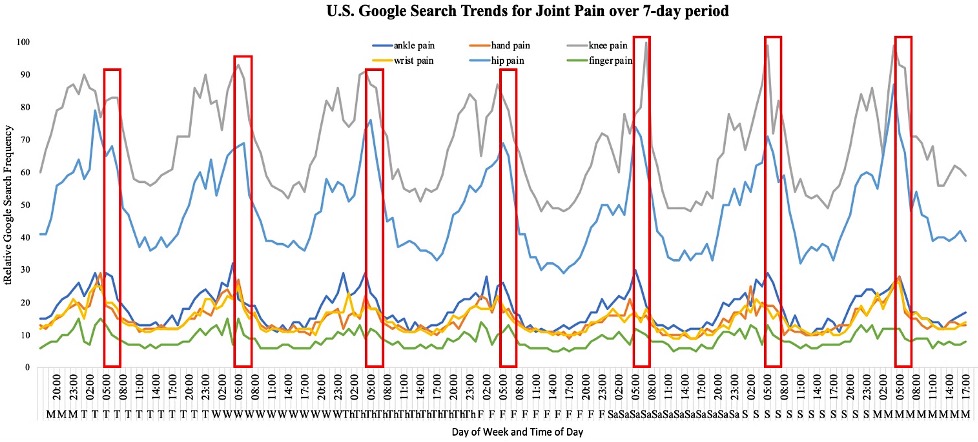
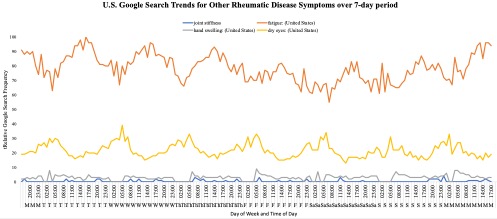
Results: Analysis of Google search trends for joint pain-related keywords revealed a consistent pattern. Searches for terms like “hand pain,” “wrist pain,” and “knee pain” peaked between 05:00 and 07:00 local time across different time zones and geographical locations, with the relative search interest for “hand pain” and “wrist pain” rapidly decreasing to less than 50% of the maximum interest by 08:00 (Figure 1). “Knee pain” sustained interest for longer throughout the day, only reaching 50% of the maximum search interest by 13:00-14:00 and re-peaking earlier, often exceeding 75% of the maximum interest by 8pm. Other nonspecific symptoms, such as “fatigue” and “hand swelling” showed a more dispersed search trend, peaking in the evenings (Figure 2). Searches related to treatment options for rheumatic diseases, including queries for specific medications like “methotrexate,” “joint pain treatment,” “anti-inflammatory,” and “NSAID,” exhibited less pronounced temporal patterns. However, searches for “NSAID” and “anti-inflammatory” showed peaks during the early morning hours (05:00-07:00).
Conclusion: Our analysis of Google search trends reveals distinct diurnal patterns in rheumatic disease-related search trends, offering another qualitative avenue for valuable insights into patient behavior and concerns. The early morning peaks in searches for “hand pain,” “ankle pain, and “swollen hands” indicate that the greatest burden of symptoms of rheumatic disease occurs during this period, suggesting that therapeutic regimens could be improved by targeting relief during these times. The evening peak in searches for “fatigue” and “knee pain” could indicate a connection between physical exertion and symptom awareness. These insights could provide clinicians with valuable information for timing medication dosing, patient education, and resource allocation to better support patients’ needs.
To cite this abstract in AMA style:
Mannstadt I, Gibbons J, Mehta B. Exploring 24-Hour Temporal Trends in Symptoms and Treatment of Rheumatic Disease Through Google Search Trends [abstract]. Arthritis Rheumatol. 2024; 76 (suppl 9). https://acrabstracts.org/abstract/exploring-24-hour-temporal-trends-in-symptoms-and-treatment-of-rheumatic-disease-through-google-search-trends/. Accessed .« Back to ACR Convergence 2024
ACR Meeting Abstracts - https://acrabstracts.org/abstract/exploring-24-hour-temporal-trends-in-symptoms-and-treatment-of-rheumatic-disease-through-google-search-trends/