
Session Information
Session Type: Poster Session A
Session Time: 8:30AM-10:30AM
Background/Purpose: Inflammatory arthritides (IA) including rheumatoid arthritis are associated with increased cardiovascular disease (CVD) mortality. Although inflammation-driven endothelial dysfunction is considered a major factor, the mechanisms driving this risk are incompletely understood. Endothelial colony forming cells (ECFC) are endothelial cells derived from peripheral blood. Due to their implied role in vessel repair, ECFC frequency in the circulation has been proposed as a marker of vascular dysfunction. Furthermore, these patient-derived EC provide an opportunity to study endothelial functions relevant to vascular injury in IA. In this ongoing study, we assessed inflammation-driven endothelial dysfunction in IA by measuring ECFC frequency and phenotype in patients before and after initiation of DMARD therapy.
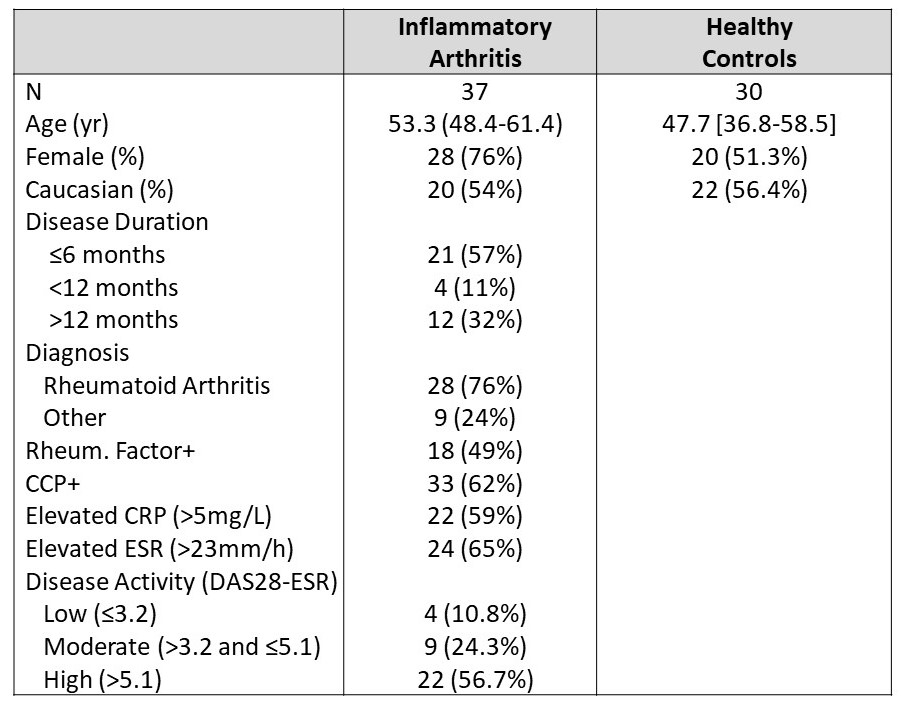
Methods: ECFC were isolated from healthy controls (HC) (n=30) and patients with clinically active, IA naïve to DMARDs (n=37) (Table 1). In patients who commenced DMARDs (MTX+HCQ n=12, MTX, n=6), ECFC were isolated 4 months post initiation (n=16). ECFC frequency was evaluated by colony count normalised to number of PBMC seeded. After confirmation of endothelial purity by flow cytometry (CD31+/CD144+/CD146+/CD45–/CD14–), ECFC phenotype was interrogated at passage 5 using proliferation and pro-inflammatory activation assays, and by transcriptional analysis of 85 key endothelial genes (Qiagen qPCR arrays). Data is presented as median [IQR]. Non-parametric statistical comparisons were made.
Results: ECFC frequency did not differ between treatment-naïve IA patients and controls (0.59 [0.27-0.75] and 0.75 [0.28-1.35] colonies/107 PBMC respectively) and no correlation was observed between frequency and DAS28, ESR or CRP. DMARD initiation led to a non-significant increase in ECFC frequency (1.49 [0.95-4.89] fold, p=0.083), but was unrelated to treatment response (DAS28, ESR, CRP).
In comparison to HC, ECFC from treatment-naïve IA patients tended to be less proliferative and had significantly increased expression of CCL2, ICAM1, SELE, ITGAV and a non-significant increase in VCAM1 and IL1B suggesting a primed pro-inflammatory state (Fig. 1). Treatment-naïve ECFC were also more sensitive to pro-inflammatory activation (TNFα), expressing 3.7-13-fold higher mRNA levels of VCAM1 (p=0.0012), ICAM1 (p=0.0006) and E-selectin (p=0.0041) with low dose TNFα stimulation. Of note, ECFC isolated after DMARD initiation demonstrated a reversal in this primed state, as exhibited by a reduction in pro-inflammatory gene expression (Fig. 1) and normalisation of TNFα sensitivity (Fig. 2).
Conclusion: Our data do not support an association between ECFC frequency and severity of inflammation or disease activity in IA. Increased ECFC frequency following DMARD initiation proved to be unrelated to inflammatory changes and may reflect a direct action of the medications. Evaluation of ECFC phenotype demonstrated a pro-inflammatory state that persisted despite ex vivo culture and which was reversed following DMARD initiation. These findings have mechanistic implications for inflammatory-driven vascular dysfunction and further analysis may highlight avenues for therapeutic targeting.
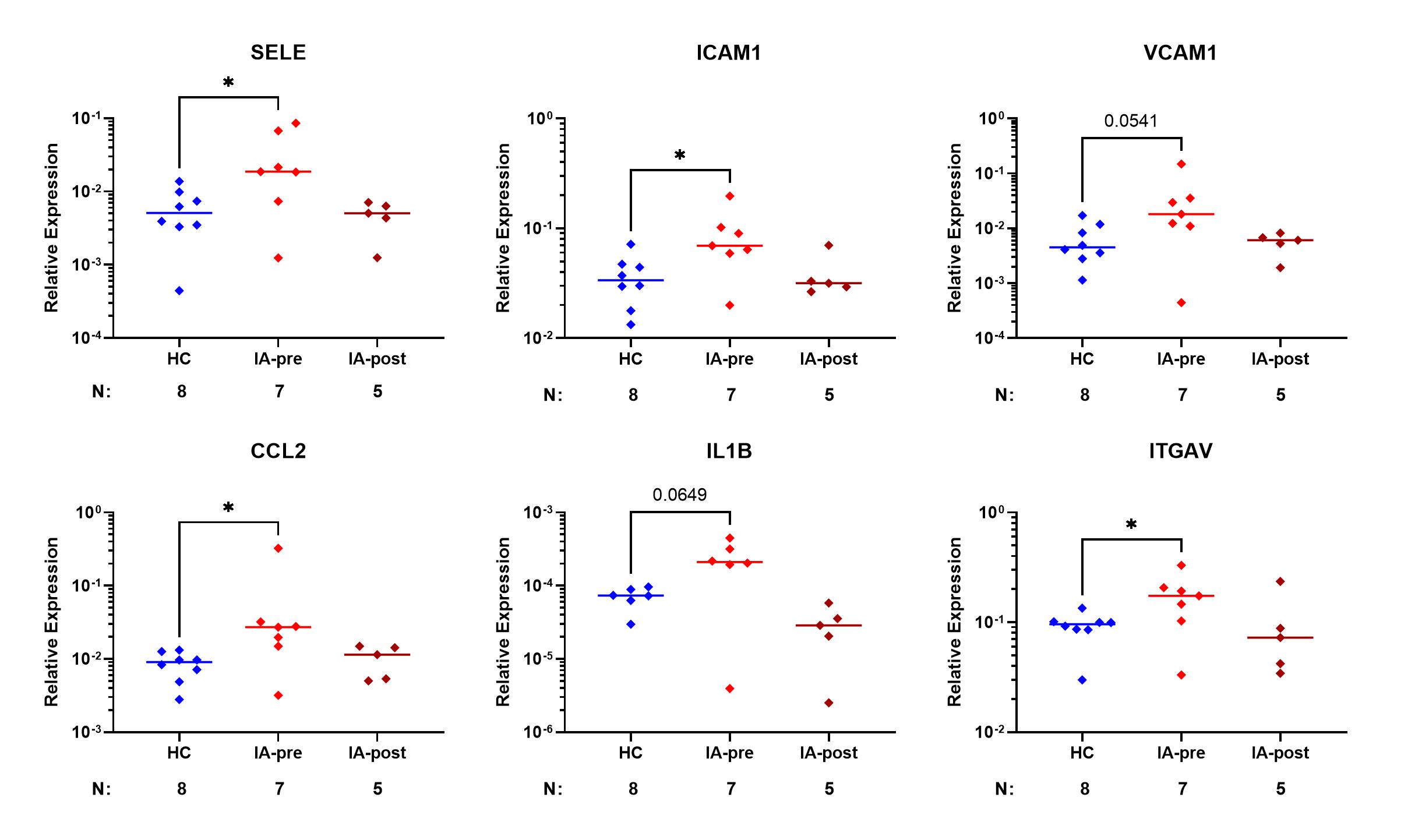
*P<0.05

*P<0.05, **P<0.01, ***P<0.005
To cite this abstract in AMA style:
Maughan R, Lang M, Olsson A, Porter A, Greeves A, Youngstein T, Pericleous C, Mason J. Endothelial Cells from Patients with DMARD Naïve, Active Inflammatory Arthritis Demonstrate Pro-inflammatory Sensitisation That Is Reversed by Therapy Initiation [abstract]. Arthritis Rheumatol. 2021; 73 (suppl 9). https://acrabstracts.org/abstract/endothelial-cells-from-patients-with-dmard-naive-active-inflammatory-arthritis-demonstrate-pro-inflammatory-sensitisation-that-is-reversed-by-therapy-initiation/. Accessed .« Back to ACR Convergence 2021
ACR Meeting Abstracts - https://acrabstracts.org/abstract/endothelial-cells-from-patients-with-dmard-naive-active-inflammatory-arthritis-demonstrate-pro-inflammatory-sensitisation-that-is-reversed-by-therapy-initiation/