
Session Information
Session Type: Poster Session B
Session Time: 10:30AM-12:30PM
Background/Purpose: Despite advances in early RA diagnosis and therapies, treatment outcomes can still vary considerably. Our objective was to compare short and long-term disease control in real-world early RA patients in routine care receiving contemporary guideline-based RA treatment in Canada and identify early predictors of poorer treatment outcomes.
Methods: Participants were adults diagnosed with early RA by a rheumatologist (symptoms < 1 year; 83% met RA classification criteria) enrolled in the Canadian Early Arthritis Cohort from 2007 to 2023. Participants completed standardized study visits including detailed RA clinical assessments, patient-reported outcomes (PROs), and laboratory investigations every 3 months in the first year, every 6-months in the second year and annually thereafter mirroring routine care practices in Canada. Treatment decisions were at the discretion of the treating rheumatologist in line with treat-to-target guidelines. Descriptive and bivariate statistics were used to summarize and compare baseline characteristics of participants with well-controlled (CDAI < 10: low disease activity or remission) vs persistently active disease (CDAI ≥10: moderate or high disease activity) throughout the first 12-months, and over the entire study follow up period, respectively. Multivariable logistic regression was used to identify early predictors of persistent active disease.
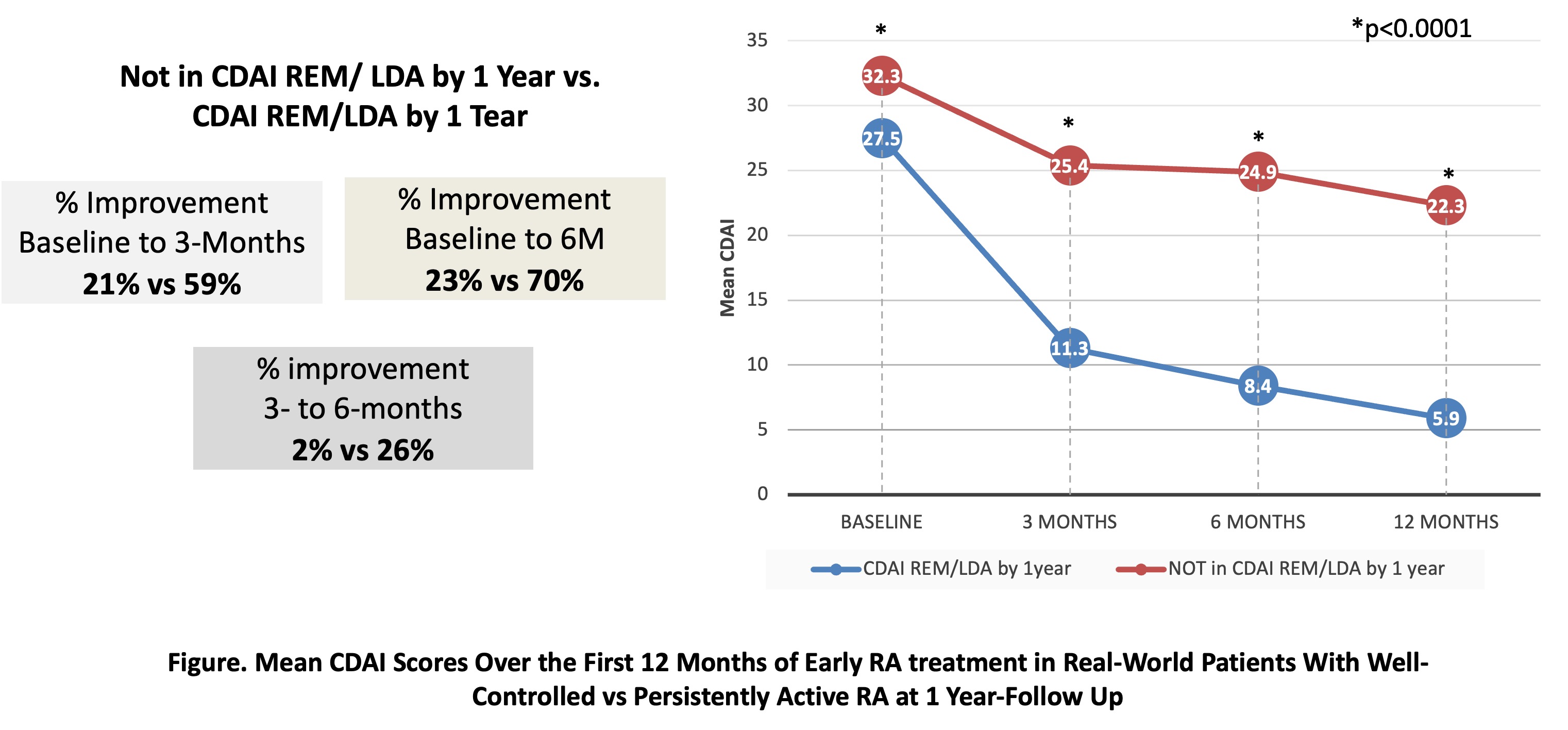
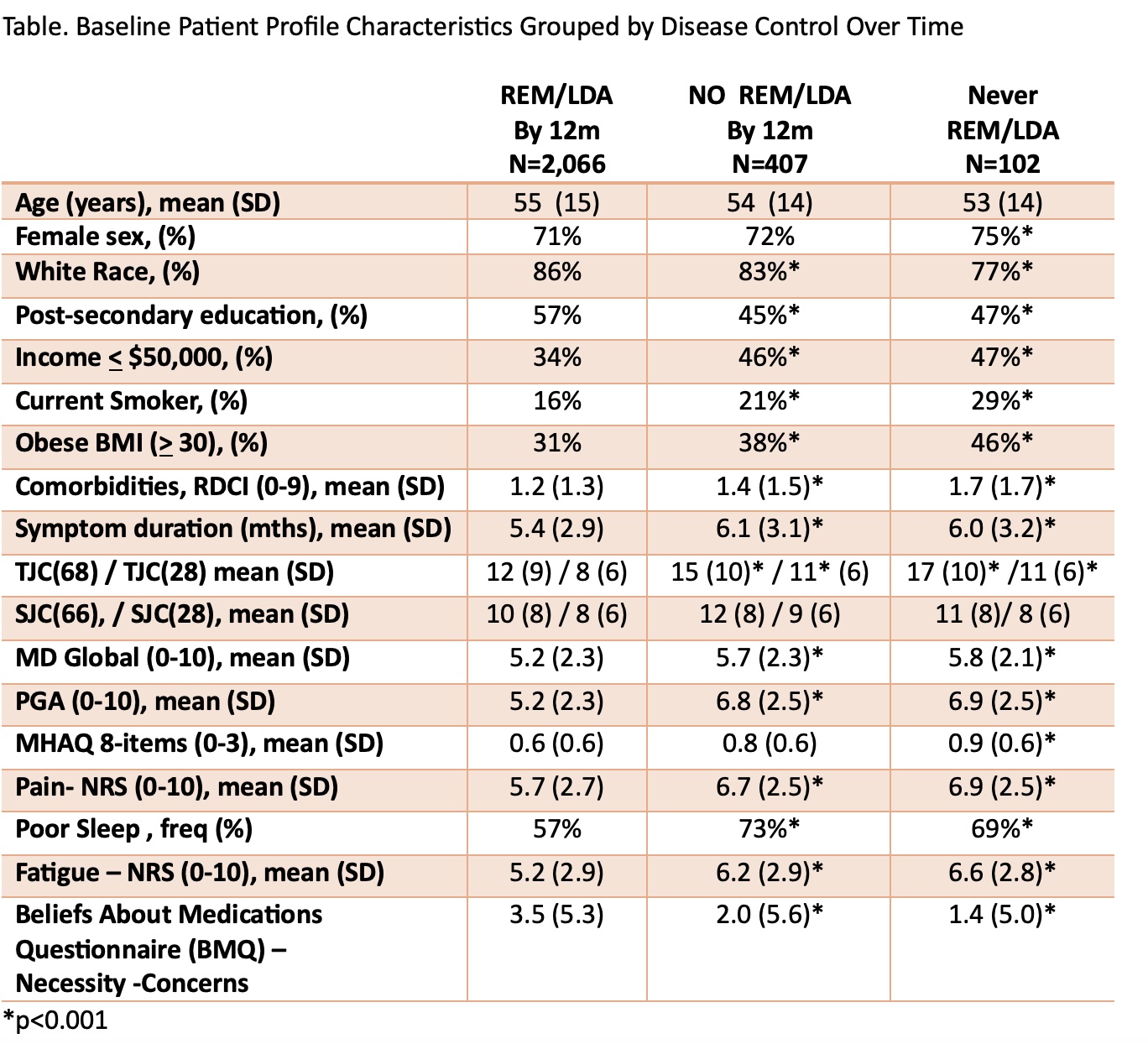
Results: The study included 2,473 early RA patients with a mean age of 55, 71% were female, 85% were White. Most (86%) had moderate or severe CDAI scores at enrolment and 88% received initial treatment with csDMARDs. While most patients’ RA became well-controlled over time, 407 (16%) experienced moderate or severe disease activity throughout the first year of RA treatment, and 102 patients (4%) had persistently active disease throughout their entire follow-up period (median (IQR) months: 35 (22-50)). Patients with well-controlled disease by 12 months showed rapid and significant CDAI improvement within the first 3-months ( >50%), continuing through 6-months. In contrast, those with poor disease control showed only modest or minimal improvement despite similar initial treatment (Figure). In bivariate and multivariable analyses, patients with well vs poorly controlled disease differed by social determinants of health (SDoH), symptom duration, indicators of medical complexity (e.g. comorbidity, smoking, excess weight), tender joint counts, PROs, and perceptions of RA treatment necessity vs. concerns (Table 1).
Conclusion: While most early RA patients respond well to early contemporary csDMARD treatment, 1 in 6 still experienced moderate or severe RA after 12 months, and 1 in 20 had poor disease control throughout follow-up. Patients presenting with greater inequities in SDoH, medical complexity, higher tender joint counts, symptom burden, lower beliefs in the necessity of and/or greater concerns about using RA medications, and those without large improvements in CDAI within 3-6months may benefit from additional supports ( e.g. rapid treatment escalation with closer monitoring, coping/ adherence support, complex care management) to optimize control of their RA.
To cite this abstract in AMA style:
Schieir O, Valois M, Boire G, Bessette L, Thorne C, Bartlett S, Hazlewood G, Hitchon C, Tin D, Allard-Chamard H, Kuriya B, Pope J, Bykerk V. Deciphering Variation in Real-World Early RA Outcomes: A Longitudinal Analysis of the Canadian Early Arthritis Cohort (CATCH) Study [abstract]. Arthritis Rheumatol. 2024; 76 (suppl 9). https://acrabstracts.org/abstract/deciphering-variation-in-real-world-early-ra-outcomes-a-longitudinal-analysis-of-the-canadian-early-arthritis-cohort-catch-study/. Accessed .« Back to ACR Convergence 2024
ACR Meeting Abstracts - https://acrabstracts.org/abstract/deciphering-variation-in-real-world-early-ra-outcomes-a-longitudinal-analysis-of-the-canadian-early-arthritis-cohort-catch-study/