
Session Information
Session Type: Poster Session (Sunday)
Session Time: 9:00AM-11:00AM
Background/Purpose: Lupus nephritis (LN), is seen in 30-50% patients with SLE and 5-10% patients progress to end-stage renal disease. The clinical disease activity indices do not reliably predict the renal histological activity. Hence, biopsy is still the gold standard to help in treatment decisions and prognosis assessment.
Soluble CD163 (sCD163), receptor shed from the alternatively activated macrophage (M2) has been recently found to be a potential urinary biomarker of active LN. To explore further, we studied the urinary sCD163 levels and CD163 positive cells in renal biopsies and studied their correlation with histological features.
Methods: SLE patients undergoing renal biopsy for LN were enrolled. The clinical data regarding disease activity and other parameters was collected. Pre-biopsy urine sample was collected and cell free supernatant was stored at -80C till analysis. Urinary sCD163 (uCD163) was measured by ELISA and the values were normalized to urinary creatinine excretion. 10 healthy control (HC) urine samples were also tested for comparison. The renal biopsies were classified according to the ISN-RPS classification. Activity index (AI) and chronicity index (CI) were calculated using modified NIH scoring system. Immunohistochemistry (IHC) for CD163 positive macrophages was done. Statistical analysis was done using SPSSv20.0
Results: Forty SLE patients with active LN were enrolled [37 females, median age 27 years (12-56)]. All patients had active disease [median SLEDAI 16 (6-43), renal SLEDAI 8 (4-16)]. Among 40 patients, 1 had class II LN, 11 had class III, 26 had class IV and 2 had class V nephritis. The median AI was 8 (1-15) and CI was 2 (0-8).
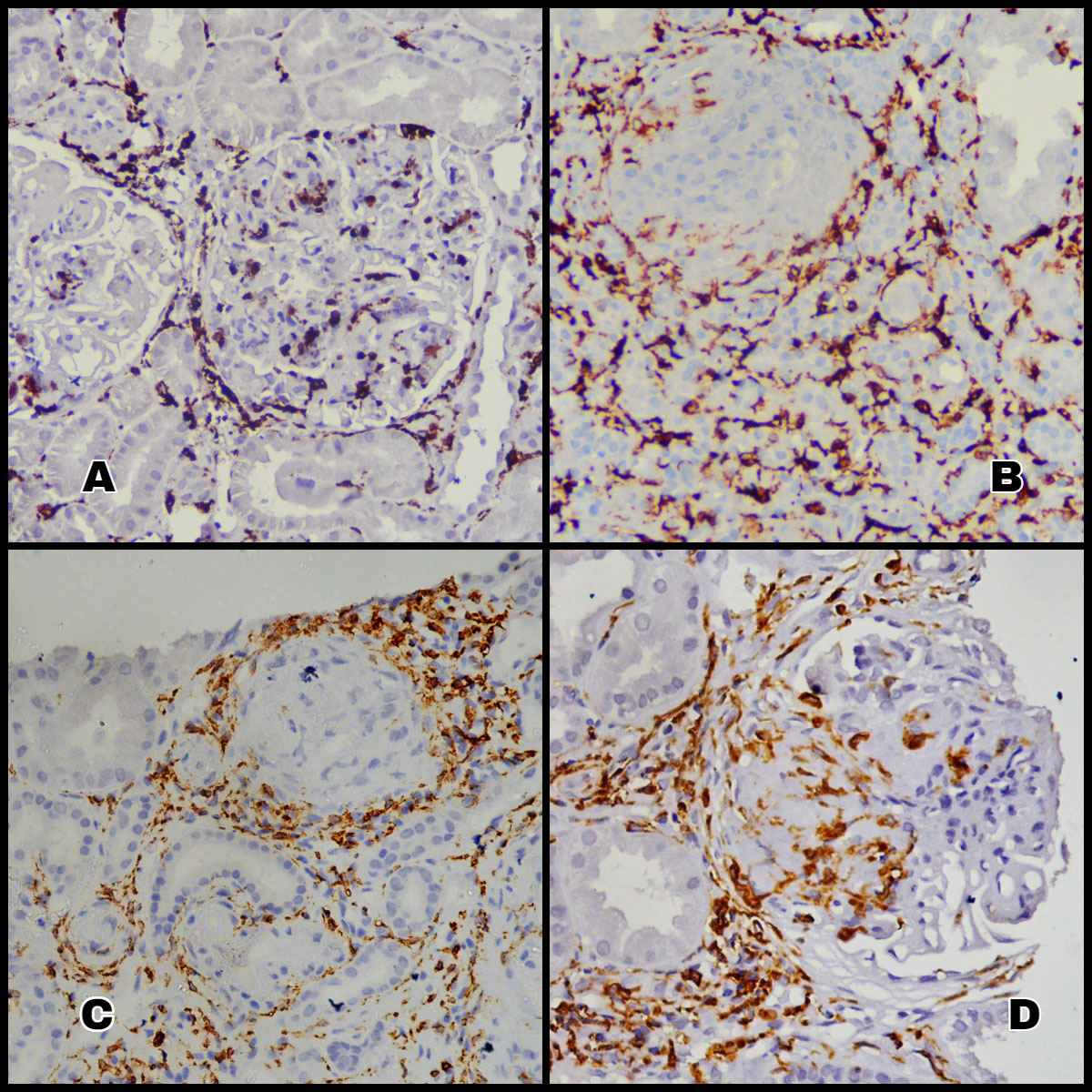
Urinary sCD163 levels were higher in proliferative LN as compared to healthy controls.[49.6 ug/mg of creatinine (3.6-451) versus 4.2 ug/mg of creatinine (0.7-12) in HC; p< 0.001] and showed significant correlation with biopsy activity index (r=0.50; p-value < 0.001), presence and frequency of subendothelial hyaline deposits (r=0.39; p-value < 0.05) and karyorrhexis (r=0.42; p-value < 0.01). They also correlated with the percentage of glomeruli with endocapillary hypercellularity (r=0.39; p-value < 0.01). The average number of CD163 positive cells/glomerulus was 7.8 (0-18). The positive association of uCD163 with activity Index was supported by the localization of CD163+ macrophages in the areas of interstitial inflammation, tubulointerstitial damage and glomeruli with proliferative lesions (Figure 1).
Renal SLEDAI (r=0.46, p-value < 0.01), serum creatinine (r=0.531; p-value < 0.001) and serum total protein (r=-0.34; p-value< 0.05) significantly correlated with chronicity index. The CD163 positive cells were seen along periglomerular fibrosis and around sclerosed glomeruli, though uCD163 levels did not correlate with chronicity index.
Conclusion: Urinary CD163 is a good marker of active LN and correlates with histological activity. CD163+ macrophages are localized to areas of activity as well as chronicity and may contribute to pathogenesis of LN.
To cite this abstract in AMA style:
Venkataraman S, Singh A, Murari M, Agrawal V, Aggarwal A, Pandey R. Correlation of Urinary Soluble CD163 Levels with Clinicopathological Features in Lupus Nephritis: Its Role as a Potential Biomarker [abstract]. Arthritis Rheumatol. 2019; 71 (suppl 10). https://acrabstracts.org/abstract/correlation-of-urinary-soluble-cd163-levels-with-clinicopathological-features-in-lupus-nephritis-its-role-as-a-potential-biomarker/. Accessed .« Back to 2019 ACR/ARP Annual Meeting
ACR Meeting Abstracts - https://acrabstracts.org/abstract/correlation-of-urinary-soluble-cd163-levels-with-clinicopathological-features-in-lupus-nephritis-its-role-as-a-potential-biomarker/