
Session Information
Session Type: Poster Session A
Session Time: 10:30AM-12:30PM
Background/Purpose: The complement (C) system has been implicated in the etiopathogenesis of rheumatoid arthritis (RA). We aimed to examine the correlation between an in-depth evaluation of the C system and the characteristics of patients with RA including disease activity and the presence of rheumatoid factor and anti-citrullinated protein autoantibodies (ACPA).
Methods: Functional assays of the three pathways of the C system, utilizing new-generation techniques, were evaluated in a cohort of 430 patients diagnosed with RA. Additionally, serum levels of C products associated with the three pathways were examined, encompassing C1q for the classical pathway, factor D and properdin for the alternative pathway, and lectin for the lectin pathway. Other assessed components included C1q inhibitor, C2, C4, and C4b for the classical and lectin pathways; C3, C3a, and C4b for the common pathway; and C5, C5a, and C9 for the terminal pathway. Multivariable linear regression analysis was conducted.
Results: Functional tests and individual components of the C correlated with acute phase reactants and indices of disease activity (heatmap of Figure 1). Notably, CRP exhibited positive and significant correlations with functional tests of all three C pathways and nearly all individual components. These correlations were particularly pronounced for the final components of the C pathway, such as the common and terminal pathways. Similar patterns were observed for ESR. All four disease activity indices showed significant and positive associations with the functional test of the classical pathway but were less consistent for the alternative and lectin routes. SDAI, which does not incorporate CRP in its formula, demonstrated positive and significant relationships with the classical and lectin cascades but not with the alternative. CDAI also revealed positive correlations with the functional tests of the classical and lectin pathways, as well as with factor I and C5. Remarkably, correlations of disease activity scores to activated C proteins like C3a and C5a were not significant. In the multivariable adjustment, the classical pathway exhibited higher values (indicating less consumption) in patients with high or moderate activity compared to those in remission or with low activity for both the DAS28-CRP and CDAI scores. Likewise, for the components of the C system in the common and terminal pathways, higher values were observed in the moderate to high disease activity group.
The differences in the C pathways based on the presence of rheumatoid factor and ACPA are detailed in Figure 2. Patients with rheumatoid factor and ACPA, or positive for either one but not the other, exhibited lower levels (indicating more consumption) of the classical pathway functional test. This phenomenon was not observed for the alternative and lectin pathways. Concerning the individual components, patients positive for both rheumatoid factor and ACPA showed lower levels of factor D and C4b, with a tendency to display higher values of C5a and C9.
Conclusion: In RA, disease activity leads to an increase in C molecules and functional assays. Conversely, positivity for rheumatoid factor or anti-citrullinated protein autoantibodies is associated with C consumption.
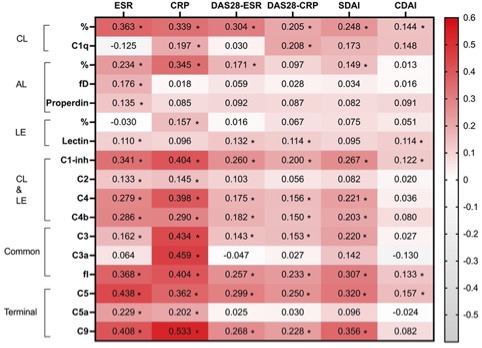
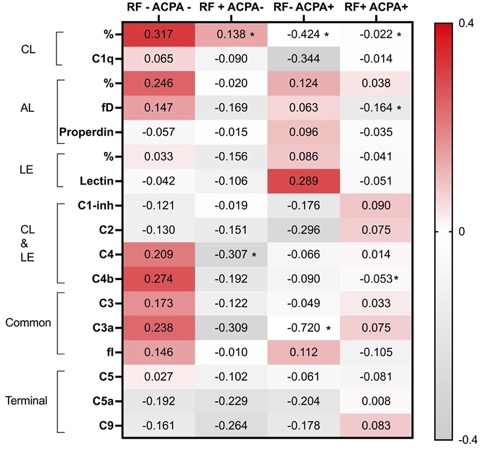
Values are shown standardized to allow comparison between them. * denotes if the comparison between each category, using RF-ACPA- as the reference, is significant (p<0.05). CL: classical, LE: lectin: alternative, fI: factor I, fD: factor D.
To cite this abstract in AMA style:
Ferraz-Amaro i, Garcia-Gonzalez M, Gomez-Bernal F, Quevedo-Abeledo J, Gonzalez-Gay M. Complete Description of the Three Pathways of the Complement System in a Series of 430 Patients with Rheumatoid Arthritis [abstract]. Arthritis Rheumatol. 2024; 76 (suppl 9). https://acrabstracts.org/abstract/complete-description-of-the-three-pathways-of-the-complement-system-in-a-series-of-430-patients-with-rheumatoid-arthritis/. Accessed .« Back to ACR Convergence 2024
ACR Meeting Abstracts - https://acrabstracts.org/abstract/complete-description-of-the-three-pathways-of-the-complement-system-in-a-series-of-430-patients-with-rheumatoid-arthritis/