
Session Information
Session Type: Abstract Session
Session Time: 1:00PM-2:30PM
Background/Purpose: Systemic juvenile idiopathic arthritis (SJIA) associated lung disease (SJIA-LD) is an emerging life-threatening disease with urgent unmet knowledge gaps. This study compares the clinical features, treatments, laboratory and biomarker profiles of the SJIA-LD cohort to SJIA patients without LD in the CARRA Registry.
Methods: CARRA Registry patients with SJIA-LD were included. These patients were matched 4:1 (when available) to a total of 141 SJIA patients without LD who have had similar CARRA Registry follow up durations. Index visit represented the baseline SJIA-LD cohort visit for SJIA-LD patients and the most recent Registry visit for SJIA non-LD patients. Plasma was analyzed from 27 SJIA-LD patients, 28 SJIA patients in the FROST study who contributed 46 samples at different time points, and 15 healthy controls from CCHMC. The study was approved by DCRI Reliant IRB and IRBs of all sites.
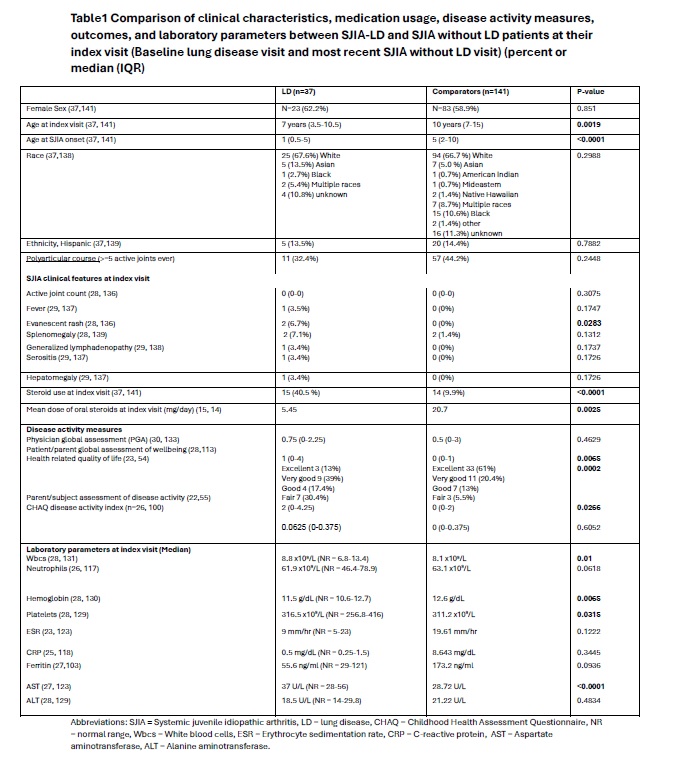
Results: 37 SJIA-LD patients from 16 sites were compared to 141 SJIA patients without LDSJIA-LD patients had a lower age at SJIA onset (median 1 vs 5 years, p< 0.0001) than patients without LD. SJIA-LD patients had higher cumulative medication exposures, being significantly more likely to have used medications including cyclosporin A, mycophenolate mofetil, anakinra, tofacitinib, ruxolitinib, etoposide, IVIG, and emapalumab. While SJIA-LD patients were somewhat less likely to have ever used daily corticosteroids (82.9 vs 99.4, p=0.01), they were much more likely to remain on daily corticosteroids (40.5% vs. 9.9%, p< 0.0001). At the index visit, SJIA-LD patients were more likely to have active SJIA rash, and exhibited significantly higher disease activity scores (higher parent/subject assessment of disease activity of 2.6 vs 1.8 (p=0.0266), higher patient/parent global assessment of wellbeing of 1 vs 0 (p=0.0065), and worse health-related quality of life (p=0.0002). The median physician global assessment (PGA) was higher in the SJIA-LD group (0.75 vs. 0.5), though this was not statistically significant. Additionally, SJIA-LD patients had significantly lower hemoglobin levels (p=0.0065), higher white blood cells (p=0.01) and platelets (p=0.0315), and higher AST (p< 0.0001). (Table 1). SJIA-LD patients also had a significantly higher prevalence of prior MAS episodes (67.6% vs. 10.6%, p < 0.0001). The mortality rate for SJIA-LD patients was significantly higher (5.4% vs. 0%, p=0.0418).
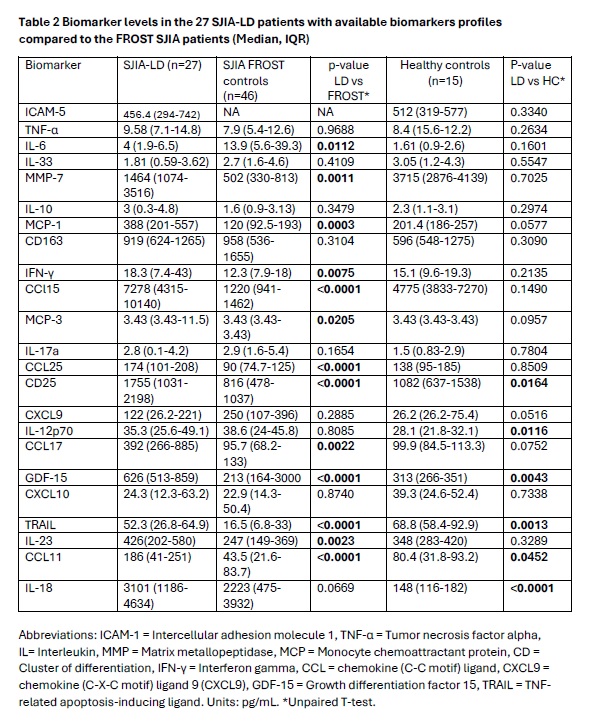
Luminex cytokine profiling demonstrated that SJIA-LD patients had significantly higher levels of several biomarkers than SJIA patients in the FROST study, including IL-23, IFN-γ, CD25, CCL11, CCL15, CCL17, CCL25, MCP-1, MCP-3, MMP-7, TRAIL, and GDF-15 (Table 2).
Conclusion: Compared to SJIA patients without LD, patients in the CARRA SJIA-LD cohort exhibit more cumulative medication exposures including continued corticosteroid use, higher measures of disease activity, and laboratory findings associated with higher disease activity. Circulating biomarkers including MMP-7 and type II chemokines may be important biomarkers for SJIA-LD. This prospective cohort will be an important tool to be able to understand the natural history of SJIA-LD through the CARRA Registry.
To cite this abstract in AMA style:
Eloseily E, Clark A, Chang M, Riordan M, Russell A, Natter M, Canna S, Thornton S, Kimura Y, schulert g. Comparison of the Clinical Features and Biomarker Profiles of the Childhood Arthritis and Rheumatology Research Alliance (CARRA) Systemic Juvenile Idiopathic Arthritis- Associated Lung Disease (SJIA-LD) Cohort to CARRA Registry SJIA Patients Without Lung Disease [abstract]. Arthritis Rheumatol. 2024; 76 (suppl 9). https://acrabstracts.org/abstract/comparison-of-the-clinical-features-and-biomarker-profiles-of-the-childhood-arthritis-and-rheumatology-research-alliance-carra-systemic-juvenile-idiopathic-arthritis-associated-lung-disease-sjia-l/. Accessed .« Back to ACR Convergence 2024
ACR Meeting Abstracts - https://acrabstracts.org/abstract/comparison-of-the-clinical-features-and-biomarker-profiles-of-the-childhood-arthritis-and-rheumatology-research-alliance-carra-systemic-juvenile-idiopathic-arthritis-associated-lung-disease-sjia-l/