
Session Information
Session Type: Poster Session B
Session Time: 10:30AM-12:30PM
Background/Purpose: Executive dysfunction is common in childhood-onset systemic lupus erythematosus (cSLE). Comprehensive neuropsychological assessments use both performance-based measures and standardized questionnaires, capturing different cognitive constructs. However, comprehensive assessments are time-consuming, resource-intensive, and often inaccessible. Standardized questionnaires measuring self-rated daily executive function (EF), are brief and easy to administer, with potential clinical utility to identify patients needing comprehensive assessment. The study aimed to examine associations between performance-based measures and self-rating of daily EF in youth with cSLE.
Methods: This cross-sectional study analyzed prospectively collected data from cSLE patients (meeting ACR 1997 or SLICC classification criteria) aged 11-17 years recruited from an outpatient Lupus Clinic from January 2020–December 2023, and age and sex-matched healthy controls. Participants completed the Behaviour Rating Inventory of Executive Function 2nd Edition Self-Report Form (BRIEF-2-SR) assessing daily EF measured by the General Executive Composite (GEC), Behavior Regulation Index (BRI), Cognitive Regulation Index (CRI), and Emotion Regulation Index (ERI). The Delis-Kaplan Executive Function System (D-KEFS) Color-Word Interference Test (CWIT), a performance-based measure, assessed information processing speed (Colour Naming, Word Reading), cognitive inhibition and flexibility (Inhibition, Inhibition/Switching). Correlations were calculated between the BRIEF-2-SR summary scores (GEC, BRI, CRI, and ERI) and scaled scores for performance in the four tasks of the D-KEFS CWIT. Mann-Whitney U tests were used to examine group differences in scores.
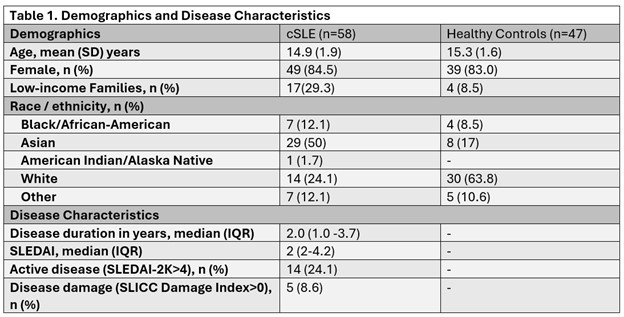
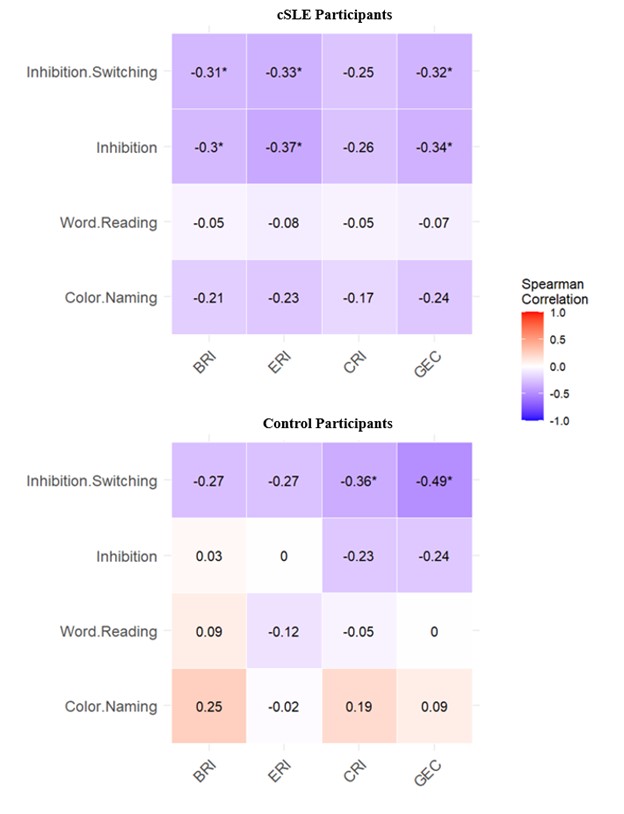
Results: There was a total of 58 cSLE participants (84% female; mean age=15.3y ± SD 1.7) and 47 controls (83% female; mean age=14.9y ± SD 1.9) (Table1). For cSLE participants, worse performance-based scores for cognitive inhibition and flexibility showed statistically significantly correlations with worse self-rated daily EF scores for the GEC, BRI, and ERI (Figure 1). For controls, worse scores for cognitive inhibition and flexibility correlated with worse self-rated daily EF scores for GEC and CRI (Figure 1). Performance-based processing speed scores were not significantly associated with the BRIEF-2 scores in either group. No significant differences were found between cSLE and controls across BRIEF-2-SR indices. On the D-KEFS, cSLE participants displayed significantly poorer performance on Color Naming (U = 1027, p = 0.022), Inhibition (U = 1027, p = 0.021), and Inhibition/Switching (U = 1049, p = 0.030) compared to controls.
Conclusion: Youth with cSLE in this cohort had worse performance-based EF measures compared to controls. Performance-based scores for cognitive inhibition and flexibility correlated with self-rated daily EF scores in both groups, but more consistently across indices in the cSLE group. Further study is needed to determine the utility of questionnaires for self-rated daily EF as efficient screening tools to identify cSLE patients needing comprehensive neuropsychological assessment.
To cite this abstract in AMA style:
El Tal T, Jaffan J, Ledochowski J, Boulard L, Mwizerwa O, Zapparoli B, Mossad S, Lishak V, Mohamed I, Law J, Ng L, Moaf P, Jeyanathan A, Davis A, Hiraki L, Levy D, Danguecan A, Knight A. Comparing Performance-Based Measures and Self-Reported Questionnaires for Assessment of Executive Function for Youth with Childhood-Onset Systemic Lupus Erythematosus [abstract]. Arthritis Rheumatol. 2024; 76 (suppl 9). https://acrabstracts.org/abstract/comparing-performance-based-measures-and-self-reported-questionnaires-for-assessment-of-executive-function-for-youth-with-childhood-onset-systemic-lupus-erythematosus/. Accessed .« Back to ACR Convergence 2024
ACR Meeting Abstracts - https://acrabstracts.org/abstract/comparing-performance-based-measures-and-self-reported-questionnaires-for-assessment-of-executive-function-for-youth-with-childhood-onset-systemic-lupus-erythematosus/