
Session Information
Date: Sunday, November 7, 2021
Title: Measures & Measurement of Healthcare Quality Poster (0623–0659)
Session Type: Poster Session B
Session Time: 8:30AM-10:30AM
Background/Purpose: Guidelines for perioperative management of antirheumatic medications were released by the American College of Rheumatology (ACR) and American Association of Hip and Knee Surgeons (AAHKS) in 2017 (Goodman SM et al, 2017). Prior to this, no formal guidelines had been published. Their primary goal was to reduce infectious complications in the perioperative setting for elective total hip and knee replacements by guiding provider decision making. However, in order for the guidelines to standardize and improve patient care, providers must be familiar with them and take them into consideration during clinical decision making. In 2021, we surveyed a multispecialty provider cohort to determine provider knowledge and opinions of the ACR/AAHKS guidelines.
Methods: A 10-question survey was sent to all anesthesia, orthopedic surgery and rheumatology providers at a single academic center. Responses were stratified by specialty and level of training. Comparisons between groups were performed by chi-squared, Fisher’s exact and Kruskal-Wallis testing.
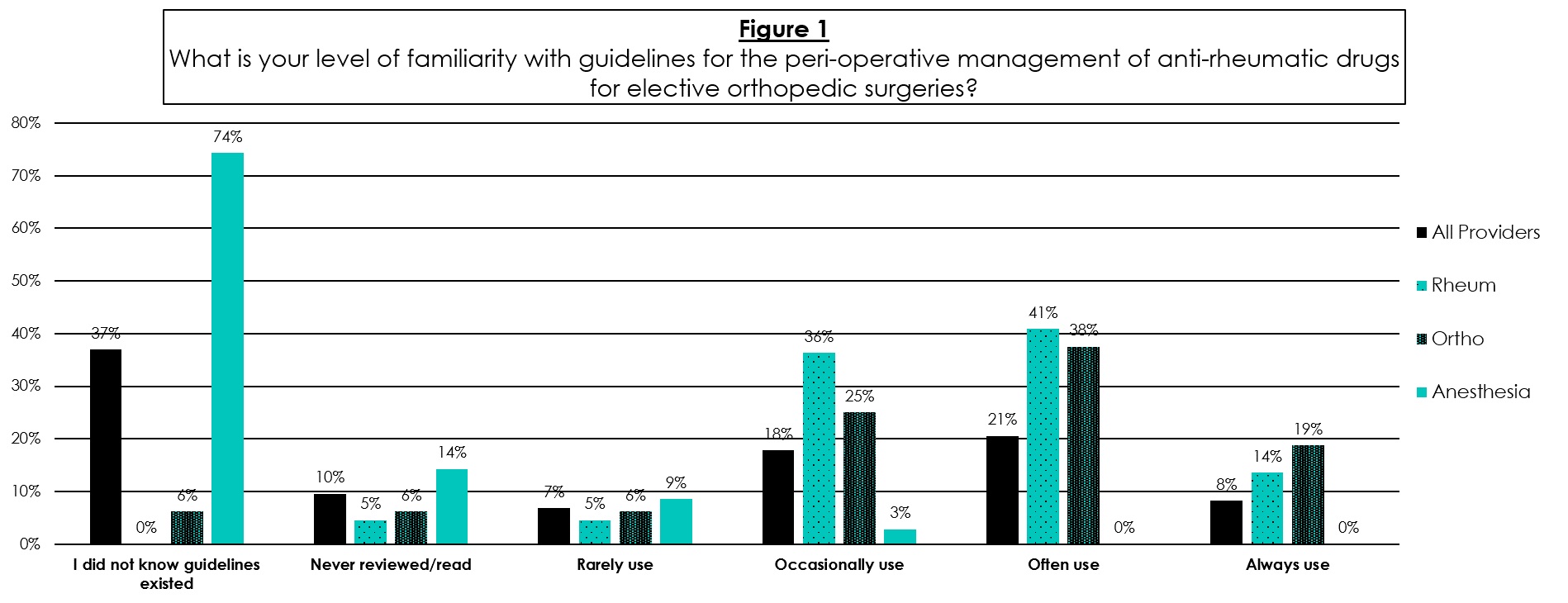
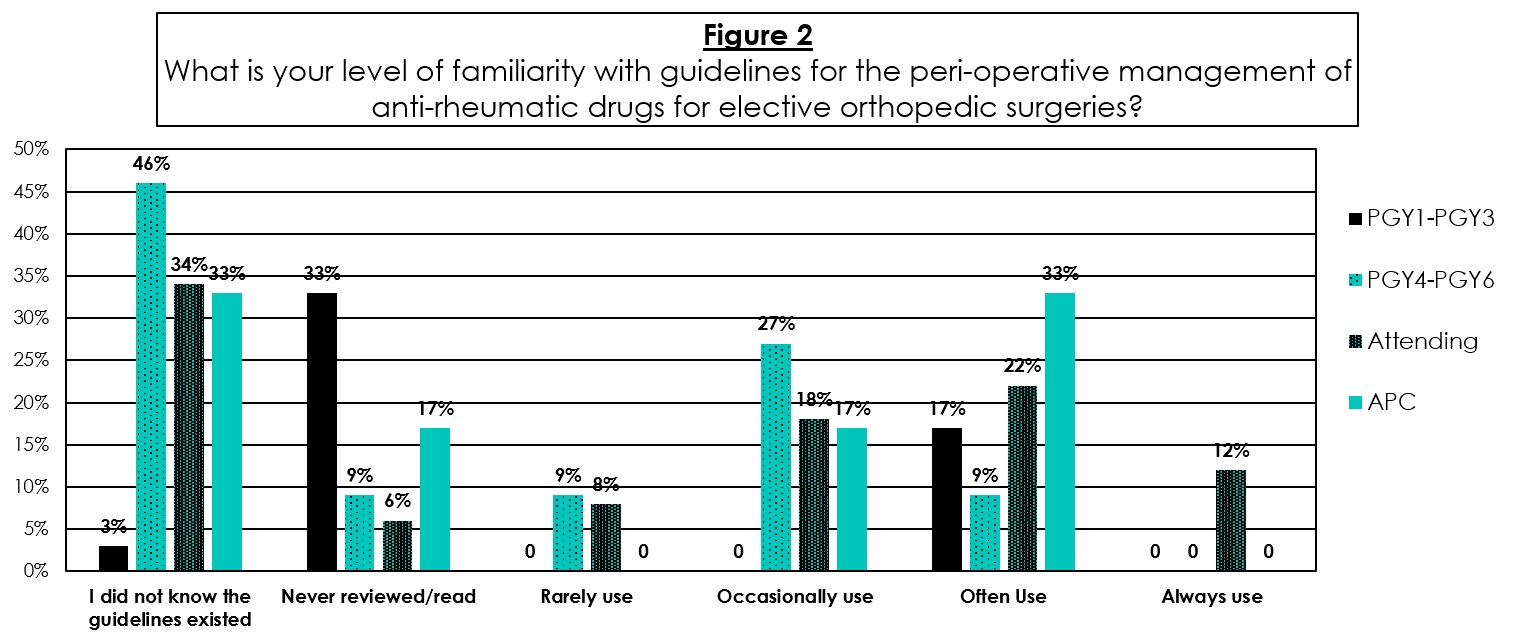
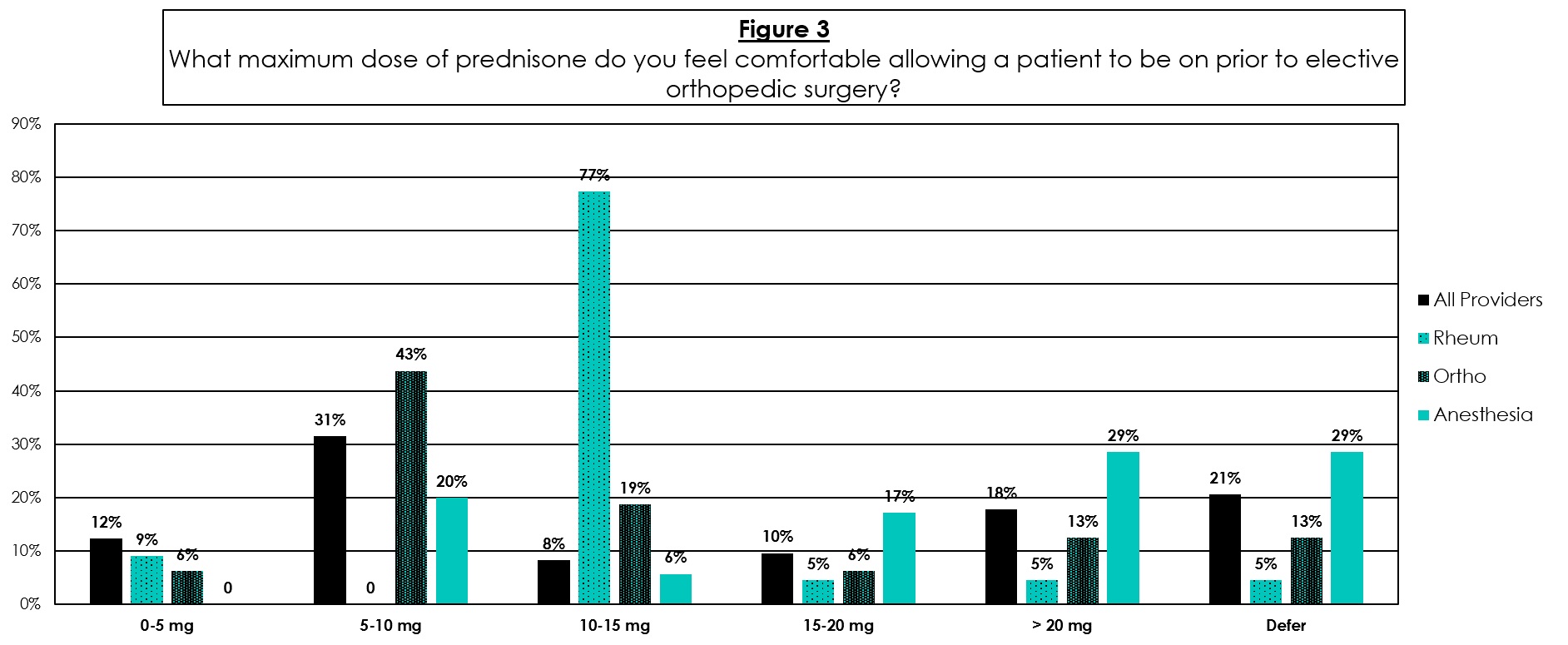
Results: Seventy-three providers responded to the survey (22 rheumatologists, 16 orthopedic surgeons, 35 anesthesiologists). 6% of orthopedic surgeons and 74% of anesthesiologists were not aware that the guidelines existed. In contrast, all of the rheumatologists were aware that the guidelines existed. Awareness of the guidelines differed significantly between anesthesiologists and both orthopedic surgeons and rheumatologists (p < 0.001, figure 1). Awareness did not differ significantly by level of training (figure 2). The most common barrier to use of guidelines was lack of awareness that they existed (26% of respondents). When evaluating the understanding of the guidelines, 51% of respondents either did not correctly identify the recommended perioperative management of conventional synthetic disease modifying antirheumatic drugs (25%), or deferred the decision to another provider (26%). 18% of respondents indicated that they felt comfortable with patients on perioperative doses of prednisone ≥20mg prednisone/day, which is higher than the dose recommended by the guidelines (figure 3). 66% of respondents felt direct communication with a rheumatologist was a helpful intervention in making decisions regarding antirheumatic drug management. 63% of respondents felt rheumatologists should make the final decision on perioperative antirheumatic medications.
Conclusion: Increased awareness and understanding of the ACR/AAHKS guidelines is needed. This is particularly important for rheumatologists, who are the providers most often relied upon to make decisions related to the management of these medications. Direct communication with a rheumatologist is felt to be a preferred intervention in the decision-making process. As a next step, we plan to evaluate the adoption and impact of the guidelines on the rate of postoperative infectious complications after hip and knee arthroplasty.
To cite this abstract in AMA style:
Shaffer A, Mulcaire-Jones E, Battistone M, Gililland J, Carlson V, Zimmerman J, Lammert K, Lebiedz-Odrobina D. Assessing Provider Knowledge and Opinions of the 2017 Guidelines for Perioperative Management of Antirheumatic Medications in a Single Academic Center [abstract]. Arthritis Rheumatol. 2021; 73 (suppl 9). https://acrabstracts.org/abstract/assessing-provider-knowledge-and-opinions-of-the-2017-guidelines-for-perioperative-management-of-antirheumatic-medications-in-a-single-academic-center/. Accessed .« Back to ACR Convergence 2021
ACR Meeting Abstracts - https://acrabstracts.org/abstract/assessing-provider-knowledge-and-opinions-of-the-2017-guidelines-for-perioperative-management-of-antirheumatic-medications-in-a-single-academic-center/