
Session Information
Session Type: Abstract Session
Session Time: 12:30PM-12:45PM
Background/Purpose: Women with rheumatoid arthritis (RA) have 1.5- and 2-fold higher risk of major osteoporotic fracture (MOF: first of distal forearm, hip, humerus, or clinical vertebral fracture) and hip fracture, respectively. Most fractures occur in women with osteopenia, where fracture risk stratification with FRAXTM guides drug therapy initiation in the United States. U.S.-FRAX was calibrated using mainly White cohorts, and its performance across racial/ethnic groups with RA is uncertain. We assessed racial/ethnic differences in U.S.-FRAX performance in predicting imminent (2-year) MOF and hip fracture risk in older U.S. women with RA.
Methods: We retrospectively analyzed RISE registry data linked to Medicare claims (2016-2018). We included women ≥ 65 years old with RA (≥ 2 RA-coded RISE visits ≥ 30 days apart by 1/1/2017) and Medicare coverage throughout 2016 and extending into 2017. Only participants identified as Asian, Black, Hispanic, or White race/ethnicity in Medicare were included as we used these four race/ethnicity-specific U.S.-FRAX models. We used Fine-Gray competing risk models to assess associations between U.S.-FRAX 10-year MOF and hip fracture probabilities and imminent fracture risk, with separate analyses overall and in each racial/ethnic group. Variables to compute U.S.-FRAX were obtained from RISE and Medicare at or before 1/1/2017. Bone mineral density (BMD) and parental hip fracture were not available. U.S.-FRAX without BMD was used, adjusting with age- and sex-specific estimates of the effect of affirming a parental hip fracture. Incident MOF and hip fracture were identified using validated claims-based definitions starting 1/1/2017. Observed absolute 2-year fracture incidence per 1,000 person-years was compared across FRAX risk categories (low: < 10% MOF, < 1% hip; moderate: 10-20% MOF, 1-3% hip; high: >20% MOF, >3% hip) using the Cochran-Armitage trend test. Discrimination was measured via cross-validated Areas Under the Curve (AUCs) in racial/ethnic groups, with comparison to White women.
Results: Among 14,533 women with RA (mean age: 73.8±6.4 years; 1% Asian; 8% Black; 5% Hispanic; 86% White), we observed 1,477 MOFs and 419 hip fractures. FRAX scores were statistically significantly associated with corresponding fracture risk at both sites overall, and in Black, Hispanic, and White women (Table 1). FRAX MOF, but not hip fracture, scores were statistically significantly associated with fracture risk in Asian women (Table 1). Observed MOF incidence increased significantly across FRAX risk categories overall and in all racial/ethnic groups (P≤0.01). For hip fracture, the trend was statistically significant overall and in White women (P< 0.01), and approached significance in Black (P=0.09) and Hispanic (P=0.07) women. FRAX discrimination for imminent MOF and hip fracture was fair, and AUCs did not differ by race/ethnicity (Table 2).
Conclusion: U.S.-FRAX without BMD predicted imminent MOF and hip fracture risk in older women with RA, and showed similar discrimination across racial/ethnic groups. Future studies with longer follow-up are needed to assess calibration by race/ethnicity and evaluate performance within RA-specific subgroups, such as stratifying by RA disease activity.
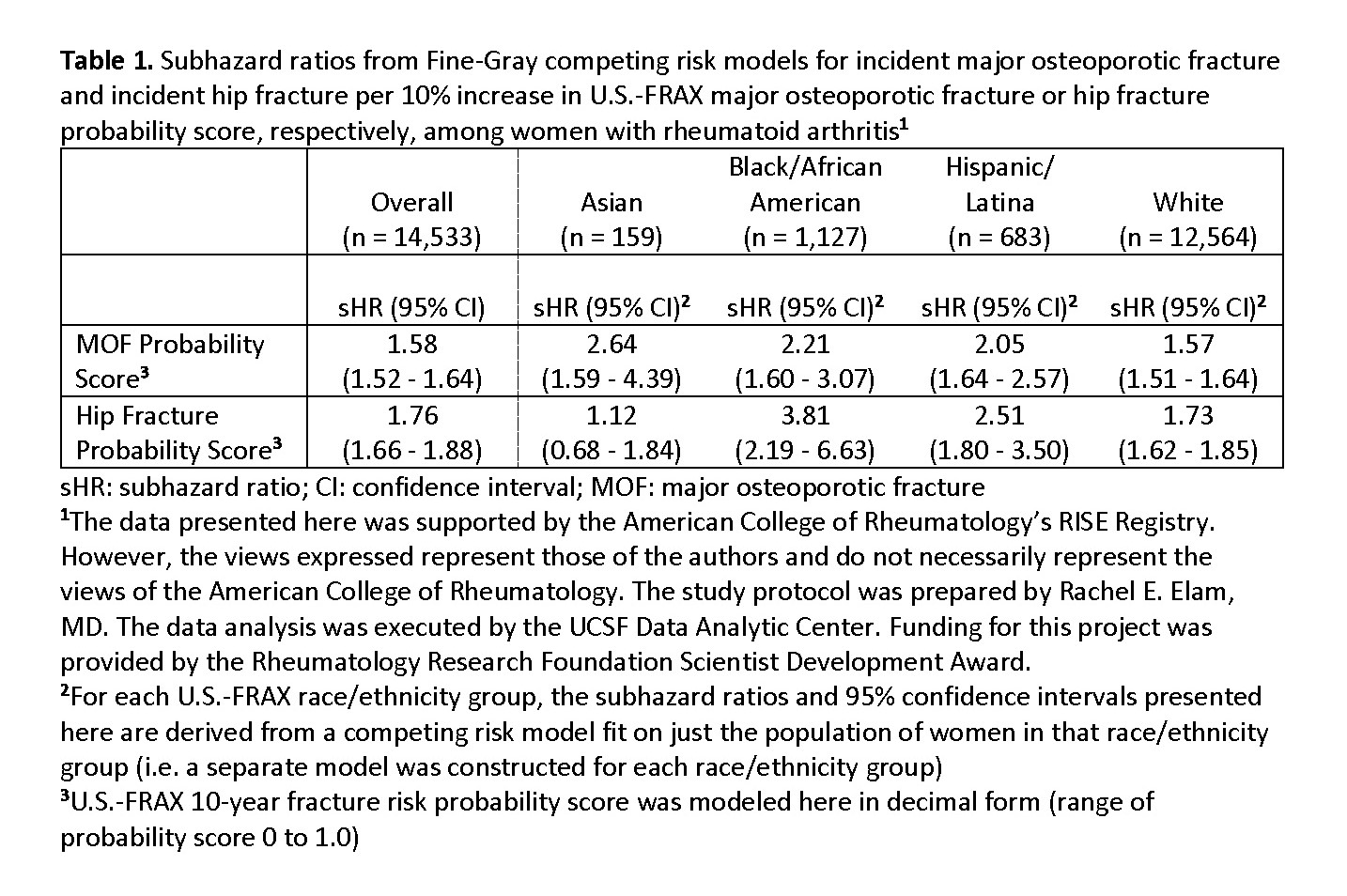 Table 1. Subhazard ratios from Fine-Gray competing risk models for incident major osteoporotic fracture and incident hip fracture per 10% increase in U.S.-FRAX major osteoporotic fracture or hip fracture probability score, respectively, among women with rheumatoid arthritis
.jpg) Table 2. Areas under the curve (AUCs) for 2-year prediction of incident fracture by site by U.S.-FRAX 10-year site-specific fracture probability score in women with rheumatoid arthritis, overall and by U.S.-FRAX race/ethnicity group
Table 2. Areas under the curve (AUCs) for 2-year prediction of incident fracture by site by U.S.-FRAX 10-year site-specific fracture probability score in women with rheumatoid arthritis, overall and by U.S.-FRAX race/ethnicity group
To cite this abstract in AMA style:
Elam R, Li J, Paul A, Kersey E, Schmajuk g, Leslie W, Carbone L. Assessing for Racial/Ethnic Variability in U.S.-FRAXTM Performance Among Older Adult Women with Rheumatoid Arthritis in the United States [abstract]. Arthritis Rheumatol. 2025; 77 (suppl 9). https://acrabstracts.org/abstract/assessing-for-racial-ethnic-variability-in-u-s-fraxtm-performance-among-older-adult-women-with-rheumatoid-arthritis-in-the-united-states/. Accessed .« Back to ACR Convergence 2025
ACR Meeting Abstracts - https://acrabstracts.org/abstract/assessing-for-racial-ethnic-variability-in-u-s-fraxtm-performance-among-older-adult-women-with-rheumatoid-arthritis-in-the-united-states/