
Session Information
Date: Wednesday, October 29, 2025
Title: Abstracts: Epidemiology & Public Health I (2657–2662)
Session Type: Abstract Session
Session Time: 12:15PM-12:30PM
Background/Purpose: Understanding longitudinal changes in serum urate (SU) allows for the development of evidence-based interventions for gout. Post-menopausal women, who are at risk of gout, have increased SU levels. This increase is partially attributed to the loss of estrogen’s protective effect on kidney function. While cross-sectional studies have been conducted, longitudinal SU changes during the menopausal transition and interactions with coexisting conditions that modify SU, such as BMI and estimated glomerular filtration rate (eGFR), are not well studied.
Methods: This retrospective longitudinal cohort study included Japanese women who underwent annual medical examinations from April 2004 to September 2024. Each woman had at least one visit before and after a self-report of menopause. Women with possible surgical menopause and those who received hormonal therapy were excluded. The median date between the two consecutive visits before and after menopause was considered the date of menopause for statistical analyses. Menopausal transition stages were temporally categorized as pre-menopause ( >5 years before menopause), peri-menopause (from 5 years before up until menopause), and post-menopause (after menopause). Longitudinal changes in SU and hyperuricemia (HU: SU ≥6.8 mg/dL or taking medications for gout/HU) were examined by interrupted time-series analyses and evaluated across subgroups stratified by median menopausal age, kidney function (eGFR < 60 or ≥ 60 mL/min/1.73 m2), BMI (< 25 or ≥ 25 kg/m2), and alcohol intake (≥1 drink/day or no drinks) at the first visit after menopause.
Results: We analyzed 8,169 eligible participants with 93,511 visits over a median follow-up of 13.8 years. SU gradually increased during pre-menopause, rose rapidly during peri-menopause, and stabilized post-menopause (Figure 1). Compared to pre-menopause, the mean SU level was 0.41 mg/dL (95% CI: 0.38, 0.43) higher during post-menopause. SU increased by 0.033 mg/dL per year (95% CI: 0.030, 0.035) during pre-menopause. The slope changed to 0.095 mg/dL (+0.062 mg/dL [95% CI: 0.057, 0.067]) during peri-menopause and 0.016 mg/dL (–0.017 mg/dL [95% CI: –0.021, –0.014]) during post-menopause (Table 1). HU prevalence was < 1.0% during pre-menopause, began to increase approximately 2-3 years before menopause, and was 4-5% during post-menopause (Figure 1). Association of SU levels with eGFR and BMI were also larger during peri-menopause and post-menopause compared to pre-menopause (Table 1). Women with an eGFR < 60 mL/min/1.73 m2 and a BMI ≥ 25 kg/m2 had a greater rise in SU during peri-menopause: HU was observed in approximately 18% of overweight or obese women at menopause (Figure 2).
Conclusion: This longitudinal study found that SU levels and HU prevalence drastically increase several years before menopause and are already elevated by the time of menopause. Maintaining a healthy body weight and preserving kidney function prior to menopause may decrease post-menopausal HU and potentially control subsequent gout in women.
 Figure 1. Longitudinal trends in serum urate and hyperuricemia observed in women. Mean serum urate levels (A) and the proportion who had hyperuricemia (B) with a 95% CI were described. The date of menopause was defined as the median date between the two consecutive visits immediately before and after the self-reported menopause occurrence. The time from menopause was calculated for each visit. Participant data was then summarized by years since menopause. eGFR, estimated glomerular filtration rate; CI, confidence intervals
 Table 1. Result of interrupted time-series analyses for serum urate levels in women
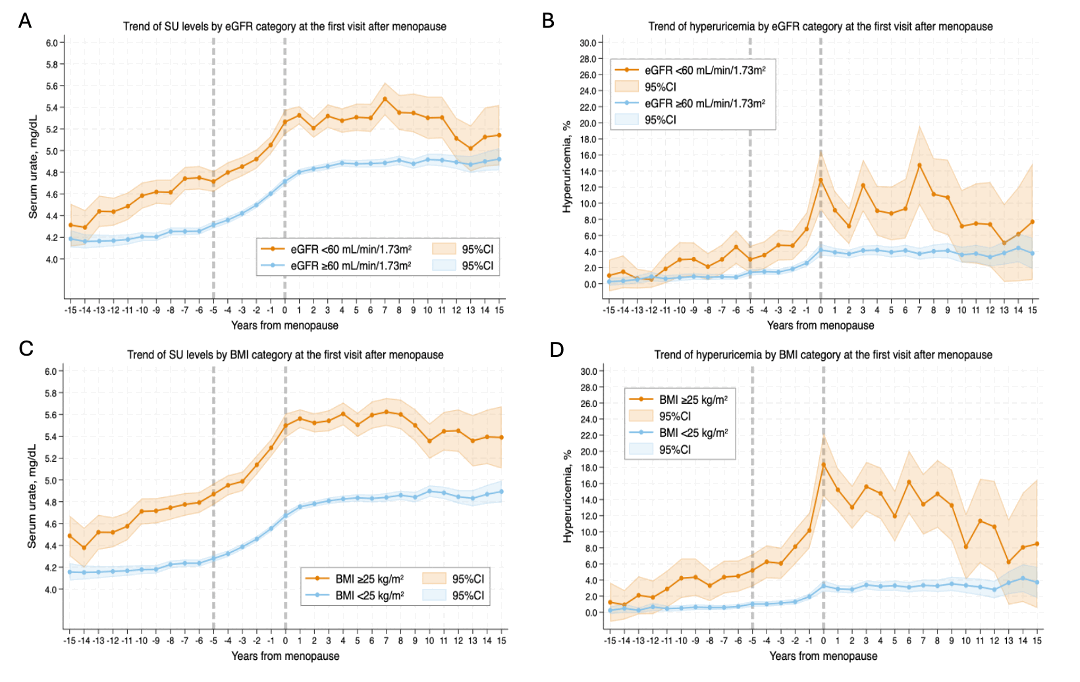 Figure 2. Longitudinal trends in serum urate by subgroups of women. Mean serum urate levels (A, C) and the proportion who had hyperuricemia (B, D) with a 95% CI were described by stratified subgroups of eGFR (A, B) and BMI (C, D) The date of menopause was defined as the median date between the two consecutive visits immediately before and after the self-reported menopause occurrence. The time from menopause was calculated for each visit. Participant data was then summarized by years since menopause. The information at the first visit after menopause was used for stratification. eGFR, estimated glomerular filtration rate; BMI, body mass index; CI, confidence intervals
To cite this abstract in AMA style:
Billa S, Fukui S, Paudel M, Suzuki T, Imai R, Kim Y, Nakai T, Tamaki H, kishimoto m, Ørbo H, Tedeschi S, Choi H, Okada M, Solomon D. Understanding Gout in Women: Longitudinal Changes in Serum Urate Levels from Pre-menopause through Post-menopause [abstract]. Arthritis Rheumatol. 2025; 77 (suppl 9). https://acrabstracts.org/abstract/understanding-gout-in-women-longitudinal-changes-in-serum-urate-levels-from-pre-menopause-through-post-menopause/. Accessed .ACR Meeting Abstracts - https://acrabstracts.org/abstract/understanding-gout-in-women-longitudinal-changes-in-serum-urate-levels-from-pre-menopause-through-post-menopause/