
Session Information
Session Type: ACR Poster Session A
Session Time: 9:00AM-11:00AM
Background/Purpose: Bariatric surgery, the most effective treatment for losing weight and maintaining weight loss among morbidly obese persons, has been evolving as a treatment for morbidly obese patients with knee OA (KOA). The purpose of this study was to evaluate trends in the volume and distribution of surgical approaches, patient characteristics, and inpatient outcomes among persons with KOA undergoing bariatric surgery from 2005-2014.
Methods: We used the National Inpatient Sample data from 2005 to 2014 to identify bariatric procedure discharges with documented comorbid KOA. We abstracted hospital setting, procedure, demographic and clinical patient characteristics, and inpatient surgical outcomes from each discharge. We calculated descriptive characteristics and the Elixhauser Comorbidity Index, a comorbidity metric designed for use with administrative datasets. Inpatient outcomes included complication rates, length of stay (LOS), and costs. We examined temporal trends on distribution of surgery types, hospital and patient characteristics, and surgical outcomes using linear regression and the Cochran-Armitage test for trend.
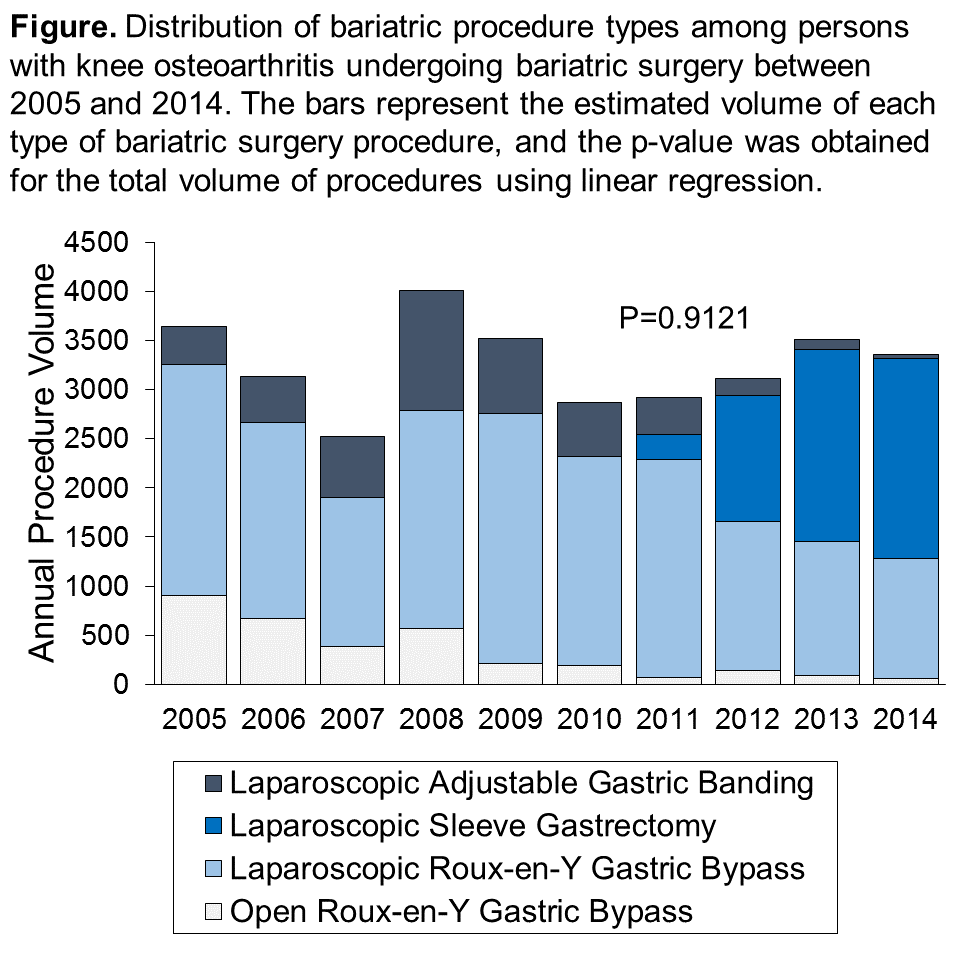
Results: The national volume of persons with KOA undergoing bariatric surgery from 2005-2014 remained consistent at a total of about 3,300 procedures annually. The procedure distribution changed over time; the most commonly-performed procedure shifted from laparoscopic Roux-en-Y gastric bypass (RYGB) (65%) in 2005-2006 to laparoscopic sleeve gastrectomy (LSG) (58%) in 2013-2014 (Figure). The median age and Elixhauser Index increased from 46 to 50 years and 1.6 to 2.0, respectively. From 2005-2014, the median costs (2017 USD), adjusted for LOS, Elixhauser Index, hospital location and teaching status, and bed size, for laparoscopic RYGB and laparoscopic banding procedures decreased from $15,100 to $13,700 (p<0.0001) and $14,100 to $10,100 (p=0.0001), respectively, whereas the adjusted costs of open RYGB did not change significantly. The adjusted costs of LSG did not change significantly between 2011, when the procedure code was introduced, to 2014. Inpatient complication rates decreased significantly from 5.2% to 1.7%, and inpatient mortality remained at 0.0%-0.1%.
Conclusion: The volume of persons with KOA undergoing bariatric surgery remained unchanged from 2005-2014. Less invasive procedures, such as LSG, are utilized more frequently over time, likely leading to a decrease in inpatient complication rates associated with bariatric surgery. Decreases in the costs of older laparoscopic techniques (RYGB and banding) may be due to improved surgical technology, whereas the cost of open RYGB has not changed over the decade. There were no significant cost changes during the four-year period of evaluation for LSG, a relatively new procedure. Mortality rates remained low despite an increase in age and number of concomitant comorbidities.
To cite this abstract in AMA style:
Gong Y, Selzer F, Deshpande B, Losina E. Trends in Procedure Type, Patient Characteristics, and Outcomes Among Persons with Knee Osteoarthritis Undergoing Bariatric Surgery, 2005-2014 [abstract]. Arthritis Rheumatol. 2018; 70 (suppl 9). https://acrabstracts.org/abstract/trends-in-procedure-type-patient-characteristics-and-outcomes-among-persons-with-knee-osteoarthritis-undergoing-bariatric-surgery-2005-2014/. Accessed .« Back to 2018 ACR/ARHP Annual Meeting
ACR Meeting Abstracts - https://acrabstracts.org/abstract/trends-in-procedure-type-patient-characteristics-and-outcomes-among-persons-with-knee-osteoarthritis-undergoing-bariatric-surgery-2005-2014/