ACR Meeting Abstracts

ACR Meeting Abstracts

  • Meeting Abstracts
    • All Meetings
    • PRSYM 2026
    • ACR Convergence 2025
    • Download Abstract Supplements
  • Keyword Index
  • My Favorites
    • View & print my favorites
  • Search

Home » Meeting Abstracts » ACR Convergence 2024

Abstract Number: 1574

­­­Therapeutic Strategy in Patients with Mixed Connective Tissue Disease: A Multicenter Retrospective Study in the French MCTD Cohort

Kevin Chevalier1, Benjamin Thoreau2, Marc Michel3, Bertrand Godeau4, Christian AGARD5, Thomas Papo6, Karim Sacré6, Raphaele Seror7, Xavier Mariette8, Patrice Cacoub9, Ygal Benhamou10, Hervé Levesque10, Cécile Goujard11, Olivier Lambotte11, Bernard Bonnotte12, Maxime SAMSON13, Felix Ackermann14, Jean Schmidt15, Pierre Duhaut16, Jean-Emmanuel Kahn17, Thomas Hanslik17, Nathalie Costedoat-chalumeau18, Benjamin Terrier19, Alexis Régent20, bertrand Dunogue2, Pascal cohen21, Veronique LE GUERN22, Eric Hachulla23, Luc Mouthon2 and Benjamin Chaigne24, 1Department of Internal Medicine, National Reference Center for Rare Systemic Autoimmune Diseases, Hôpital Cochin, Assistance Publique-Hôpitaux de Paris, Université Paris Cité, Paris, France, Paris, France, 2Service de Médecine Interne, Centre de Référence Maladies Systémiques Autoimmunes et Autoinflammatoires Rares d'Ile de France de l’Est et de l’Ouest, Hôpital Cochin, Assistance Publique-Hôpitaux de Paris (AP-HP), Paris, France, 32. Department of Internal Medicine, Henri-Mondor University Hospital, Assistance Publique-Hôpitaux de Paris, Université Paris Est Créteil (UPEC), Créteil, France., Créteil, France, 4Department of Internal Medicine, Henri-Mondor University Hospital, Assistance Publique-Hôpitaux de Paris, Université Paris Est Créteil (UPEC), Créteil, France., Créteil, France, 5Nantes University Hospital, Nantes, France, 6Université Paris Cité, Paris, France, 7Service de Rhumatologie, Hôpital Bicêtre, AP-HP, le Kremlin Bicetre, Ile-de-France, France, 8Service de Rhumatologie, Hôpital Bicêtre, AP-HP, Le Kremlin Bicetre, France, 9Sorbonne Université, Paris, 10Department of Internal Medicine, CHU de Rouen, UniRouen, Rouen, France., Rouen, France, 11Université Paris Saclay, Department of Internal Medicine and clinical immunology, Bicêtre hospital, Assistance Publique-Hôpitaux de Paris, UMR1184 Inserm, CEA, Le Kremlin Bicêtre, France, Kremlin-Bicêtre, France, 12Department of Internal Medicine and Clinical Immunology, Dijon University Hospital, Dijon, France., Dijon, France, 13Dijon University Hospital, Dijon, France, 14Department of Internal Medicine, Foch Hospital, Suresnes, France., Suresnes, France, 15Department of Internal Medicine and RECIF, Amiens University Hospital, Université Picardie Jules Verne, Amiens, France., Amiens, France, 16Department of Internal Medicine and RECIF, Amiens-Picardie University Hospital, AMIENS, France, 17Department of Internal Medicine, Ambroise Paré Hospital, Assistance Publique - Hôpitaux de Paris, Université de Versailles Saint-Quentin-en-Yvelines, Boulogne-Billancourt, France, Boulogne Billancourt, France, 18University Paris Cité, Paris, France, 19Service de Médecine interne, Hôpital Cochin, AP-HP, Paris, Ile-de-France, France, 20National Referral Center For Rare Systemic Autoimmune Diseases, Paris, France, 21National Referral Center For Rare Systemic Autoimmune Diseases, Paris, Ile-de-France, France, 22Cochin hospital, Paris, France, 23Department of Internal Medicine and clinical immunology, North-West National Reference Center for Rare Systemic Autoimmune Diseases iques et Auto-Immunes Rares du Nord-Ouest, Hôpital Claude Huriez, Université de Lille, France, Lille, France, 24Service de Médecine Interne, Centre de Référence Maladies Systémiques Autoimmunes et Autoinflammatoires Rares d'Ile de France de l’Est et de l’Ouest, Hôpital Cochin, Assistance Publique-Hôpitaux de Paris (AP-HP), Paris, Ile-de-France, France

Share on X (Twitter) Share on Facebook Share on LinkedIn Share on Email
Print

Meeting: ACR Convergence 2024

Keywords: Cohort Study, lupus-like disease, Therapy, complementary

Session Information

Date: Sunday, November 17, 2024

Title: Systemic Sclerosis & Related Disorders – Clinical Poster II

Session Type: Poster Session B

Session Time: 10:30AM-12:30PM

Background/Purpose: Mixed connective tissue disease (MCTD) is a rare systemic disorder that belongs to connective tissue diseases (CTD). Few studies are available on MCTD treatment. Taking advantage of the French MCTD cohort (1), we conducted an observational study to describe the therapeutic strategy used in MCTD.

Methods: We conducted an observational study within the French MCTD cohort (1). This cohort includes patients diagnosed with MCTD according to at least one of the four diagnostic criteria for MCTD and who, at disease onset, did not fulfill classification criteria for systemic sclerosis, systemic lupus erythematosus, Sjögren’s syndrome, idiopathic inflammatory myopathies, nor rheumatoid arthritis. Data regarding treatment were collected at MCTD diagnosis, during follow-up, and at the last follow-up (LFU).

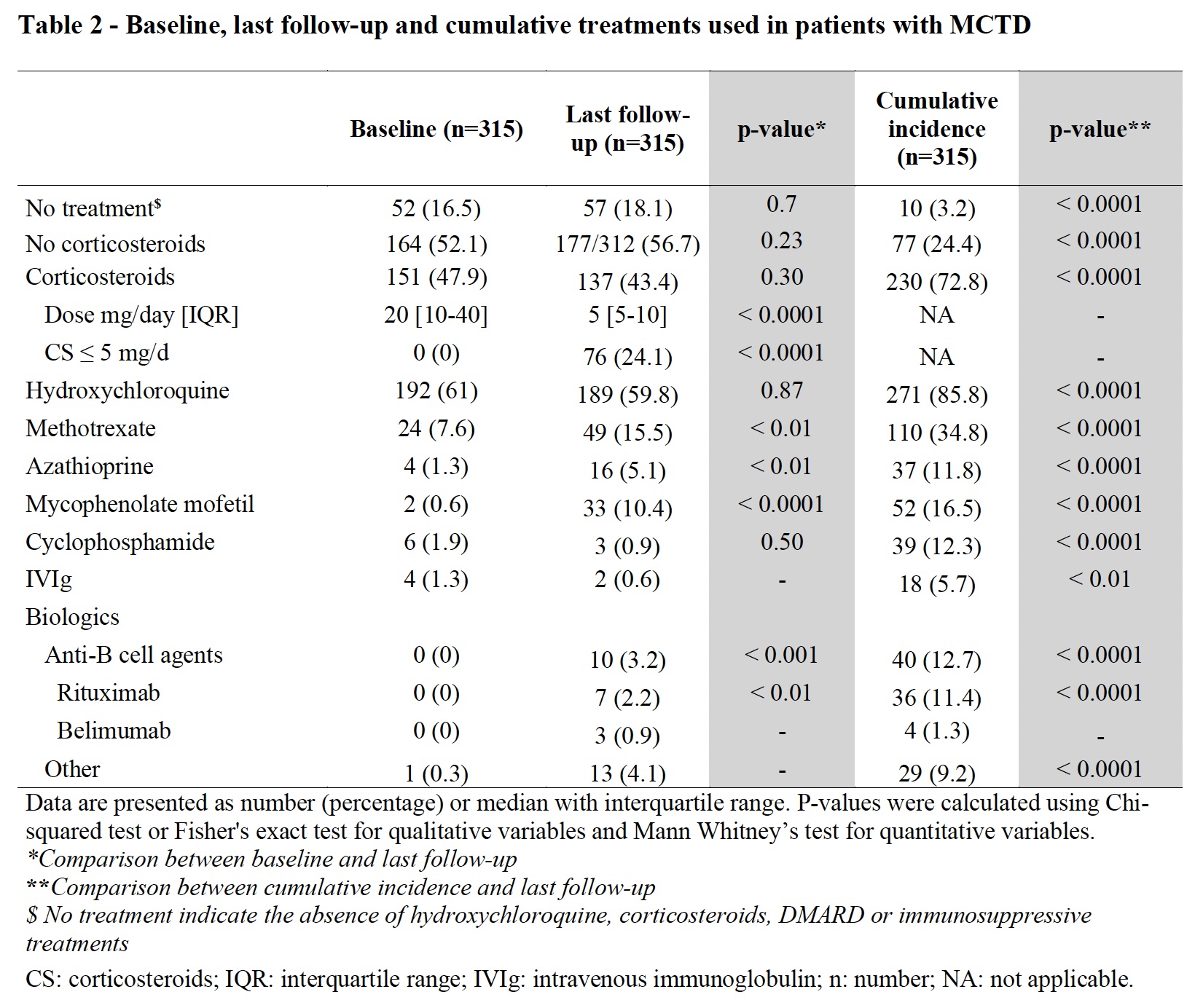
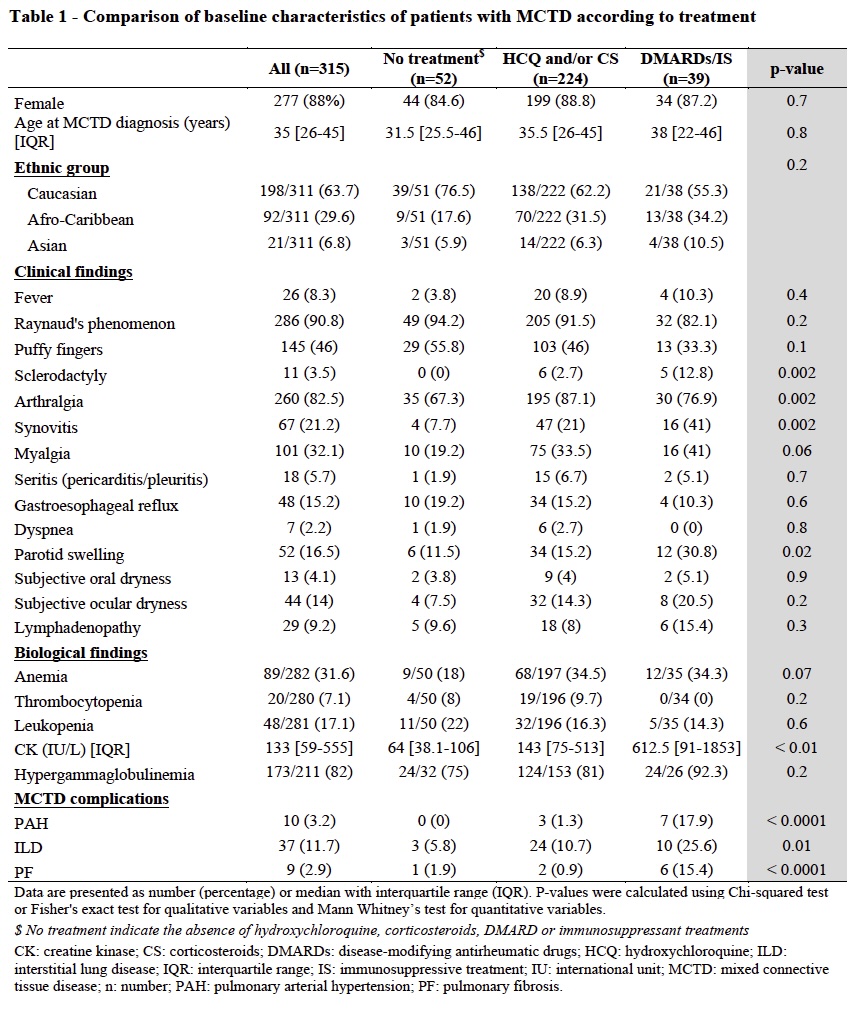
Results: Of the 330 MCTD patients enrolled in the French MCTD cohort, 315 (96%) were included and followed up during 96 [40-156] months. Patient’s main characteristics and treatments are described in Table 1 and Table 2. At disease onset, 52 (17%) patients were treated with calcium channel blockers and/or nonsteroidal anti-inflammatory drugs only and/or no treatment at all, while 36 (11%) were treated with corticosteroids (CS) alone, 188 (60%) with hydroxychloroquine (HCQ) without disease-modifying antirheumatic drugs (DMARDs) or immunosuppressive treatment (IS), and 39 (12%) with DMARDs and/or IS. At LFU, patients received a lower median dose of CS compared to baseline (5 [5-10] vs 20 [10-40] mg/day; p< 0.001) and more frequently received DMARDs and/or IS than at baseline (p< 0.001). Overall, 10 (3%) patients remained treatment-free, 77 (24%) CS-free, and 148 (47%) were only treated with HCQ and/or low-dose CS at LFU. Among IS, anti-B cell agents were used in 39 (12%) patients during follow-up.

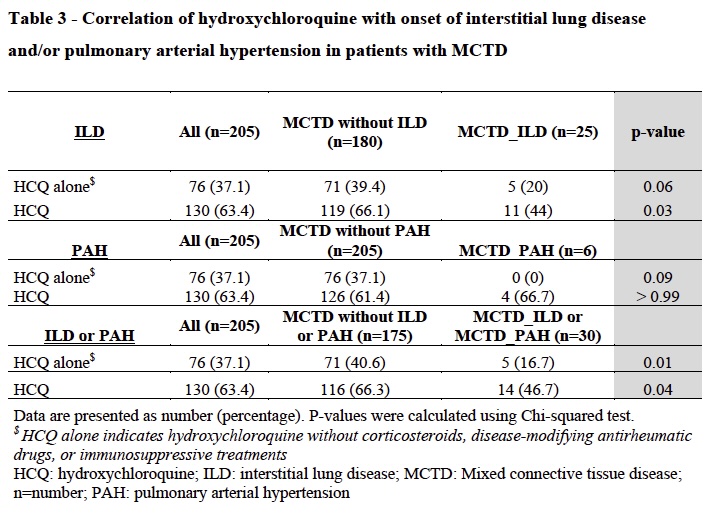
At baseline, patients with sclerodactyly (p=0.002), synovitis (p=0.002), dyspnea (p=0.02), pulmonary arterial hypertension (PAH) (p< 0.0001), interstitial lung disease (ILD) (p=0.01), pulmonary fibrosis (p< 0.0001), and elevated CK (p< 0.01), received significantly more frequently DMARDs and/or IS than others. When comparing MCTD patients who evolved to a differentiated CTD (MCTD-dCTD, n=86; 27%) to patients who remained classified as MCTD, MCTD-dCTD patients were less frequently treated with HCQ (± CS) (23 (27%) vs 144 (46%), p< 0.0001) and were more often treated with a DMARD and/or IS (61 (71%) vs 100 (44%), p< 0.0001). At LFU, they were less frequently treatment-free (7 (8%) vs 51 (22%), p< 0.01) and received higher doses of CS (median dose of 7.5 [5-10] vs. 5 [5-10] mg/day, p=0.004) than MCTD patients. Development of ILD and/or PAH, as well as ILD alone, was associated with a less frequent use of HCQ at baseline (p< 0.05) (Table 3).

Conclusion: Treatments prescribed in patients with MCTD reflect the wide spectrum of the disease. HCQ and CS are cornerstones of the treatment and are sufficient in nearly half of MCTD patients, reflecting the good prognosis of this disease. MCTD-dCTD patients more often require DMARDs or IS. This work suggests that HCQ could prevent the development of life-threatening complications in MCTD.

1. Chevalier K, et al. J Intern Med. 2023
Supporting image 1

Table 1 – Comparison of baseline characteristics of patients with MCTD according to treatment

Supporting image 2

Table 2 – Baseline, last follow-up and cumulative treatments used in patients with MCTD

Supporting image 3

Table 3 – Correlation of hydroxychloroquine with onset of interstitial lung disease and/or pulmonary arterial hypertension in patients with MCTD


Disclosures: K. Chevalier: None; B. Thoreau: None; M. Michel: None; B. Godeau: None; C. AGARD: None; T. Papo: None; K. Sacré: None; R. Seror: Amgen, 6, Boehringer-Ingelheim, 2, Bristol-Myers Squibb(BMS), 2, GlaxoSmithKlein(GSK), 2, Janssen, 2, Pfizer, 6, Roche, 6; X. Mariette: Bristol-Myers Squibb(BMS), 2, Galapagos, 2, GlaxoSmithKlein(GSK), 2, Novartis, 2, Pfizer, 2; P. Cacoub: None; Y. Benhamou: None; H. Levesque: None; C. Goujard: None; O. Lambotte: None; B. Bonnotte: None; M. SAMSON: AstraZeneca; Novartis; CSL Vifor; GlasgowSmithKline; Chugai; BOEHRINGER; FRESENIUS KABI, 2; F. Ackermann: None; J. Schmidt: None; P. Duhaut: None; J. Kahn: None; T. Hanslik: None; N. Costedoat-chalumeau: Bristol-Myers Squibb(BMS), 1; B. Terrier: AstraZeneca, 2, GlaxoSmithKline, 2, Novartis, 2, Vifor Pharma, 2; A. Régent: None; b. Dunogue: None; P. cohen: None; V. LE GUERN: None; E. Hachulla: None; L. Mouthon: None; B. Chaigne: None.

To cite this abstract in AMA style:

Chevalier K, Thoreau B, Michel M, Godeau B, AGARD C, Papo T, Sacré K, Seror R, Mariette X, Cacoub P, Benhamou Y, Levesque H, Goujard C, Lambotte O, Bonnotte B, SAMSON M, Ackermann F, Schmidt J, Duhaut P, Kahn J, Hanslik T, Costedoat-chalumeau N, Terrier B, Régent A, Dunogue b, cohen P, LE GUERN V, Hachulla E, Mouthon L, Chaigne B. ­­­Therapeutic Strategy in Patients with Mixed Connective Tissue Disease: A Multicenter Retrospective Study in the French MCTD Cohort [abstract]. Arthritis Rheumatol. 2024; 76 (suppl 9). https://acrabstracts.org/abstract/therapeutic-strategy-in-patients-with-mixed-connective-tissue-disease-a-multicenter-retrospective-study-in-the-french-mctd-cohort/. Accessed .

ACR Meeting Abstracts - https://acrabstracts.org/abstract/therapeutic-strategy-in-patients-with-mixed-connective-tissue-disease-a-multicenter-retrospective-study-in-the-french-mctd-cohort/

My Favorites

Save and print abstracts during your browser session by clicking the “Favorite” button at the bottom of any abstract (must have cookies enabled in browser). See saved favorites.

Abstract Policies

  • ACR Convergence Abstract Embargo Policies
  • ACR Convergence Abstract Permissions & Reprints
  • PRSYM Abstract Policies

ACR Convergence. Where Rheumatology Meets

ACR Convergence 2026

Join us November 6-11 in Orlando, Florida.
See Registration Information

  • Contact ACR
  • Privacy Policy
  • ACR Policies
  • Cookie Preferences

© Copyright 2026 American College of Rheumatology