
Session Information
Date: Sunday, October 26, 2025
Title: (0593–0640) Systemic Lupus Erythematosus – Diagnosis, Manifestations, & Outcomes Poster I
Session Type: Poster Session A
Session Time: 10:30AM-12:30PM
Background/Purpose: The Systemic Lupus International Collaborating Clinics Frailty Index (SLICC-FI) was developed to ascertain frailty in systemic lupus erythematosus (SLE) patients. The aim of this study is to evaluate the SLICC-FI as a predictor of self-efficacy in patients from a prevalent Latin American Mestizo lupus cohort.
Methods: Patients from a single-center lupus cohort were included in these analyses. Self-efficacy was ascertained with the Patient-Reported Outcomes Measurement Information System (PROMIS) self-efficacy for managing chronic conditions. Frailty was ascertained using the SLICC-FI. Results are shown as means and standard deviations or numbers and percentages, as appropriate. Generalized estimating equations were performed, using each domain of the PROMIS self-efficacy as an outcome in the subsequent visit and the SLICC-FI (as a continuous variable) in the previous visit. Alternative analyses were also carried out including the SLICC-FI as a categorical variable (frail versus non frail). In both approaches, the multivariable models were adjusted for possible confounders (age at diagnosis, sex, socioeconomic status, ethnicity, Systemic Lupus Erythematosus Disease Activity Index-2000 (SLEDAI-2K), SLICC/American College of Rheumatology Damage Index (SLICC/ACR or SDI), disease duration, prednisone daily dose, antimalarial and immunosuppressive drug use, and the same domain of the PROMIS self-efficacy in the previous visit). Statistical significance set at p< 0.05.
Results: Three-hundred and seventy SLE patients and 1561 visits were included in this study; these patients were followed for 4.9 (3.7) years; 342 (92.4%) were women and the age of diagnosis was 35.2 (13.4) years. At baseline, the disease duration was 1.01 (7.4) years, while SDI and SLICC-FI scores were 1.3 (1.5) and 0.17 (0.05), respectively. Eighty patients (21.6%) were classified as frail, 270 (73.0%) were classified as least fit, 20 (5.4%) were classified as less fit, and no patient was classified as robust. At baseline, of the PROMIS general self-efficacy was 47.3 (9.8), self-efficacy for managing emotions was 44.8 (7.5), for managing symptoms was 47.4 (7.5), for managing daily activities was 45.5 (7.2), for managing social interactions was 42.4 (7.6) and for managing medications and treatment was 43.8 (7.5). In the main analyses, after adjusting by possible confounders, the SLICC-FI scores predicted worse general self-efficacy and worse self-efficacy for managing daily activities; these data are depicted in Table 1. In the alternative analyses, the frail category, predicted worse general self-efficacy and worse self efficacy for managing daily activities, after adjustment by possible confounders; these data are depicted in Table 2.
Conclusion: The SLICC-FI predicts worse self-efficacy as assessed by the PROMIS self-efficacy for managing chronic conditions in a prevalent Latin American lupus cohort, supporting the relevance of this index in the evaluation of these patients.
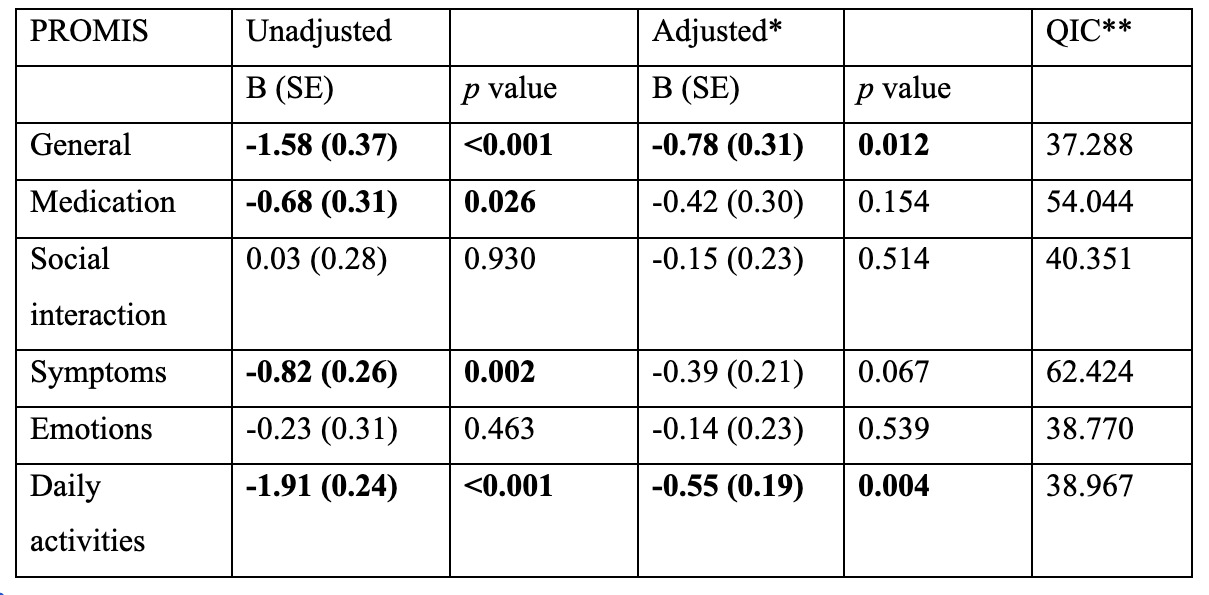 Table 1: The predictive value of the SLICC-FI (as a continuous variable) on PROMIS self-efficacy for managing chronic conditions in SLE patients
*Adjusted for age at diagnosis, sex, ethnicity, socioeconomic status, Systemic Lupus Erythematosus Disease Activity Index-2000 (SLEDAI-2K), Systemic Lupus Erythematosus International Collaborating Clinics/American College of Rheumatology Damage Index (SLICC/ACR DI), disease duration at baseline, prednisone daily dose, antimalarial, immunosuppressive drugs use and the same domain of self-efficacy from the previous visit.
**QIC – Quasi-likelihood Information Criterion value to assess model fit
.jpg) Table 2: The predictive value of frailty (as a categorical variable) on PROMIS self-efficacy for managing chronic conditions in SLE patients
Table 2: The predictive value of frailty (as a categorical variable) on PROMIS self-efficacy for managing chronic conditions in SLE patients
*Adjusted for age at diagnosis, sex, ethnicity, socioeconomic status, Systemic Lupus Erythematosus Disease Activity Index-2000 (SLEDAI-2K), Systemic Lupus Erythematosus International Collaborating Clinics/American College of Rheumatology Damage Index (SLICC/ACR DI), disease duration at baseline, prednisone daily dose, antimalarial, immunosuppressive drugs use and the same domain of self-efficacy from the previous visit.
**QIC – Quasi-likelihood Information Criterion value to assess model fit
To cite this abstract in AMA style:
Singh A, Gamboa-Cárdenas R, Pimentel-Quiroz V, Rodriguez-Bellido Z, Pastor-Asurza C, Perich-Campos R, Ugarte-Gil M, Alarcón G. The Systemic Lupus International Collaborating Clinics Frailty Index (SLICC-FI) Predicts Worsening Self-Efficacy in the Patients from the Almenara Lupus Cohort [abstract]. Arthritis Rheumatol. 2025; 77 (suppl 9). https://acrabstracts.org/abstract/the-systemic-lupus-international-collaborating-clinics-frailty-index-slicc-fi-predicts-worsening-self-efficacy-in-the-patients-from-the-almenara-lupus-cohort/. Accessed .« Back to ACR Convergence 2025
ACR Meeting Abstracts - https://acrabstracts.org/abstract/the-systemic-lupus-international-collaborating-clinics-frailty-index-slicc-fi-predicts-worsening-self-efficacy-in-the-patients-from-the-almenara-lupus-cohort/