
Session Information
Date: Tuesday, November 10, 2015
Title: Systemic Lupus Erythematosus - Clinical Aspects and Treatment Poster Session III
Session Type: ACR Poster Session C
Session Time: 9:00AM-11:00AM
Background/Purpose:
Cognitive
dysfunction (CD) significantly affects SLE patients with many contributing
causal factors. The effect of disease activity on cognitive function remains
unclear and currently there is no definitive measure for CD in SLE. Functional
magnetic resonance imaging (fMRI) provides a sensitive measure of brain
functionality during cognitive tasks. The limited studies using fMRI in SLE
have shown that SLE patients employ compensatory brain mechanisms to maintain
adequate cognitive function. The aim of this study is to investigate fMRI as a
potential biomarker for CD in SLE and examine other factors that affect CD in
SLE.
Methods:
Data
from 12 healthy controls (HC), 9 SLE patients with active disease (SLE-F) and 15
stable SLE patients (SLE-S) were analysed. SLE patients met ACR 1997 criteria. Basic
demographic, disease and mood variables were collected. We also performed two
fMRI tasks; the n-back (working memory task) and the facial emotional recognition
task (FERT). The n-back had three levels (0-, 1-, and 2- back) with the 2-back being
the most difficult. The FERT displayed faces expressing different emotions:
happiness, sadness, fear and neutral. Both tasks were preprocessed and modelled
using SPM12. The out of scanner variables and region of interest (ROI) data
extracted from the fMRI tasks were analysed using SPSS 22.
Results:
Participants
were matched on demographic and clinical variables except for the SLEDAI score
and steroid dose where, as expected, the SLE-F group scored higher. The SLE-F
patients had significantly higher depression scores than the SLE-S and HC. The
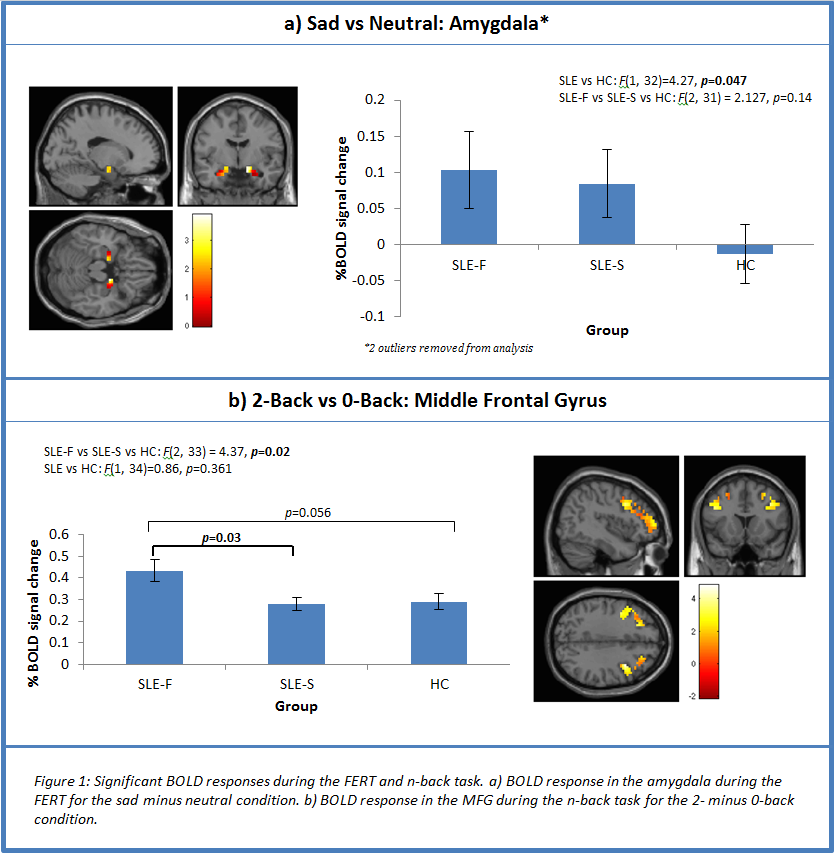
FERT mean results for the amygdala (sad vs neutral condition) were significantly
different when comparing all SLE participants to the HC group. The n-back task
showed a significant difference in the blood-oxygen-level dependent (BOLD)
response for the 2- vs 0-back condition in the middle frontal gyrus (MFG), with
an increased response for the SLE-F group compared to the other two groups.
Conclusion:
We
found an increased BOLD response using the n-back in the MFG but only in the
SLE-F group. This combined with the FERT amygdala result suggests that CD in
SLE is affected by both disease activity and mood disorders. Functional MRI
biomarkers may help differentiate features of CD in SLE patients related to disease
activity and aid better targeting of relevant pathways for interventions in
this condition.
This independent research is funded by Genzyme in the context of
the ISS Program.
|
Table 1: Group comparisons of demographic, disease and mood variables |
|||||
|
Variable |
SLE-F (n=9) Mean (SD) Median (IQR) |
SLE-S (n=15) Mean (SD) Median (IQR) |
HC (n=12) Mean (SD) Median (IQR) |
Test statistic |
Post hoc – significant results |
|
Demographics |
|||||
|
Age (yrs)* |
39 (20.5, 48.5) |
40 (33.3, 50.8) |
36 (32.3, 49.5) |
H(2) = 1.71, p=0.42 |
n/a |
|
Sex (% female) |
100 |
100 |
100 |
n/a |
n/a |
|
Handedness (% right-handed) |
78 |
81 |
92 |
χ2 (2) = 0.86, p=0.65 |
|
|
Disease |
|||||
|
Disease duration (yrs) |
8.56 (4.53) |
13.00 (8.08) |
n/a |
F(1, 23) = 2.29, p=0.14 |
n/a |
|
ACR criteria ever |
7.11 (1.27) |
5.94 (1.44) |
n/a |
F(1, 23) = 4.16, p=0.05 |
n/a |
|
SLEDAI-2K |
5.78 (3.53) |
1.50 (1.59) |
n/a |
F(1, 23) = 17.62, p<0.001 |
n/a |
|
Steroid dose (mg)* |
5 (20) |
0 (3.8) |
0 |
H(2) = 9.385, p=0.01 |
HC vs SLE-F |
|
Mood |
|||||
|
BDI score* |
22 (13, 26.5) |
7.5 (0, 11.8) |
1 (0, 3.8) |
H(2) = 15.85, p<0.001 |
HC vs SLE-F SLE-S vs SLE-F |
|
MADRS* |
9.5 (2.8, 13.5) |
1 (0, 5.5) |
1 (1, 0) |
H(2) = 8.55, p=0.01 |
HC vs SLE-F |
|
*Post-hoc statistics: significant p-value set to 0.167 to account for multiple comparisons. ACR: American College of Rheumatology SLE criteria SLEDAI: Systemic Lupus Erythematosus Disease Activity Index BDI-II: Beck’s Depression Inventory II MADRS: Montgomery Asberg Depression Rating Scale |
|||||
To cite this abstract in AMA style:
Barraclough M, Elliott R, McKie S, Parker B, Bruce IN. The Effects of Disease Activity and Mood Disorders on Cognitive Function in Systemic Lupus Erythematosus [abstract]. Arthritis Rheumatol. 2015; 67 (suppl 10). https://acrabstracts.org/abstract/the-effects-of-disease-activity-and-mood-disorders-on-cognitive-function-in-systemic-lupus-erythematosus/. Accessed .« Back to 2015 ACR/ARHP Annual Meeting
ACR Meeting Abstracts - https://acrabstracts.org/abstract/the-effects-of-disease-activity-and-mood-disorders-on-cognitive-function-in-systemic-lupus-erythematosus/