
Session Information
Date: Wednesday, November 16, 2016
Title: Rheumatoid Arthritis – Clinical Aspects VI: Management of Early Rheumatoid Arthritis
Session Type: ACR Concurrent Abstract Session
Session Time: 9:00AM-10:30AM
Background/Purpose:
Anti-acetylated-peptide antibodies (AAPA) have recently been described in rheumatoid arthritis (RA) patients and may be used as a further diagnostic marker in patients with early arthritis. In this study we aimed to determine the prevalence of AAPA in a cohort of RA patients starting their first conventional synthetic DMARD treatment (csDMARD) and additionally evaluated the usefulness of AAPA as potential predictors of clinical response to methotrexate (MTX) therapy.Methods:
We measured IgG and IgA AAPA by ELISA using two acetylated peptides derived from vimentin. We tested by regression, parametric and non-parametric analyses of disease activity measures if AAPA show potency for predicting response to MTX.Results:
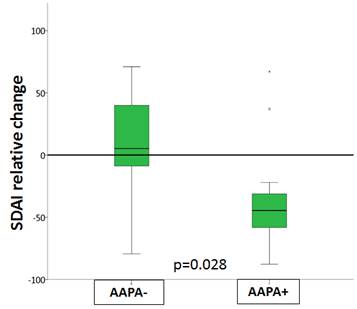
IgG and/or IgA AAPA were detected in 74.5% of the 110 RA patients who stated MTX treatment: 49% were positive for either IgA or IgG antibodies and 25.5% were IgA/IgG double positive. In the AAPA positive patients, 73.6% were positive for IgG AAPA while 26.4% showed IgA antibodies. Importantly, of the 36.4% of patients negative for both RF and ACPA (double negative), 55% were positive for IgG and/or IgA AAPA, and the remaining patients (i.e. 16% of the total cohort) were completely seronegative (triple-negative), see Table. When comparing triple negative patients with the AAPA positive double-negative ones, no significant difference in baseline characteristics was found but a trend that patients with more seroreactivities showed higher composite disease activity scores. Analyzing the clinical response to MTX, IgG-AAPA positive double-negative patients showed a significantly greater relative SDAI change after 6 months compared to triple-negative patients (p=0.028; median (IQR): -44.6% (-58.5 – -28.90) vs. 5.26% (-23.9 – 55.5%) (Figure). In addition, there was a significantly greater relative change in CRP (p=0.035) and erythrocyte sedimentation rate (p=0.003) in AAPA positive double-negative patients . Table: Crosstable of status of RF, ACPA and antiacetylated peptide antibodies|
Anti-acetylated peptide antibodies |
||||
| Negative | IgA or IgG positive | IgA and IgG positive | Total | |
| Negative | 16.4% | 16.4% | 3.6% | 36.4% |
| RF | 3.6% | 3.6% | 2.7% | 10% |
| ACPA | .9% | 1.8% | 0.9% | 3.6% |
| RF+ACPA | 4.5% | 27.3% | 18.2% | 50% |
| Total | 25.5 | 49.1 | 25.4 | 100% |
Figure: Boxplots of relative changes of simplified disease activity score (SDAI) in RF and ACPA negative patients, shown for anti-acetylated (AAPA) positive and negative patients
Conclusion: AAPA commonly occur in RA patients . Measuring AAPA in addition to RF and ACPA reduced the prevalence of seronegative patients by more than 50 %. These AAPA positive but RF and ACPA negative patients responded significantly better to MTX. Therefore, AAPA positivity in RF and ACPA negative patients identifies a subgroup of patients with a more favorable response to MTX.
To cite this abstract in AMA style:
Studenic P, Blüml S, Bang H, Unger M, Raza K, Aletaha D, Smolen JS, Steiner G. The Diagnostic and Predictive Value of Anti-Acetylated Peptide Antibodies in RA Patients Starting Methotrexate Treatment [abstract]. Arthritis Rheumatol. 2016; 68 (suppl 10). https://acrabstracts.org/abstract/the-diagnostic-and-predictive-value-of-anti-acetylated-peptide-antibodies-in-ra-patients-starting-methotrexate-treatment/. Accessed .« Back to 2016 ACR/ARHP Annual Meeting
ACR Meeting Abstracts - https://acrabstracts.org/abstract/the-diagnostic-and-predictive-value-of-anti-acetylated-peptide-antibodies-in-ra-patients-starting-methotrexate-treatment/