
Session Information
Date: Friday, November 6, 2020
Title: Miscellaneous Rheumatic & Inflammatory Diseases Poster I: Diagnosis and Testing
Session Type: Poster Session A
Session Time: 9:00AM-11:00AM
Background/Purpose: Inflammation of the bicipital tendon contributes heavily to shoulder joint morbidity. To date, diagnosis of bicipital tendinitis has relied on physical exam findings, particularly Yergason’s sign and the Speed’s test (ST). These tests have fallen out of fervent use due to their relative insensitivity. In this study, we introduce a novel diagnostic paradigm, the Bicipital Stress Test (BST), with improved sensitivity in comparison to previously standard tests.
Methods: This retrospective cohort study reviewed 151 patients over a six-month period. Patients were included who presented with upper body pain and whose exam demonstrated a positive ST and/or BST. Given a positive test, a treatment paradigm was utilized, and patients were reevaluated at four to six-week intervals for clinical improvement. Statistical analysis determined the sensitivity and specificity of the BST.
Results: The BST identified 248 positive upper extremities versus 71 for the traditional ST test. In every case that the ST test was positive, the BST was also positive.
Conclusion: Physical examination techniques of the upper extremity have been described but are infrequently utilized in clinical practice; this is due to the relative insensitivity of the most well-known tests for bicipital tendinitis, Yergason’s sign (43%) and the ST (32%). The BST is a more sensitive test in diagnosing bicipital tendinitis. The clinical validity of the BST is supported by normalization of the physical exam and improvement in symptomatology following treatment of a positive test. Implementation of the BST yields early detection, accurate diagnosis, and successful treatment of bicipital tendinitis and its referred pain patterns.
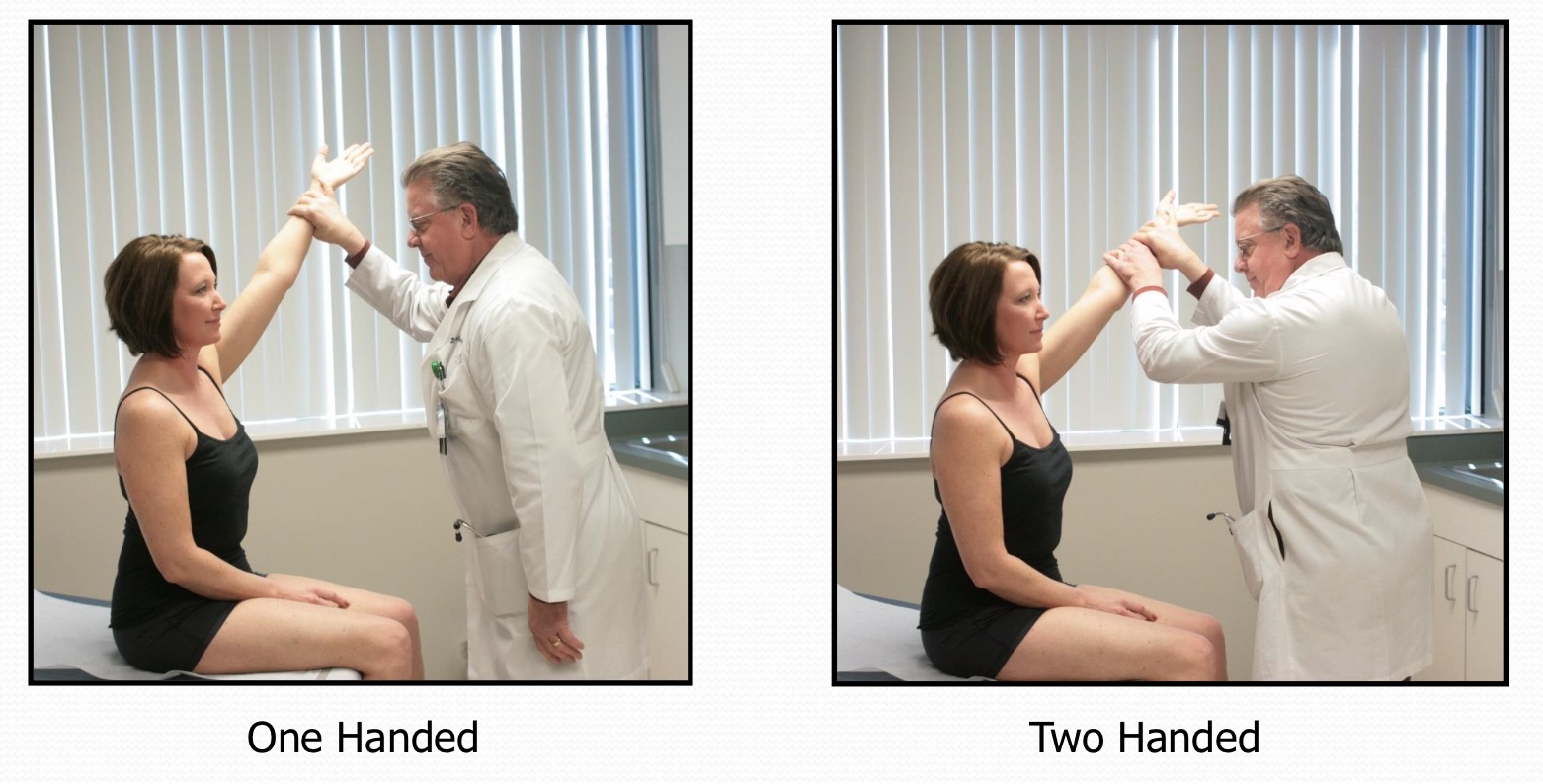 Figure 1. The Bicipital Stress Test. In the BST, the clinician faces the seated patient. The shoulder is forward flexed to 120 degrees, abducted to 30 degrees, and the arm is in the supinated position. The examiner then places direct downward force at the wrist. Inability to maintain position against forceful downward pressure is the key that determines a positive test.
To cite this abstract in AMA style:
Thomley M, Spalding D, Preda-Naumescu A, Waldrop R. The Bicipital Stress Test: A Maneuver to More Accurately Diagnose Bicipital Tendinitis and Its Referred Pain Patterns [abstract]. Arthritis Rheumatol. 2020; 72 (suppl 10). https://acrabstracts.org/abstract/the-bicipital-stress-test-a-maneuver-to-more-accurately-diagnose-bicipital-tendinitis-and-its-referred-pain-patterns/. Accessed .« Back to ACR Convergence 2020
ACR Meeting Abstracts - https://acrabstracts.org/abstract/the-bicipital-stress-test-a-maneuver-to-more-accurately-diagnose-bicipital-tendinitis-and-its-referred-pain-patterns/