
Session Information
Session Type: Abstract Session
Session Time: 10:30AM-11:30AM
Background/Purpose: The SARS-COVID-19 pandemic has had a substantial, predominantly negative impact on rheumatology training and on overall trainee well-being. During the early stages of the pandemic, from March 2020 to August 2020, it was found that in-person rheumatology visits decreased by 10.9% and rheumatology telemedicine visits increased from 0% to 12.1%. Trainees and faculty have had to teach virtual care without formal training in video visit communication and clinical skills and lack of well-developed video visit entrustable professional activity guidelines.
Methods: We developed 4 rheumatology video visit scenarios to be used in the rheumatology observed clinical skills exam (ROSCE). The visits were designed to be follow-up visits and the patients’ background history was provided. The cases were gout with recent exacerbation, stable rheumatoid arthritis, fibromyalgia and osteoporosis.
Each trainee completed pre and post ROSCE surveys where they reported self-assessments regarding telemedicine, self-perceived clinical knowledge in the ROSCE clinical cases. The t quality of the ROSCE cases and self-reported future video visit practice opportunities were also analyzed. Feedback was provided by standardized patients and by faculty after incorporating specific telemedicine milestones as suggested by the ACR and the ACGME.
Results: 22 trainees (17 residents and 5 rheumatology fellows) complete the ROSCE. Evaluations from 100% of participants were obtained. Standardized patient assessments and ROSCE faculty assessment of trainees demonstrated a high degree of quantitative and qualitative concordance. Trainees excelled at verbal, non verbal communication skills and on information gathering but needed improvement on telemedicine focused physical exams and on specific case related counseling of the patients.
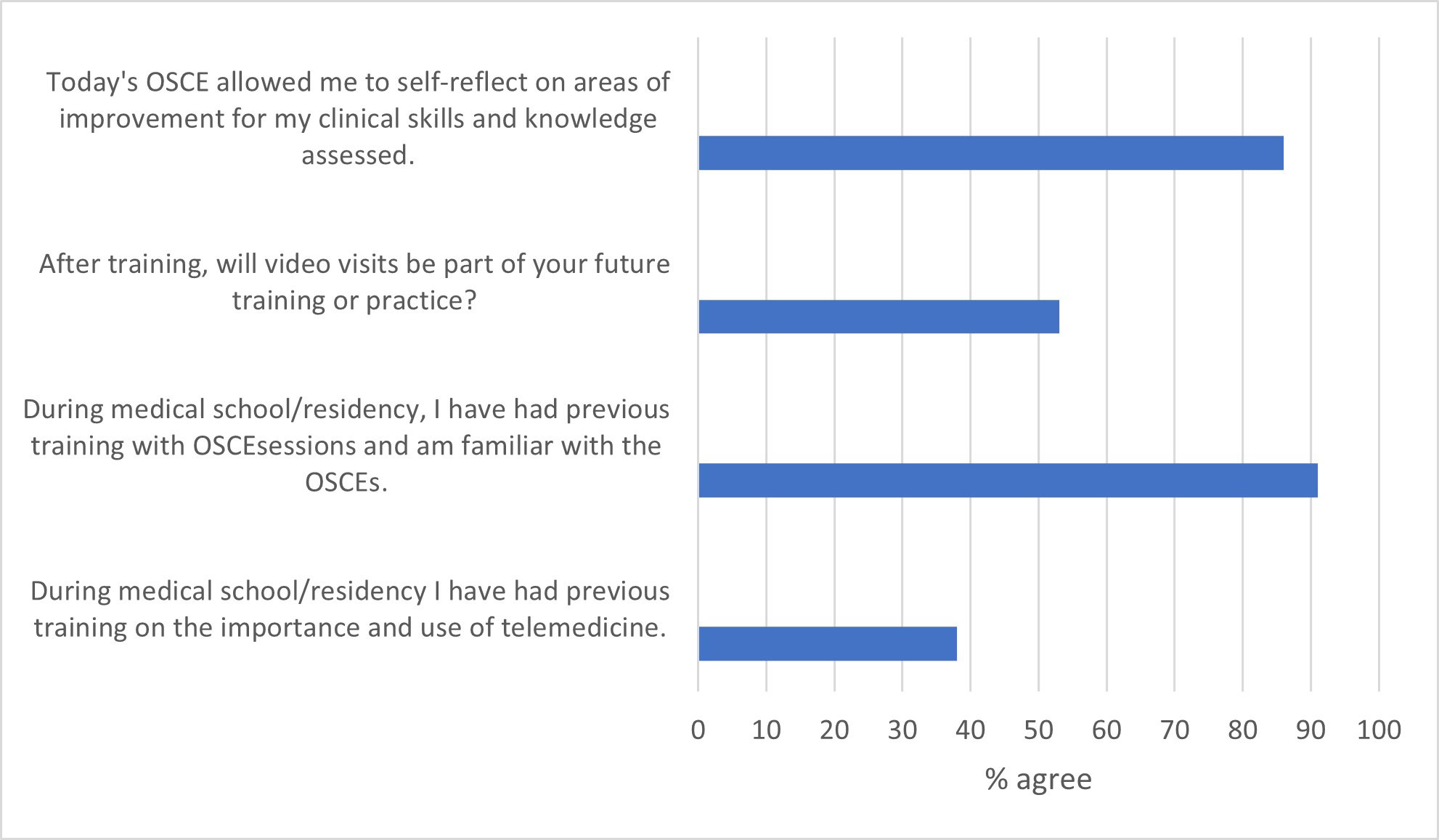
In debrief, 62% of the trainees reported having no prior training on telemedicine, but 91% had previous experience with OSCEs. 100% of trainees felt that the experience met their expectations, with 95% reporting that the instructions were clear, and time was adequate for each case. 81% of the trainees felt that the cases were between average to good quality. Most trainees evaluated the fibromyalgia (3.85/5) and gout cases (3.77/5) as the cases with the self-perceived higher quality.
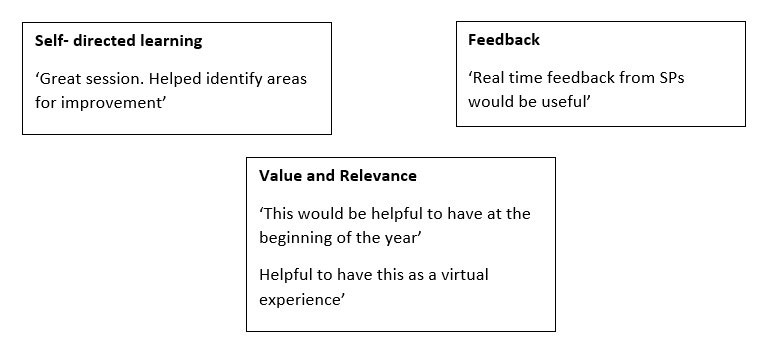
60% of trainees felt that video visits would be relevant to their future clinical career. 87% of trainees reported that the exercise allowed them to self-reflect on areas of improvement.
Conclusion: The rapid deployment and continued patient use of video visits necessitates the need to develop standardized assessments. Our ROSCE, allowed trainees an opportunity to practice and demonstrate virtual visit skills and provided a novel assessment tool to address specific knowledge and clinical skills gaps for synchronous video visits. We recommend that training programs incorporate video visit ROSCE for trainee assessments into the curriculum

To cite this abstract in AMA style:
Priyanka I, Emilie C. TeleRheumatology in the COVID Era: Preparing Trainees for Virtual Care Using an Observed Clinical Skills Exam (OSCE) [abstract]. Arthritis Rheumatol. 2022; 74 (suppl 9). https://acrabstracts.org/abstract/telerheumatology-in-the-covid-era-preparing-trainees-for-virtual-care-using-an-observed-clinical-skills-exam-osce/. Accessed .« Back to ACR Convergence 2022
ACR Meeting Abstracts - https://acrabstracts.org/abstract/telerheumatology-in-the-covid-era-preparing-trainees-for-virtual-care-using-an-observed-clinical-skills-exam-osce/