
Session Information
Date: Sunday, October 26, 2025
Title: Abstracts: Orthopedics, Low Back Pain, & Rehabilitation (0783–0788)
Session Type: Abstract Session
Session Time: 1:00PM-1:15PM
Background/Purpose: People with knee osteoarthritis (OA) have higher fall rates than their age-matched peers. Studies in another at-risk group, healthy older adults, have linked fall risk to shorter step lengths, narrower stride width, and slower walking speed. These spatiotemporal gait characteristics are also affected by knee OA, but it remains unclear whether they differ between those with a history of falls and those without. Therefore, we tested the hypothesis that spatiotemporal gait characteristics would differ between fallers and non-fallers with knee OA. We also investigated the potential influence of pain catastrophizing and physical activity as representative psychological and behavioral variables that may either influence or be influenced by a history of falls.
Methods: We categorized 22 women and 14 men with knee OA (age 57 ± 9 years) into fallers and non-fallers based on the question: “Have you experienced a fall in the past 12 months?” Gait data were collected during walking trials on an instrumented split-belt treadmill at each participant’s preferred speed. Spatiotemporal variables included walking speed, step length and step width normalized to height, cadence, and double limb support time. Surveys were completed prior to testing, and we used the KOOS pain sub-score, the Pain Catastrophizing Scale, and the UCLA activity score for this analysis. We used independent T-Tests to compare variables between fallers and non-fallers, and linear regression, controlling body mass, for further analyses.
Results: Twelve participants (33%) were classified as fallers. Although walking speeds were similar between the groups (Table 1), fallers walked with significantly shorter steps and higher cadences than non-fallers. Fallers also had significantly narrower step widths. A regression model in which walking speed was the independent variable and step length, cadence, fall status, and fall interaction terms were the dependent variables, showed that the association between step length and speed differed by fall status. Additional models demonstrated that higher UCLA scores were associated with longer step lengths (p=0.054) and faster walking speeds (p = 0.005), and lower double limb support times (p < 0.000). Higher pain catastrophizing was associated with lower cadence in fallers (p = 0.052).
Conclusion: Gait patterns differ between fallers and non-fallers with knee OA, with fallers taking shorter, narrower, and more frequent steps, despite similar speeds. While this strategy may help maintain pace, it may come at the cost of balance and stability. Narrower step width is especially concerning as it reduces the base of support during walking. Psychological and behavioral factors had a complex relationship with fall history. For example, higher physical activity levels were associated with both more favorable and less stable gait attributes. Taken together, these results suggest that addressing modifiable psychological and behavioral factors in conjunction with gait biomechanics may be important for improving function and reducing fall risk in this population.
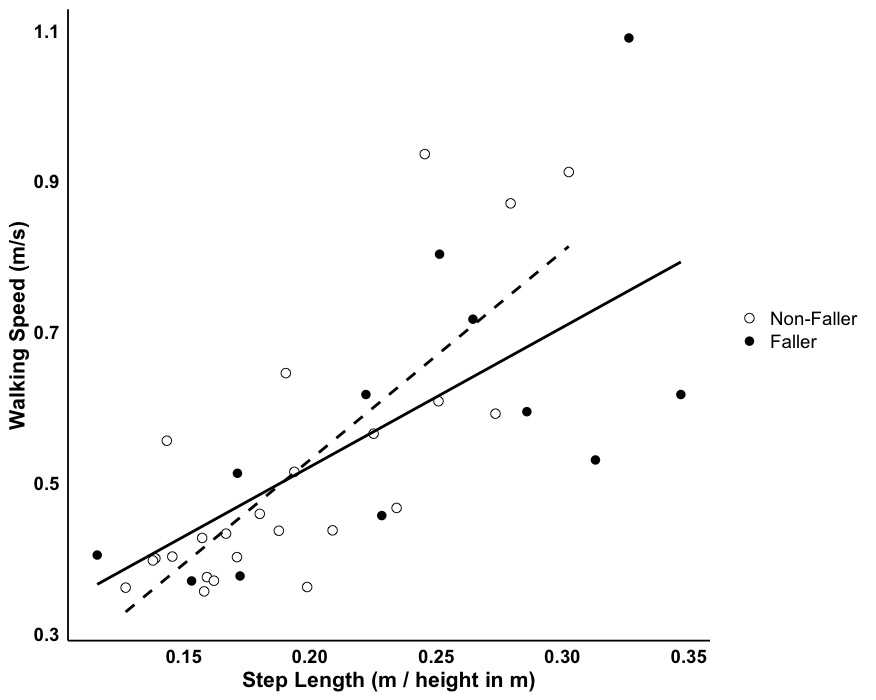 Table 1. Spatiotemporal gait characteristics during level treadmill walking at self-selected speeds for fallers (N = 12) and nonfallers (N = 24) with knee OA.
.jpg) Figure 1: Association between normalized step length and walking among fallers and non-fallers with knee osteoarthritis.
Figure 1: Association between normalized step length and walking among fallers and non-fallers with knee osteoarthritis.
Disclosures: J. Itodo: None; S. Garcia: None; O. Peters: None; O. Ogundiran: None; K. Foucher: None.
To cite this abstract in AMA style:
Itodo J, Garcia S, Peters O, Ogundiran O, Foucher K. Spatiotemporal Gait Differences Between Fallers and Non-Fallers in People with Knee Osteoarthritis [abstract]. Arthritis Rheumatol. 2025; 77 (suppl 9). https://acrabstracts.org/abstract/spatiotemporal-gait-differences-between-fallers-and-non-fallers-in-people-with-knee-osteoarthritis/. Accessed .« Back to ACR Convergence 2025
ACR Meeting Abstracts - https://acrabstracts.org/abstract/spatiotemporal-gait-differences-between-fallers-and-non-fallers-in-people-with-knee-osteoarthritis/