
Session Information
Date: Monday, November 8, 2021
Title: Systemic Sclerosis & Related Disorders – Clinical Poster II (1364–1390)
Session Type: Poster Session C
Session Time: 8:30AM-10:30AM
Background/Purpose: Interstitial lung disease (ILD) and pulmonary arterial hypertension (PAH) are the leading causes of death in Systemic Sclerosis (SSc). Markers for early detection of these pulmonary complications are urgently needed. The receptor for advanced glycation endproducts (RAGE) is highly expressed in lung tissue. RAGE is involved in cell-matrix adhesion, proliferation and migration of alveolar epithelial cells, and remodeling of pulmonary vasculature. Therefore, we aimed to investigate soluble RAGE (sRAGE) in its association with current and future incidence of SSc-related pulmonary complications.
Methods: In a case-control study, sRAGE levels in 20 patient with SSc (age 51 (44-58) years, 13 female, disease duration since first non-RP 2 (1-8) years, 50% lung involvement, 40% gastrointestinal involvement) were compared with 20 age- and sex matched healthy controls (age 52 (45-62) years, 14 female). Subsequently, sRAGE was measured in an independent retrospective cohort of 188 patients with SSc (64 years (55-72), 145 female, 60% ACA positive, 89% limited SSc, 83% sclerodactyly, 53% history of pitting scars or digital ulcers, 74% telangiectasia, 36% calcinosis cutis, 68% gastrointestinal involvement) who were followed for the long-term occurrence of pulmonary events and mortality. Levels of sRAGE were measured by an enzyme-linked immunosorbent assay in serum.
Results: Serum sRAGE levels were significantly higher in patients with SSc compared with controls (fig. 1). In the second cohort, levels of sRAGE were significantly lower (median 735.0 pg/ml [IQR 525.5-1988.5], p = 0.001) in SSc-ILD (n=41) and higher in SSc-PAH (n=12; 4099.0 pg/ml [936.3-6365.3], p = 0.011) compared to patients without pulmonary involvement at baseline (n=124; 1444.5 pg/ml [966.8-2276.0]). sRAGE levels in patients who had ILD as wel as PAH at baseline (n=11) did not differ significantly from those without pulmonary involvement (fig. 2). Regression analyses revealed that sRAGE levels were positively associated with the presence of SSc-PAH (p < 0.001), ACA serology (p < 0.001), and sclerodactyly (p = 0.017), independent of age, gender, ILD, COPD, use of vasodilators, or immunosuppression. Lung involvement developed in 13% (4% PAH after median time of 57 (10-73) months and 9% ILD after median time of 31 (15-57) months) of the patients without baseline lung involvement. sRAGE levels > 4th quartile were associated with the incidence of PAH (log-rank p = 0.01, fig. 3a) and PAH-related mortality (p = 0.001,fig. 3b). However, low sRAGE levels were not associated with ILD occurrence (p = 0.713) or ILD-specific mortality.
Conclusion: This is the first study to demonstrate that serum sRAGE levels are increased in patients with SSc, with significantly lower levels in SSc-ILD and higher levels in SSc-PAH. The association with PAH was independent of potential confounders. Importantly, high sRAGE levels in patients without baseline lung involvement were prospectively associated with the incidence of PAH and PAH-related mortality in SSc, potentially indicating it’s role as a predictor for SSc-PAH and a putative future therapeutic target for early interventions.
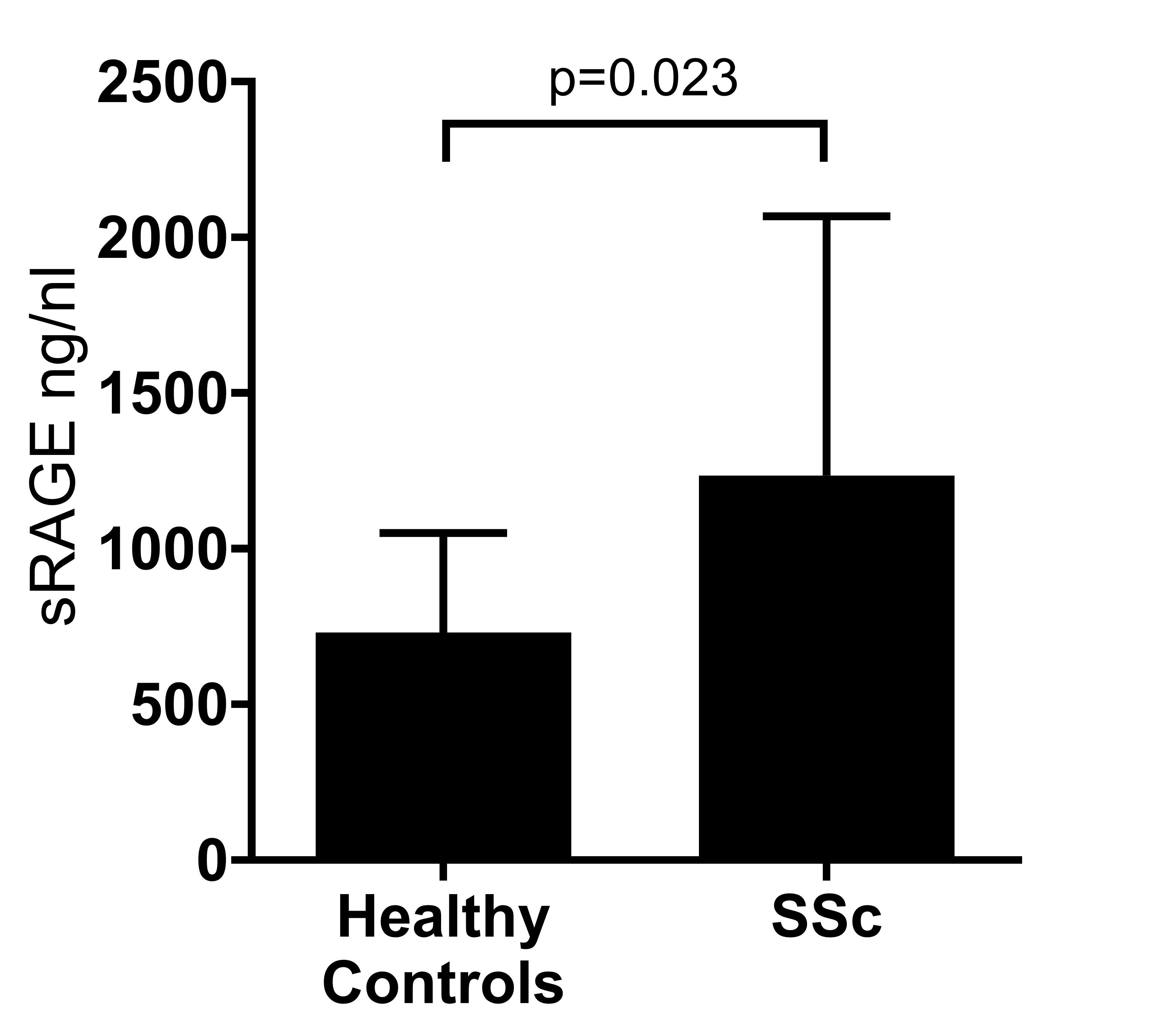 Figure 1: Serum sRAGE levels in patients with SSc compared with age- and sex matched healthy controls.
 Figure 2: Serum sRAGE levels in patients with SSc in a retrospective cohort. Patients are divided into group of baseline presence of pulmonary complications. No pulm. indicates that ILD and PAH were not present clinically. ILD+PAH indicated that these patients had ILD as wel as PAH at baseline.
 Figure 3: Kaplan-Meier survical curves of sRAGE quartiles. Fig 3a shows the association of sRAGE with the delepoment of SSc-PAH in those without pulmonary involvement at baseline. Fig 3b shows the association of sRAGE with mortality related to PAH. P value was calculated by log-rank test.
To cite this abstract in AMA style:
Atzeni I, Al-Adwi Y, Doornbos-van der Meer B, Van Roon A, Roozendaal C, Smit A, Stel A, Van Goor H, Gan T, Westra J, Mulder D. Serum Levels of the Soluble Receptor for Advanced Glycation Endproducts Are Prospectively Associated with Pulmonary Arterial Hypertension in Systemic Sclerosis [abstract]. Arthritis Rheumatol. 2021; 73 (suppl 9). https://acrabstracts.org/abstract/serum-levels-of-the-soluble-receptor-for-advanced-glycation-endproducts-are-prospectively-associated-with-pulmonary-arterial-hypertension-in-systemic-sclerosis/. Accessed .« Back to ACR Convergence 2021
ACR Meeting Abstracts - https://acrabstracts.org/abstract/serum-levels-of-the-soluble-receptor-for-advanced-glycation-endproducts-are-prospectively-associated-with-pulmonary-arterial-hypertension-in-systemic-sclerosis/