
Session Information
Date: Sunday, November 17, 2024
Title: Metabolic & Crystal Arthropathies – Basic & Clinical Science Poster II
Session Type: Poster Session B
Session Time: 10:30AM-12:30PM
Background/Purpose: While it is well established that patients with gout have increased mortality risk compared to the general population [1, 2, 3], it is less clear whether this risk is further heightened in those with tophaceous gout. Two prior cohort studies reported increased mortality risk in those with tophaceous gout, but these cohorts were both relatively small with fewer than 1000 patients [4,5], and one was limited to patients seen in tertiary care [5]. Similarly, while gout has been associated with an increased risk of acute myocardial infarction (MI) [1,6,7,8] and end-stage renal disease (ESRD) [9], it has not been previously demonstrated that these risks are further heightened in those with tophaceous gout. The objective of our study was to determine whether patients with tophaceous gout are at increased risk of mortality, acute MI, or ESRD compared to those with non-tophaceous gout.
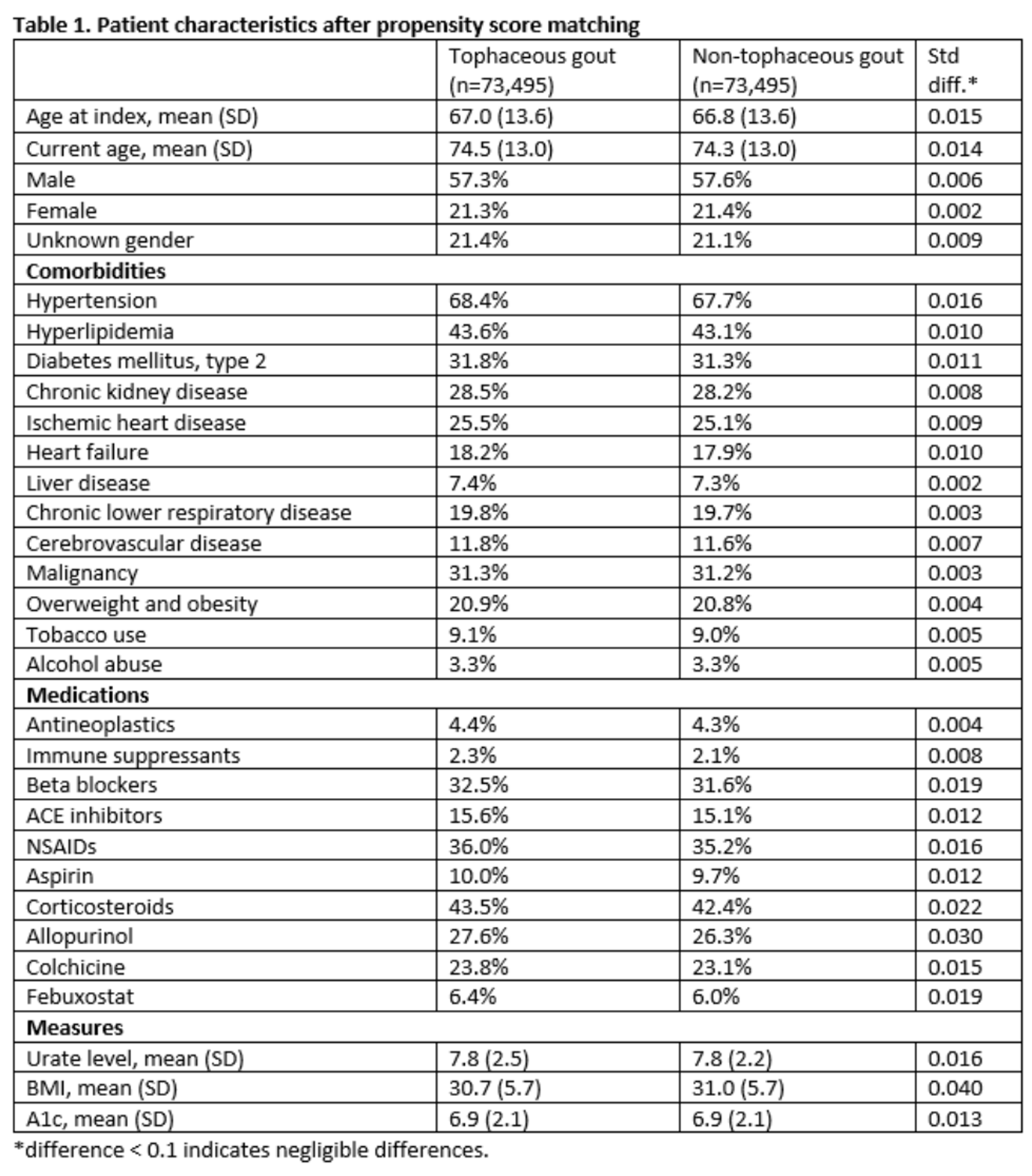
Methods: We conducted a cohort study using the TriNetX Diamond network, a large, multicenter network of United States claims data. ICD-10 codes identified patients with tophaceous and non-tophaceous gout. We analyzed the risks of mortality, acute MI, and ESRD at 1 year and 5 years from the time of gout diagnosis. Propensity score matching included 126 factors to adjust for demographics, comorbidities, medications, and serum urate level; some representative covariates are included in Table 1. Kaplan-Meier analysis and Cox proportional hazard models estimated the risk of the outcomes of interest.
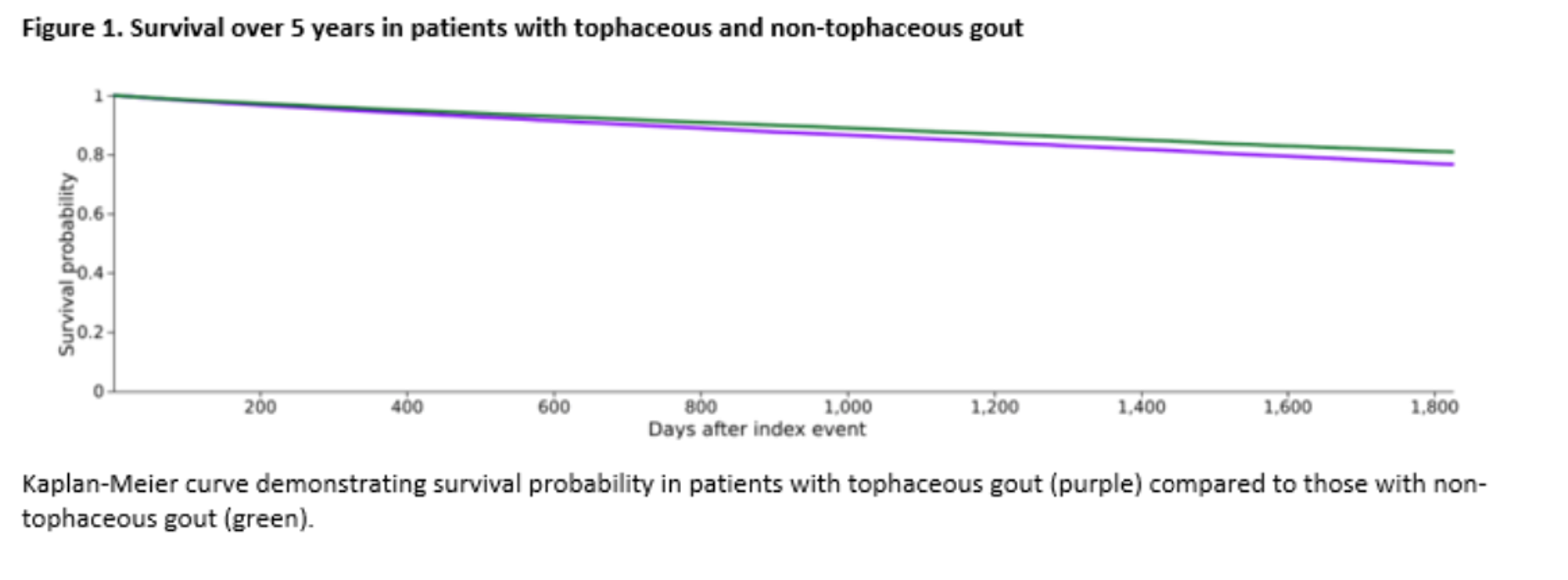
Results: After 1:1 propensity score matching, 73,495 patients in each group were compared, with well-balanced baseline characteristics (Table 1; all standardized mean differences < 0.1). After 1 year of follow-up, 5.0% of patients with tophaceous gout died versus 4.2% with non-tophaceous gout (hazard ratio [HR] 1.20, 95% CI: 1.15-1.26). At 5 years, mortality rates were 14.1% and 11.4%, respectively (HR 1.24, 95% CI: 1.20-1.27) (Figure 1). Patients with tophaceous gout had 1.7% and 4.4% risk of acute MI at 1 and 5 years, respectively, compared to 1.4% and 3.7%, respectively, among patients with non-tophaceous gout (HR 1.20 with 95% CI of 1.10-1.31 at 1 year; HR 1.21 with 95% CI of 1.15-1.28 at 5 years). Patients with tophaceous gout had 1.2% and 3.2% risk of ESRD at 1 and 5 years, respectively, compared to 1.1% and 2.8%, respectively, among patients with non-tophaceous gout (HR 1.12 with 95% CI of 1.02-1.24 at 1 year; HR 1.16 with 95% CI of 1.09-1.23 at 5 years).
Conclusion: This study of a large gout population suggests that tophaceous gout is associated with increased risks of mortality, acute MI, and ESRD compared to non-tophaceous gout. This may relate to increased total urate burden, inflammation, cumulative cardio-renal adverse effects of NSAID or glucocorticoid use, and functional decline related to severe gout, calling for investigations for potential roles of intensive urate-lowering therapy (e.g., uricase) to reduce these critical risks.
References
1. PMID: 17698728
2. PMID: 37832433
3. PMID: 38191784
4. Choi HK, et al. Tophaceous gout and the risk of mortality: A general population-based study [abstract]. Arthritis Rheumatol. 2016;68 (suppl 10)
5. PMID: 23313809
6. PMID: 16871533
7. PMID: 26230580
8. PMID: 29859125
9. PMID: 22513212
To cite this abstract in AMA style:
Challener G, sheng-kai ma k, McCormick N, Yokose C, Tinianow A, Choi H. Risk of Mortality and Major Cardiovascular-Kidney Outcomes in Patients with Tophaceous versus Non-Tophaceous Gout [abstract]. Arthritis Rheumatol. 2024; 76 (suppl 9). https://acrabstracts.org/abstract/risk-of-mortality-and-major-cardiovascular-kidney-outcomes-in-patients-with-tophaceous-versus-non-tophaceous-gout/. Accessed .« Back to ACR Convergence 2024
ACR Meeting Abstracts - https://acrabstracts.org/abstract/risk-of-mortality-and-major-cardiovascular-kidney-outcomes-in-patients-with-tophaceous-versus-non-tophaceous-gout/