
Session Information
Session Type: ACR/ARHP Combined Abstract Session
Session Time: 2:30PM-4:00PM
Background/Purpose: Pain exacerbation on walking is common among patients with knee osteoarthritis and often lead to activity avoidance. To date, few risk factors for pain flares have been identified, limiting the development of target prevention and treatment approach. We examined several knee-specific risk factors for this disabling pain experience.
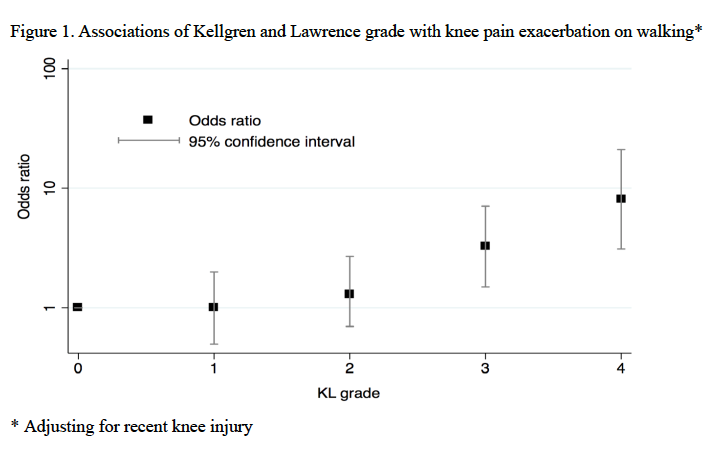
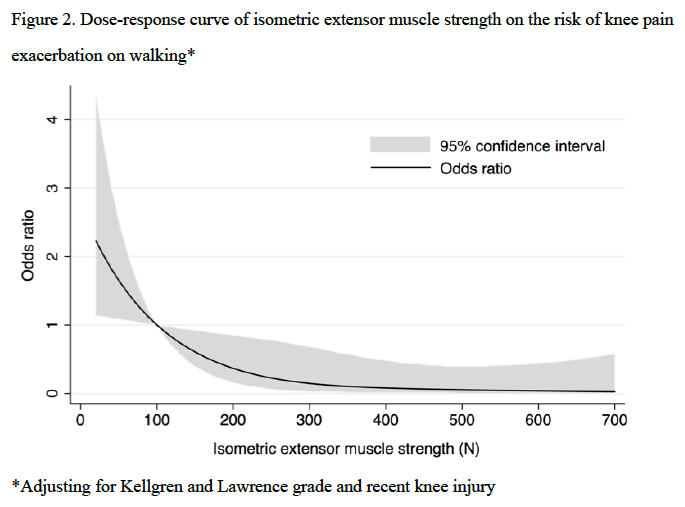
Methods: Participants in the Osteoarthritis Initiative underwent a 20-meter walking test at the 24-month visit. We defined a knee as experiencing pain exacerbation on walking if its pain severity increased by ≥1 point from before participating to that during the walking test on a numeric rated scale (0-10). Among subjects who had unilateral knee pain exacerbation on walking, we conducted a within-person between-knee matched case-control study to examine the relation of recent knee injury (i.e., knee injury occurred in the past 12 months that was bad enough to limit the ability to walk for at least two days), Kellgren and Lawrence (KL) grade and isometric extensor muscle strength (IEMS) to unilateral knee pain exacerbation on walking using conditional logistic regression adjusting for each other. We consider a difference in IEMS ≥4% as meaningful difference. We depicted the dose-response relationship between IEMS and the risk of knee pain exacerbation on walking using restrictive cubic spline curve.
Results: Among 277 people who experienced unilateral knee pain exacerbation during the walking test, 63.9% were women, mean age = 63.6 years, and the mean body mass index = 29.2 kg/m2. Recent knee injury was associated with pain exacerbation on walking with an odds ratio (OR) of 3.4 (95% confidence interval (CI):1.3, 9.2). Compared with knees with KL=0, the ORs of pain exacerbation on walking were 1.3 (95% CI: 0.7, 2.7), 3.3 (95% CI:1.5, 7.1), and 8.1 (95% CI: 3.1, 21.1) for knees with KL=2, 3 and 4, respectively. Knees that had 4% lower IEMS than their contralateral knees were at 1.4 (95% CI: 1.0-1.9) higher risk of pain exacerbation on walking.
Conclusion: Recent knee injury, KL grade and IEMS were associated with knee pain exacerbation on walking. Our findings reinforce the vital role of pain management in the early stage of radiographic knee OA in preventing pain-related disability and also suggest preventing injury and strengthening extensor muscle may reduce the risk of knee pain on walking.
|
Table 1. Difference in isometric extensor muscle strength (IEMS) within pairs of knees discordant for pain exacerbation on walking |
|||
|
IEMS difference between matched knees |
No. matched sets |
OR (95% CI) * |
P value |
|
IEMS lower ≥4% in case knee |
57 |
1.0 (reference) |
0.045 |
|
IEMS lower ≥4% in control knee |
79 |
1.4 (1.0, 1.9) |
|
|
Absolute difference <4% |
18 |
– |
|
|
OR = Odds ratio, CI = Confidence interval. |
|||
|
* Adjusting for recent knee injury and Kellgren and Lawrence grade. |
|||
To cite this abstract in AMA style:
Liu Q, Hunter DJ, Ferreira M, Wise BL, Tao K, Zhang Y, Lin J. Risk Factors for Knee Pain Exacerbation on Walking: A within-Person Knee-Matched Study [abstract]. Arthritis Rheumatol. 2018; 70 (suppl 9). https://acrabstracts.org/abstract/risk-factors-for-knee-pain-exacerbation-on-walking-a-within-person-knee-matched-study/. Accessed .« Back to 2018 ACR/ARHP Annual Meeting
ACR Meeting Abstracts - https://acrabstracts.org/abstract/risk-factors-for-knee-pain-exacerbation-on-walking-a-within-person-knee-matched-study/