
Session Information
Session Type: Poster Session C
Session Time: 10:30AM-12:30PM
Background/Purpose: Previous studies show that Tai Chi achieves clinical improvement for osteoarthritis (OA) through multiple pathways. There is evidence for interaction of the gut microbiota with occurrence and severity of OA pain. Behavioral responses to Tai Chi might modulate gut microbial composition and function through vagal modulation and the hypothalamic-pituitary-adrenal axis to influence the pathogenesis of OA pain. We conducted a randomized mechanistic trial to explore gut microbiota profile changes in response to remote-delivered Tai Chi among patients with symptomatic OA.
Methods: Adults ≥ 55 years meeting American College of Rheumatology criteria for symptomatic OA were randomized to Tai Chi or Wellness Education and attended 12 weeks of biweekly remote sessions. The primary outcome was difference in gut microbiota composition and diversity measured via Bray-Curtis dissimilarity and change in relative abundance of the genus Streptococcus (previously associated with OA pain) at 12 weeks. Secondary outcomes included change in Western Ontario and McMaster Universities (WOMAC) pain and function scores and the Hospital Anxiety and Depression (HADS) scale. We measured gut microbial communities via 16S rRNA gene amplicon sequencing of fecal DNA samples and the Quantitative Insights into Microbial Ecology 2 pipeline. Beta diversity associations were assessed via Permutational analysis of variance (PERMANOVA), and treatment*time interactions in mixed-effects regression models were used for all other outcomes. Analyses adjusted for treatment group, age, gender, disease duration and BMI.
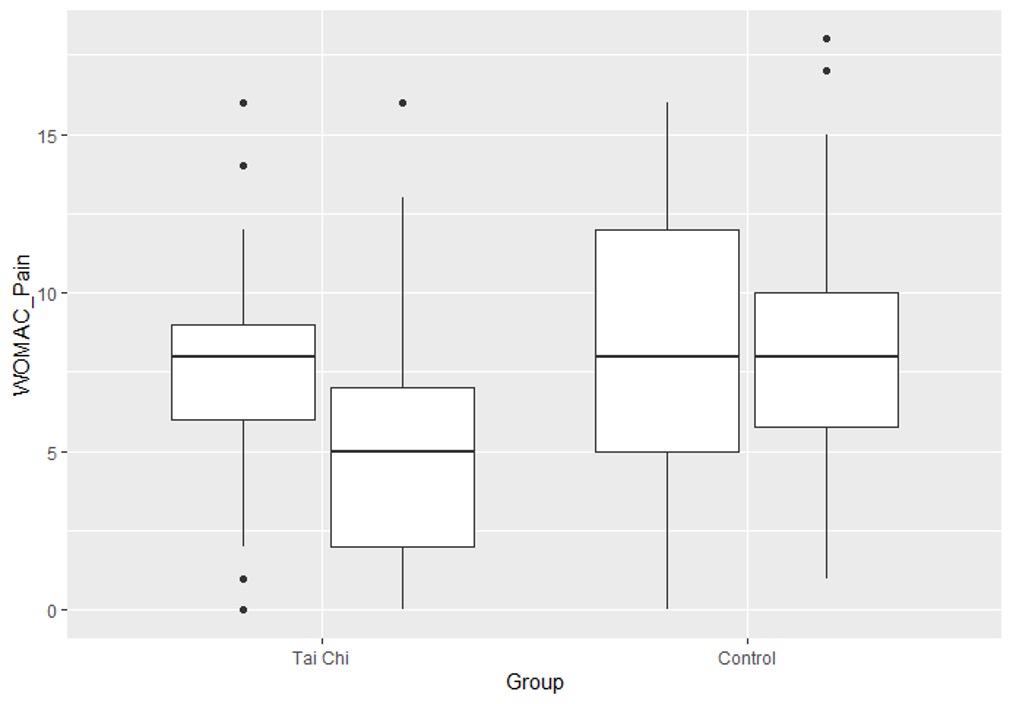
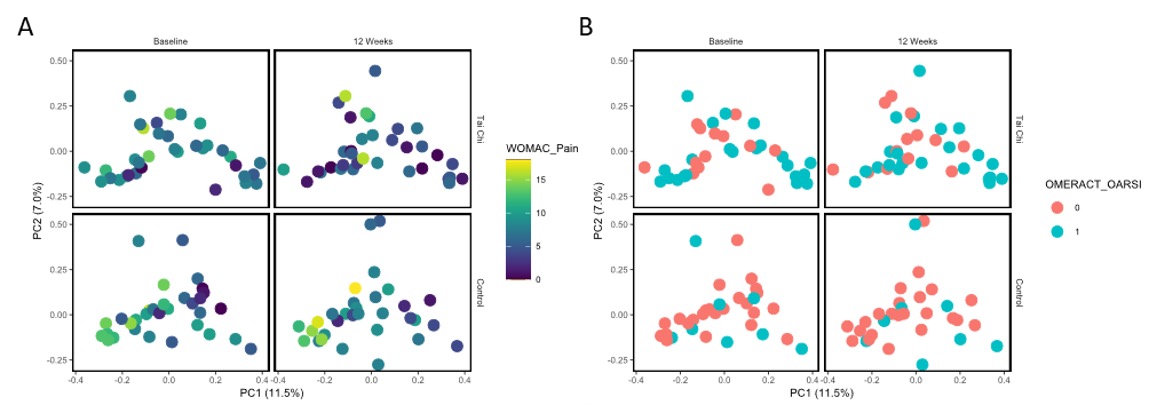
Results: Seventy-three patients were randomized to the remote delivery interventions and 67 completed pre- and post-intervention and sample collections. Mean participant age was 66.5 (7.5) years, 73.1% female. Baseline characteristics including participant expectation of treatment benefit were similar across treatment groups. At 12 weeks, Tai Chi significantly improved WOMAC Pain (effect difference =2.4 points, interaction p=0.005) and Function scores (effect difference=10.3 points, int. p< 0.0001) compared to wellness education. HADS scales did not differ significantly between the treatment groups. WOMAC scores were associated with microbial beta diversity at baseline (pain: R2=0.029, p=0.003; function: R2=0.025, p=0.012) and at 12 weeks (pain: R2=0.025, p=0.013; function: R2=0.029, p=0.001). Microbial beta diversity was not different between the treatment groups at baseline (R2=0.012, p=0.79) or after 12 weeks (R2=0.013, p=0.76). Fold-change relative abundance of Streptococcus in Tai Chi versus wellness education was 0.82 at baseline (p=0.71) and 1.02 after 12 weeks (p=0.96); the difference in Streptococcus change over time between treatment groups was not significant (int. p=0.74).
Conclusion: This study confirms a benefit of Tai Chi on OA pain and function and a relationship of microbial composition on OA symptoms but this preliminary analysis does not support an effect of Tai Chi on the microbiome. More research is needed in this field.
To cite this abstract in AMA style:
Wang C, McAlindon T, Short M, Chung M, Chen Y, Tai A, Ward H. Remote-Delivered Tai Chi and Gut Microbiota in Osteoarthritis: A Randomized Mechanistic Trial [abstract]. Arthritis Rheumatol. 2024; 76 (suppl 9). https://acrabstracts.org/abstract/remote-delivered-tai-chi-and-gut-microbiota-in-osteoarthritis-a-randomized-mechanistic-trial/. Accessed .« Back to ACR Convergence 2024
ACR Meeting Abstracts - https://acrabstracts.org/abstract/remote-delivered-tai-chi-and-gut-microbiota-in-osteoarthritis-a-randomized-mechanistic-trial/