
Session Information
Date: Sunday, November 17, 2024
Title: Orthopedics, Low Back Pain, & Rehabilitation – ACR/ARP Poster
Session Type: Poster Session B
Session Time: 10:30AM-12:30PM
Background/Purpose: Low physical activity levels are associated with osteoarthritis (OA) development and progression in individuals at risk for OA development. Including both structural and symptomatic constructs of early onset knee osteoarthritis (OA) allows for a more holistic view of the patient improving personalized care. Structural knee OA can be assessed using quantitative magnetic resonance imaging (MRI), while symptomatic knee OA can be determined with patient-reported and objectively measured knee function measures. The purpose of this study was to determine the relationship between changes in daily physical activity and structural and symptomatic signs of early onset knee (OA) 18 months after anterior cruciate ligament reconstruction (ACLR).
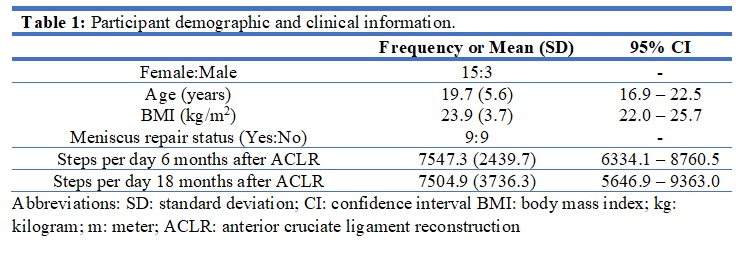
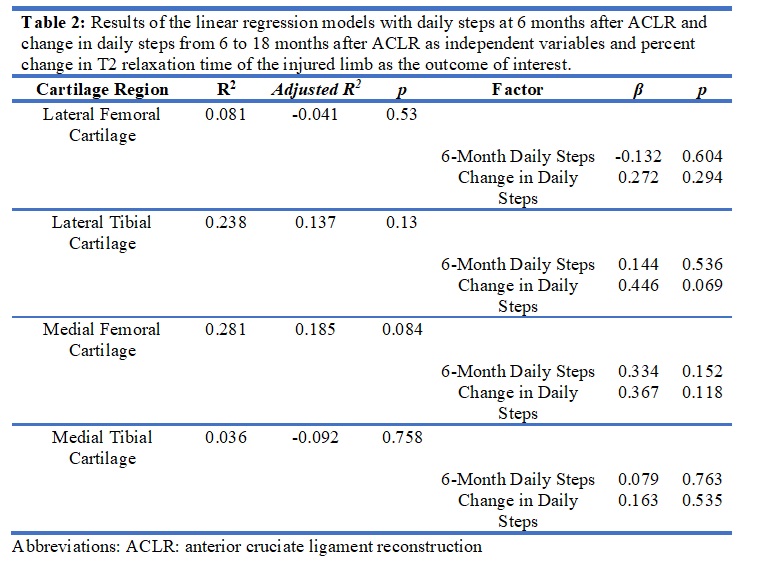
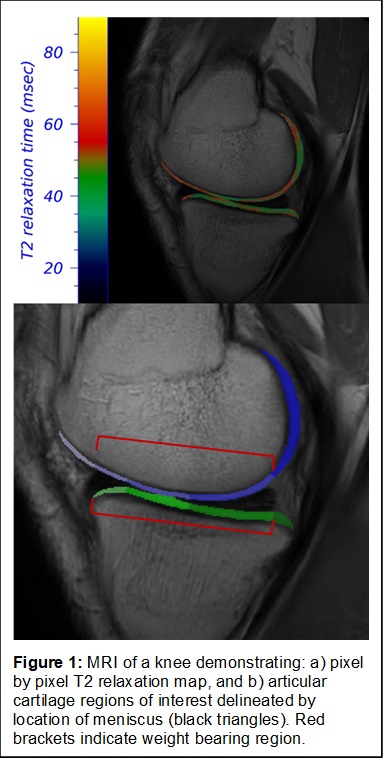
Methods: Eighteen individuals (83.3% female, mean age 19.7 ± 5.6 years old, mean BMI = 23.9 ± 3.7 kg/m2, 50% meniscal repair) completed testing six and 18 months after ACLR. Physical activity, measured by daily steps, and structural cartilage health, measured using T2 relaxation time on MRI (Figure 1), were collected six and 18 months after ACLR. Patient-reported knee function (International Knee Documentation Committee Form 2000) and objectively measured knee function (isometric quadriceps strength) were assessed 18 months after ACLR. A linear regression model was used to explore the relationship between change in physical activity from six to 18 months after ACLR and the percent change in T2 relaxation time from six to 18 months after ACLR. A Fisher’s Exact test was calculated to assess the relationship between change in physical activity (increase/decrease) between six and 18 months after ACLR and knee function (adequate/inadequate) 18 months after ACLR.
Results: Participants averaged 7547.3 ± 2439.7 steps per day six months after ACLR and 7504.9 ± 3736.3 steps per day 18 months after ACLR (Table 1). There were no associations between change in physical activity with knee cartilage regions (p > 0.069, Table 2). Additionally, there was no association with change in physical activity status (increased physical activity = 8; decreased physical activity = 10) and knee function (adequate function = 8; inadequate function = 10) (p = 1.000).
Conclusion: This study found no relationship between physical activity from six to 18 months after ACLR and knee health outcomes at 18 months after ACLR. This may be related to the relatively small change in physical activity from six to 18 months after ACLR despite this being a time period when many participants would be returning to their sport. While the sample size of the current study small and mostly female, our novel approach provides initial evidence regarding the impact of physical activity on both the structural and symptomatic constructs of early onset knee OA. Continued investigation of the relationship between OA development risk factors and structural and symptomatic signs of early onset knee OA is needed. With the lack of relationship between daily steps and knee health outcomes, other movement-related deficits, such as knee joint loading during gait, may be important to promote appropriate knee loading in efforts to reduce the risk of early onset knee OA after ACLR.
To cite this abstract in AMA style:
Werner D, Golightly Y, Rosenthal M, Sajja B, Wichman C, Manzer M, Tao M, Wellsandt E. Relationship Between Changes in Physical Activity and Early Onset Knee Osteoarthritis in Individuals After ACL Reconstruction [abstract]. Arthritis Rheumatol. 2024; 76 (suppl 9). https://acrabstracts.org/abstract/relationship-between-changes-in-physical-activity-and-early-onset-knee-osteoarthritis-in-individuals-after-acl-reconstruction/. Accessed .« Back to ACR Convergence 2024
ACR Meeting Abstracts - https://acrabstracts.org/abstract/relationship-between-changes-in-physical-activity-and-early-onset-knee-osteoarthritis-in-individuals-after-acl-reconstruction/