
Session Information
Date: Saturday, November 7, 2020
Title: Epidemiology & Public Health Poster II: OA, Osteoporosis, & Other Rheumatic Disease
Session Type: Poster Session B
Session Time: 9:00AM-11:00AM
Background/Purpose: Central and local alterations in nociception are related to heightened pain severity and can be present in people who have knee osteoarthritis (OA). Yet, it is unknown if pain sensitization independently contributes to alterations in muscle function beyond the effect of pain severity. Thus, we aimed to examine the relation of pain sensitization to knee extension torque in adults with or at risk for knee OA.
Methods: Data from the 60-month visit of the MOST Study were used for this cross-sectional analysis. MOST is a cohort study of persons with or at risk for knee OA. Pain pressure threshold (PPT) and temporal summation (TS) were assessed at the right wrist and patella. PPT was measured with mechanical algometry (tip size=1 cm2; rate=0.5 kg/s), and defined as the minimum pressure that caused slight pain. Three trials were performed at each site and averaged. For analysis, PPTs were divided into sex-specific tertiles. TS was assessed by repeatedly touching the skin (rate=1 Hz) with a 60 g monofilament for 30 s, and the presence of TS was defined as new or increased pain. Isokinetic knee extension torque was measured for the right leg at 60°/s with a computerized dynamometer. Maximum concentric knee extension torque was extracted from 4 maximal-effort trials, and normalized to body mass. Separate general linear regression models determined the relation of PPT and TS at the right wrist and patella to maximal knee extension torque of the right leg. Models were adjusted for age, sex, body mass index (BMI), clinic site, depressive symptoms, pain catastrophizing, average knee pain severity in the past month (Visual Analog Scale; VAS), and the presence of radiographic OA (ROA). Additionally, analyses were repeated after stratifying by sex and the presence of pain (VAS > 0) separately.
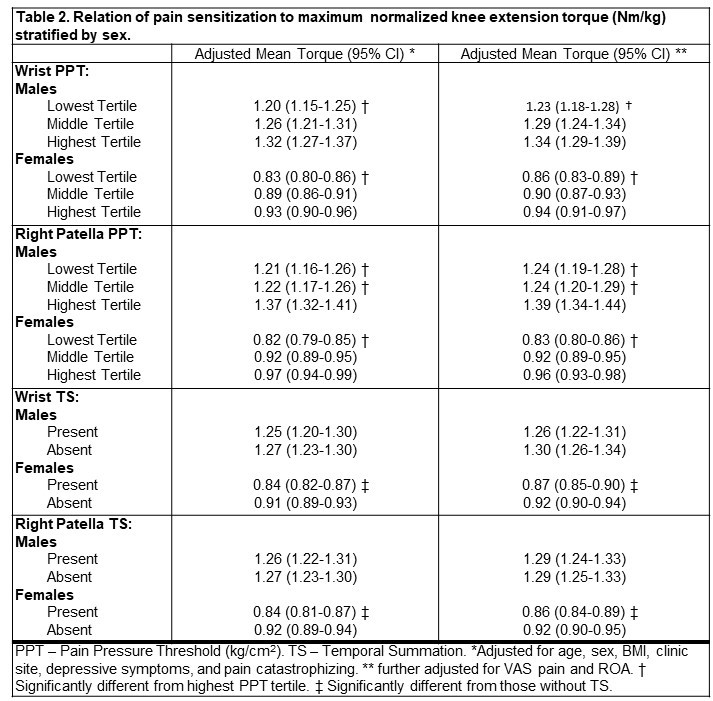
Results: 1702 participants (60% female) were included, with a mean (SD) age of 67.3 (7.7) years, BMI of 30.3 (5.6) kg/m2, VAS of 15.3 (19.6) mm, and maximum knee extension torque of 1.03 (0.41) Nm/kg. Mean PPTs at the right wrist and patella were 3.4 (1.5) and 5.2 (2.2) kg/cm2, respectively. Knee extension torque was significantly less in those with lower PPTs (i.e., higher pain sensitivity) compared to those with high PPTs (Table 1). Notably, those with the lowest PPTs at the patella were 14.3% weaker than those with the highest PPTs. For TS, the prevalence was 40.8% at the right wrist and 39.7% at the patella. Knee extension torque was significantly less in those with TS compared to those without TS, but the difference was small (i.e., < 5% weaker) (Table 1). In sex-specific analyses, lower PPTs were significantly associated with lower knee extension torques for both sexes, but the presence of TS was only associated with lower knee extension torques for females (Table 2). Lastly, low PPTs were associated with lower knee extension torques regardless of the presence of pain, but the presence of TS was only associated with lower knee extension torques for those with pain (Table 3).
Conclusion: Increased pain sensitivity, centrally and locally, is related to lower knee extension torque in adults with or at risk for knee OA. This relation is independent of knee pain severity and provides support that nervous system alterations may not only affect pain severity, but also muscle function.


To cite this abstract in AMA style:
Corrigan P, Neogi T, Frey Law L, Segal N, Nevitt M, Lewis B, Stefanik J. Relation of Pain Sensitization to Isokinetic Knee Extension Torque: The MOST Study [abstract]. Arthritis Rheumatol. 2020; 72 (suppl 10). https://acrabstracts.org/abstract/relation-of-pain-sensitization-to-isokinetic-knee-extension-torque-the-most-study/. Accessed .« Back to ACR Convergence 2020
ACR Meeting Abstracts - https://acrabstracts.org/abstract/relation-of-pain-sensitization-to-isokinetic-knee-extension-torque-the-most-study/