
Session Information
Date: Monday, October 22, 2018
Session Type: ACR Poster Session B
Session Time: 9:00AM-11:00AM
Background/Purpose: The benefits of physical activity (PA) in persons with OA are well-documented: PA reduces OA pain, improves mental health, and reduces the risk of cardiovascular disease (CVD), diabetes mellitus (DM), and some cancers. Despite this, the majority of knee OA patients are physically inactive. The public health impact of low uptake of PA in this population has not been evaluated.
Methods: We used data from the Osteoarthritis Initiative and Centers for Disease Control to estimate the proportion of the US knee OA population that is inactive, insufficiently active, and active, defined as 0-10, 10-149, and 150+ minutes of moderate-to-vigorous PA per week. Using the Osteoarthritis Policy Model (OAPol), a widely published and validated microsimulation of knee OA, we estimated survival and quality-adjusted survival losses among cohorts of individuals with knee OA and different levels of PA. We calculated the per person quality-adjusted years of life (QALYs) lost among those who are inactive or insufficiently active compared to those who are active. We estimated the negative public health impact by multiplying the per-person QALYs lost due to physical inactivity or insufficient activity by the number of persons with knee OA in each of those activity groups. We also calculated the positive public health impact of increasing PA levels among knee OA patients (assuming interventions that could lead 5% or 10% of the population at lower PA levels to increase their activity) by calculating QALYs saved and cases of CVD, DM, and cancer prevented due to such interventions. OAPol data inputs were derived from national and multicenter cohorts and included: 1) background mortality rates; 2) prevalence of and mortality attributable to CVD, DM, and cancers; 3) reduction in quality of life due to physical inactivity and major comorbidities; 4) increased risk of comorbidities due to physical inactivity.
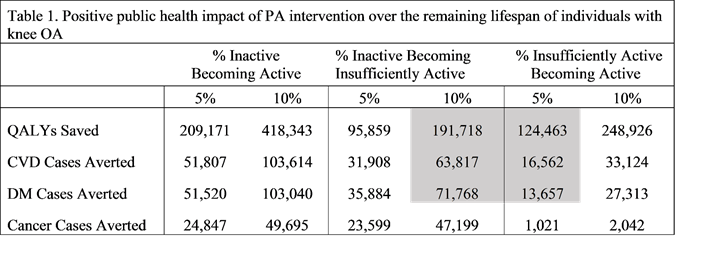
Results: Currently, of 11.7 million persons in the US with knee OA, 47% are inactive and 41% are insufficiently active, resulting in 6.7 million QALYs lost over their remaining lifespan. Table 1 presents the positive public health impact of PA interventions. If an intervention could simultaneously lead 10% of inactive persons to become insufficiently active and 5% of insufficiently active persons to become active over their remaining life spans, 316,181 QALYs would be saved (191,718+124,463, Table 1, QALYs row, shaded cells). This would also prevent 80,379 (63,817+16,562, Table 1, CVD row, shaded cells) cases of CVD and 85,425 (71,768+13,657, Table 1, DM row, shaded cells) cases of DM.
Conclusion: These results suggest that even modestly effective programs focused on increasing PA among knee OA patients could have a tremendous public health impact. Our projections of improvements in morbidity and mortality could be useful in setting realistic goals for activity promotion among knee OA patients.
To cite this abstract in AMA style:
Losina E, Silva GS, Smith KC, Collins JE, Hunter DJ, Shrestha S, Messier SP, Yelin EH, Suter LG, Paltiel AD, Katz JN. Public Health Impact of Physical Inactivity in the Knee OA Population in the US [abstract]. Arthritis Rheumatol. 2018; 70 (suppl 9). https://acrabstracts.org/abstract/public-health-impact-of-physical-inactivity-in-the-knee-oa-population-in-the-us/. Accessed .« Back to 2018 ACR/ARHP Annual Meeting
ACR Meeting Abstracts - https://acrabstracts.org/abstract/public-health-impact-of-physical-inactivity-in-the-knee-oa-population-in-the-us/