ACR Meeting Abstracts

ACR Meeting Abstracts

  • Meeting Abstracts
    • All Meetings
    • PRSYM 2026
    • ACR Convergence 2025
    • Download Abstract Supplements
  • Keyword Index
  • My Favorites
    • View & print my favorites
  • Search

Home » Meeting Abstracts » ACR Convergence 2024

Abstract Number: 2688

HLA-DRB4: A Novel Susceptibility Locus in Systemic Sclerosis Patients with Severe Calcinosis

Sara Faghihi-Kashani1, srijana davluri2, Kamini Kuchinad3, Zuoming deng4, Faiza Naz4, Stefania Dell'Orso4, Zsuzsanna McMahan5, Laura Hummers6, Daniel Kastner7, Fredrick Wigley3, david fiorentino8, Christian Lood9, Ami Shah10, Lorinda Chung11 and Pravitt Gourh4, 1Division of Immunology and Rheumatology, Stanford University School of Medicine, Stanford, CA, San Francisco, CA, 2Division of Immunology and Rheumatology, Stanford University School of Medicine, Stanford, CA, Sunnyvale, CA, 3Johns Hopkins University, Division of Rheumatology, Baltimore, MD, Baltimore, MD, 4National Institutes of Arthritis and Musculoskeletal and Skin Diseases (NIAMS), National Institutes of Health (NIH), Bethesda, MD, Bethesda, MD, 5UTHealth Houston Division of Rheumatology, Houston, TX, 6Johns Hopkins University, Division of Rheumatology, Baltimore, MD, Ellicott City, MD, 7National Human Genome Research Institute, Bethesda, MD, Bethesda, MD, 8Department of Dermatology, Stanford University School of Medicine, Stanford, CA, Palo Alto, CA, 9Division of Rheumatology, University of Washington, Seattle, WA, Seattle, WA, 10Division of Rheumatology, Johns Hopkins University, Ellicott City, MD, 11Stanford University, Woodside, CA

Share on X (Twitter) Share on Facebook Share on LinkedIn Share on Email
Print

Meeting: ACR Convergence 2024

Keywords: calcinosis, genetics, Scleroderma

Session Information

Date: Tuesday, November 19, 2024

Title: Abstracts: Systemic Sclerosis & Related Disorders – Clinical III

Session Type: Abstract Session

Session Time: 11:00AM-12:30PM

Background/Purpose: Systemic sclerosis (SSc) is a complex autoimmune disease. Class II HLA alleles have been reported to play an important role in SSc pathogenesis. Calcinosis, deposition of insoluble calcium deposits in the dermis and subcutaneous tissues, contributes to morbidity in SSc patients, leading to a decreased quality of life. We previously reported the presence of rare variants in the ABCC6 and ENPP1 genes in SSc patients with severe calcinosis. ABCC6 and ENPP1 genes are involved in dysregulated phosphate metabolism leading to reduced inorganic pyrophosphate (PPi) levels which are implicated in the development of calcinosis. In this study, we examine the HLA associations in patients with SSc and severe calcinosis.

Methods: Genome sequencing, with an average 30X coverage, was performed in thirty-two SSc patients of European ancestry with severe calcinosis, defined as the simultaneous presence of calcinosis at three or more sites. HLA alleles were determined using the HLA∗PRG:LA software. Publicly available genotypes from 6,446 healthy controls of European ancestry were imputed using the Michigan Imputation Server, and the required 6,114 markers were submitted to the SNP2HLA software for HLA imputation. We examined 84 HLA allelic associations by implementing an unconditional logistic regression analysis using Golden helix SVS software. A Bonferroni’s multiple test corrected significance threshold of p-value (P) < 6×10⁻⁴ was used for association analyses.

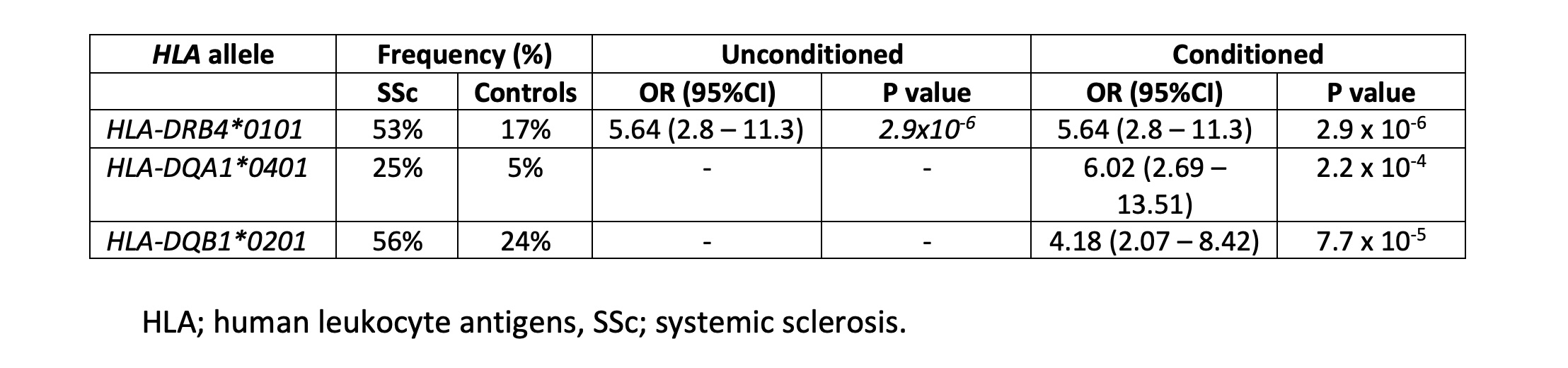
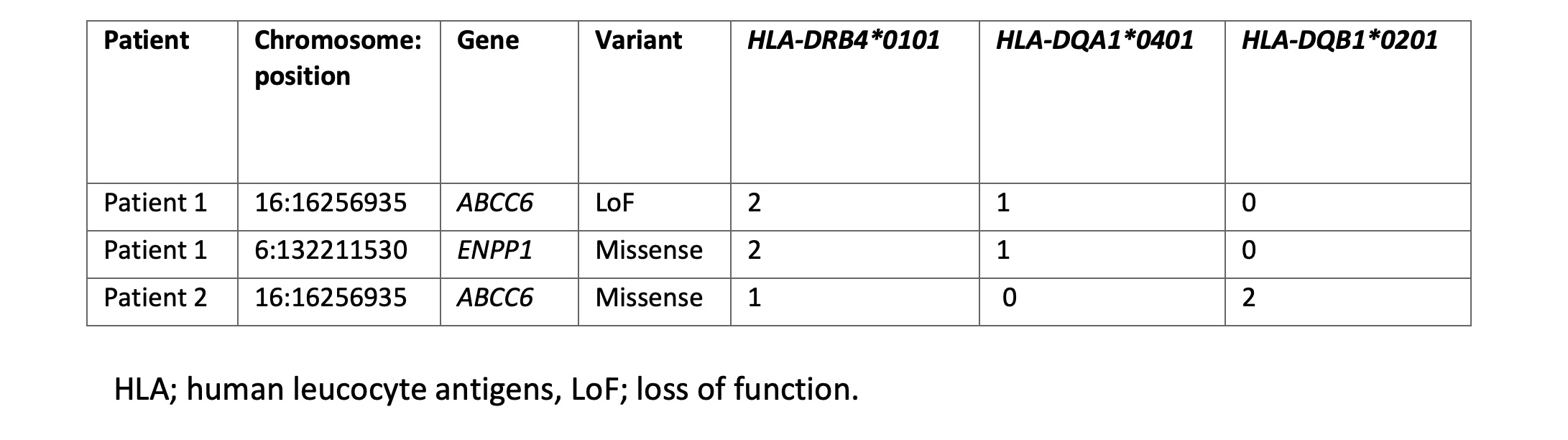
Results: Analyzing this unique cohort of SSc patients with severe calcinosis we identified significant associations between HLA alleles and the calcinosis phenotype. HLA-DRB4*0101 allele showed the strongest association with a P=2.9×10⁻⁶ (OR 5.64, [95%CI 2.8-11.3]) (Table 1). The HLA-DQB1*0201 allele is not yet reported in SSc but has been identified as a risk factor for other autoimmune diseases. In our SSc cohort, we identified a significant association with HLA-DQB1*0201 allele (P=7.7×10⁻⁵, OR 4.2, [95% CI 2.1-8.4]). The HLA-DQA1*0401 allele was previously reported in anti-centromere antibody positive patients, and we observed a statistically significant association in our cohort as well with a P=2.2×10⁻⁴ (OR 6 [95% CI 2.7-13]). Finally, we identified two SSc patients with severe calcinosis who carried rare variants in the ABCC6 and ENPP1 genes and also carried two of the HLA risk alleles (Table 2).

Conclusion: This is the first study to report the association of the HLA-DRB4*0101 allele with calcinosis in SSc. The presence of HLA risk alleles along with rare variants in ABCC6 and ENPP1 genes raises intriguing hypotheses about the genetic contributions to severe calcinosis in SSc and highlights the need for further investigation.
Supporting image 1

Table 1. Logistic regression and conditional analyses of HLA alleles in systemic sclerosis patients with severe calcinosis phenotype

Supporting image 2

Table 2. HLA alleles in systemic sclerosis patients with severe calcinosis phenotype with coding variants in genes involved in calcification pathways


Disclosures: S. Faghihi-Kashani: None; s. davluri: None; K. Kuchinad: None; Z. deng: None; F. Naz: None; S. Dell'Orso: None; Z. McMahan: Boehringer-Ingelheim, 2; L. Hummers: AbbVie/Abbott, 2, AstraZeneca, 5, Biotest, 1, 2, Boehringer-Ingelheim, 2, 5, Cumberland, 5, GlaxoSmithKlein(GSK), 5, Kadmon, 5, Medpace, 5, Merck/MSD, 5, Mitsubishi Tanabe, 5, prometheus, 5; D. Kastner: None; F. Wigley: None; d. fiorentino: Argenyx, 2, biogen, 2, bus, 2, johnson & johnson, 2, kyverna, 2, 5, Pfizer, 2, Priovant, 5, 12, gift, Serono, 5, usb, 2; C. Lood: Amytryx, 5, Boehringer-Ingelheim, 5, Citryll, 2, Eli Lilly, 5, Exagen Inc, 2, Gilead Sciences, 5, Horizon Diagnostics, 5, Pfizer, 5, Redd Pharma, 2, 4, 5, 11; A. Shah: Arena Pharmaceuticals, 5, Kadmon, 5, Medpace LLC, 5; L. Chung: Boehringer-Ingelheim, 5, Eicos, 1, 2, Eli Lilly, 2, Genentech, 2, IgM Biosciences, 2, Janssen, 1, Kyverna, 2, Mitsubishi Tanabe, 1, 2; P. Gourh: None.

To cite this abstract in AMA style:

Faghihi-Kashani S, davluri s, Kuchinad K, deng Z, Naz F, Dell'Orso S, McMahan Z, Hummers L, Kastner D, Wigley F, fiorentino d, Lood C, Shah A, Chung L, Gourh P. HLA-DRB4: A Novel Susceptibility Locus in Systemic Sclerosis Patients with Severe Calcinosis [abstract]. Arthritis Rheumatol. 2024; 76 (suppl 9). https://acrabstracts.org/abstract/hla-drb4-a-novel-susceptibility-locus-in-systemic-sclerosis-patients-with-severe-calcinosis/. Accessed .

ACR Meeting Abstracts - https://acrabstracts.org/abstract/hla-drb4-a-novel-susceptibility-locus-in-systemic-sclerosis-patients-with-severe-calcinosis/

My Favorites

Save and print abstracts during your browser session by clicking the “Favorite” button at the bottom of any abstract (must have cookies enabled in browser). See saved favorites.

Abstract Policies

  • ACR Convergence Abstract Embargo Policies
  • ACR Convergence Abstract Permissions & Reprints
  • PRSYM Abstract Policies

ACR Convergence. Where Rheumatology Meets

ACR Convergence 2026

Join us November 6-11 in Orlando, Florida.
See Registration Information

  • Contact ACR
  • Privacy Policy
  • ACR Policies
  • Cookie Preferences

© Copyright 2026 American College of Rheumatology