
Session Information
Session Type: Poster Session C
Session Time: 10:30AM-12:30PM
Background/Purpose: Health literacy (HL) is a key social determinant of health in inflammatory arthritis (IA), including rheumatoid arthritis, psoriatic arthritis and axial spondyloarthritis, as it can determine engagement in diagnostic, treatment and self-management. We aimed to conduct a systematic literature review (SLR) to i) summarise associations between HL and IA outcomes; iii) inform management in IA; ii) identify areas for further research.
Methods: This SLR was registered on PROSPERO (CRD42024511354). Inclusion criteria were adults (≥18 years) with IA; studies assessing HL or interventions targeting HL; observational and qualitative studies, randomised controlled trials; English-language articles.
A comprehensive search was performed in February 2024, with MeSH headings and keywords for HL and IA, in MEDLINE, Scopus, Cochrane Library, Health Technology Assessment and PsycINFO, with no time restriction. HL measures and outcomes were not defined, to ensure capture of all potentially relevant articles.
Data were extracted on demographics, HL assessment and relevant outcomes such as (but not limited to) disease activity, quality of life, function and healthcare utilisation. Outcomes were then grouped into core themes.
Results: Of 3087 identified articles (following de-duplication), 29 were included, comprising: 22 cross-sectional studies; two randomised controlled trials; two prospective cohort studies; one case-control study; one retrospective cohort study; one qualitative study. The total cohort comprised 16402 individuals (75% female), with a mean age of 57.5 years (SD 9.6). Ethnicity was reported in 13 studies; 66% of patients were Caucasian. 89% had rheumatoid arthritis, 4% axial spondyloarthritis, 3% psoriatic arthritis and 4% unspecified IA (Table 1).
Measures of HL included: Test of Functional Health Literacy in Adults (short and long form; n=13); Single Item Literacy Screener (n=10); Rapid Estimate of Adult Literacy in Medicine (n=6); Health Literacy Questionnaire (n=2).
Identified themes included disease activity, patient-reported outcomes (PROs), healthcare utilisation and medication history. Key findings are in Figure 1.
Meta-analysis was deemed inappropriate due to marked heterogeneity of exposure and outcome measures. Outcomes were grouped based on themes. Overall, low HL was associated with worse disease activity (across a cohort of n=816 patients); greater disability (n=6678); higher depression and anxiety (n=958); higher cognitive, emotional and physical fatigue (n=708); poorer medication adherence (n=6051); lower internet access and confidence with remote consultations (n=832); increased healthcare utilisation (n=123); decreased understanding of health information and shared decision-making.
Conclusion: This is the first SLR to comprehensively synthesise the extensive outcomes associated with HL in people with IA, including increased disease activity, worse PROs, greater healthcare utilisation and decreased access to medication and care.
Our findings may be used to inform policy and resource allocation, and improve access and quality of care in IA, particularly among those patients with lower HL.
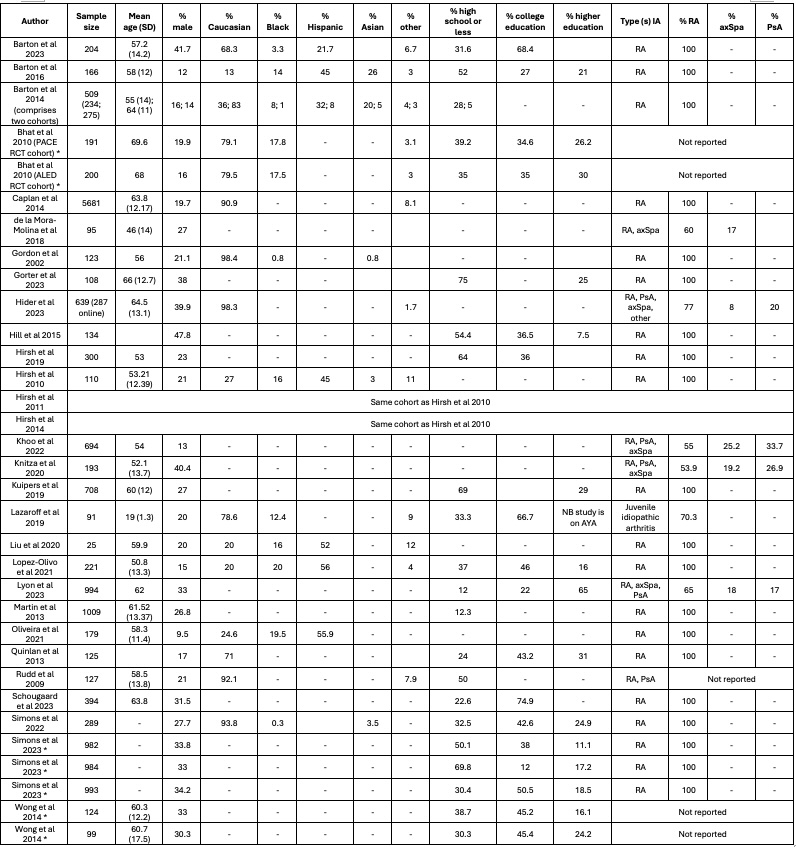
axSpa: axial spondyloarthritis. AYA: adolescents and young adults. IA: inflammatory arthritis. PsA: psoriatic arthritis. RA: rheumatoid arthritis. RCT: randomised controlled trial. * denotes cohorts from the same study.
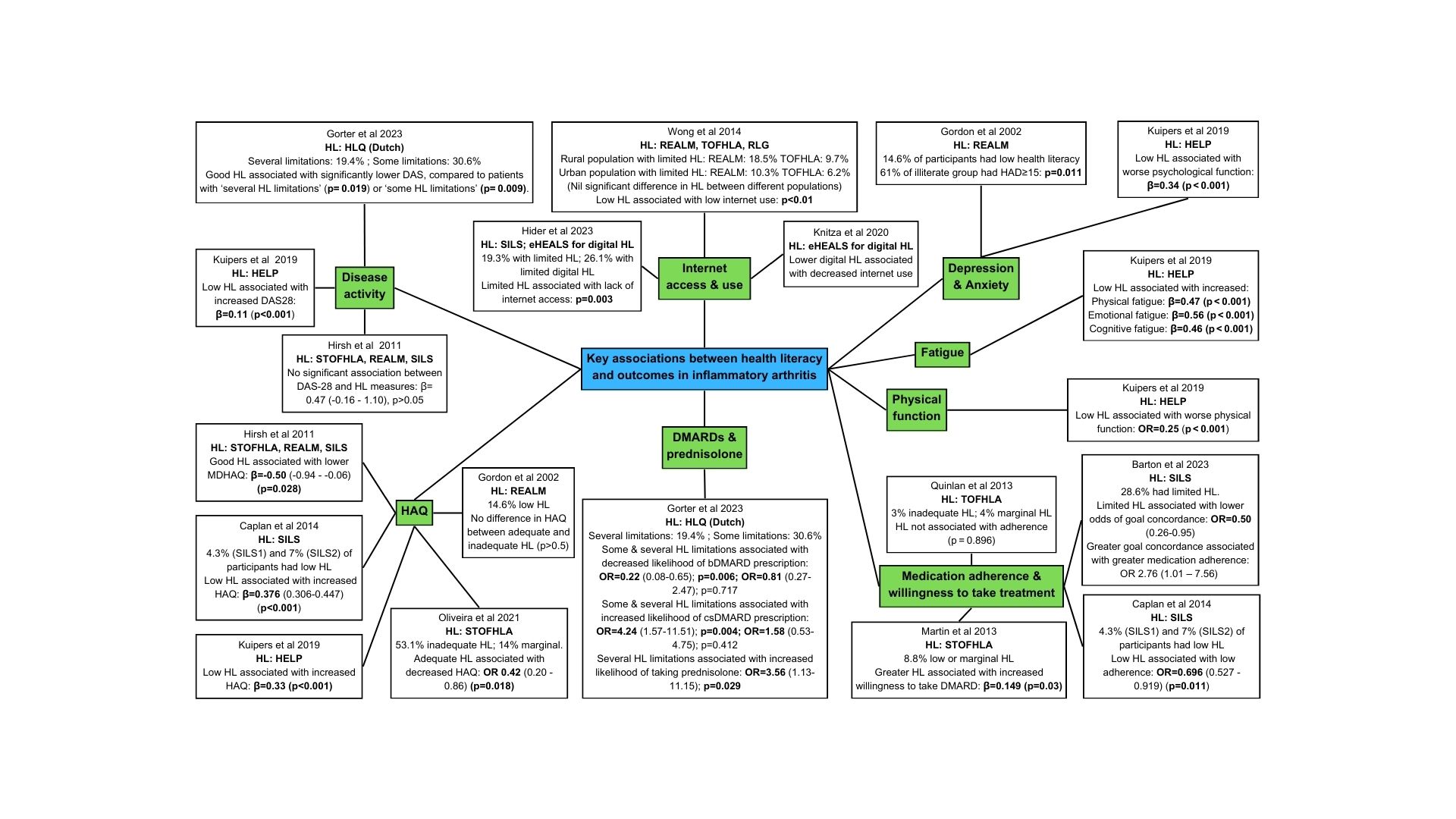
eHEALS: eHealth Literacy Scale. HELP: Health Education Literacy. HLQ: Health Literacy Questionnaire. REALM: Rapid Estimate of Adult Literacy in Medicine. RLG: Rheumatology Literacy Guide. SILS: Single Item Literacy Screener. STOFHLA: Short Test of Functional Health Literacy in Adults. TOFHLA: Test of Functional Health Literacy in Adults. DMARD: disease-modifying anti-rheumatic drug. bDMARD: biologic DMARD. csDMARD: conventional synthetic DMARD. DAS: disease activity score. DAS28: disease activity score 28- joints. HAQ: Health Assessment Questionnaire. MDHAQ: Multi-Dimensional Health Assessment Questionnaire. HAD: Hospital Anxiety and Depression scale. OR: odds ratio.
To cite this abstract in AMA style:
Dey M, Budhathoki S, Ramiro S, Michaud K, Elwell H, Norton S, Buch M, Cope A, Osborne R, Galloway J, Nikiphorou E. Health Literacy and Disease, Clinical, Functional and Management Outcomes in Inflammatory Arthritis: A Systematic Literature Review [abstract]. Arthritis Rheumatol. 2024; 76 (suppl 9). https://acrabstracts.org/abstract/health-literacy-and-disease-clinical-functional-and-management-outcomes-in-inflammatory-arthritis-a-systematic-literature-review/. Accessed .« Back to ACR Convergence 2024
ACR Meeting Abstracts - https://acrabstracts.org/abstract/health-literacy-and-disease-clinical-functional-and-management-outcomes-in-inflammatory-arthritis-a-systematic-literature-review/