
Session Information
Session Type: Poster Session B
Session Time: 5:00PM-6:00PM
Background/Purpose: Rheumatic disease disproportionately impacts specific racial and ethnic groups frequently, resulting in health care inequities. Health care disparities are prevalent within certain geographic areas including the Southern United States, and Texas has been reported as having lower quality of care and worse racial and ethnic disparities.1 The LUMINA cohort demonstrated that adult Texan Hispanics with lupus have increased disease activity and greater damage accrual compared to other groups.2 Our objective was to estimate the geographic distribution of race and ethnicity in a cohort of adolescents with rheumatic disease followed at a single center to begin to explore risk factors for disparities in our patient population.
Methods: Demographic data of patients 14 years of age and older with a permanent Texas address was extracted from the EMR. Zip codes were translated into counties and mapped by geographic region and color coded by numeric frequency. Diversity index (DI) extracted from the 2013 Census data was used to measure the probability that two people chosen at random will be from different racial and ethnic groups. The DI ranges from 0 indicating that the population has the same racial and ethnic characteristics, to 1 indicating completely different backgrounds.2 Using zip code and county the DI was reported geographically.
Results: A total of 834 unique patients were identified and mapped geographically. Forty-three patients were excluded as they lived out of state. Seventy-six percent identified as female. Seventy-four percent reported Caucasian race, and 11% African American. Thirty-three percent identified as Hispanic/Latino ethnicity. Fifty-eight percent had private commercial insurance, 34% government insurance, and 8% were uninsured. The county with the highest DI was Fort Bend, and the lowest DI in Starr County. Most (33%) patients reside in Dallas County. The farthest distance counties included Cameron at 478 miles and El Paso at 572 driving miles from clinic.
Conclusion: Patients in our center come from diverse racial and ethnic backgrounds. Some have the burden of driving a long distance to their pediatric rheumatologist. Ease of access to a pediatric rheumatologist is a health care systems factor that may contribute to disparities.3 Provider awareness of patient diversity, in terms of both race/ethnicity and geography is essential to understanding inequities in health care. Our findings demonstrate a broad range of diversity across Texas and are the first step in evaluating barriers to care.
1. 2022 National Healthcare Quality and Disparities Report. AHRQ Pub. No. 22(23)-0030.
2. Gonzalez LA, Pons-Estel GJ, Toloza SMA, Ugarte-Gil MF, Alarcon GS. Understanding Risk Factors for Poor Outcomes in a Multiethnic Longitudinal Cohort: The LUMINA (Lupus in Minorities: Nature vs. Nurture) Experience (LUMINA LXXXII). Rheum Dis Clin North Am. Feb 2021;47(1):55-64. doi:10.1016/j.rdc.2020.09.002
3. Census US. Racial and Ethnic Diversity in the United States. 2023.
4. Rubinstein TB, Knight AM. Disparities in Childhood-Onset Lupus. Rheum Dis Clin North Am. Nov 2020;46(4):661-672. doi:10.1016/j.rdc.2020.07.007
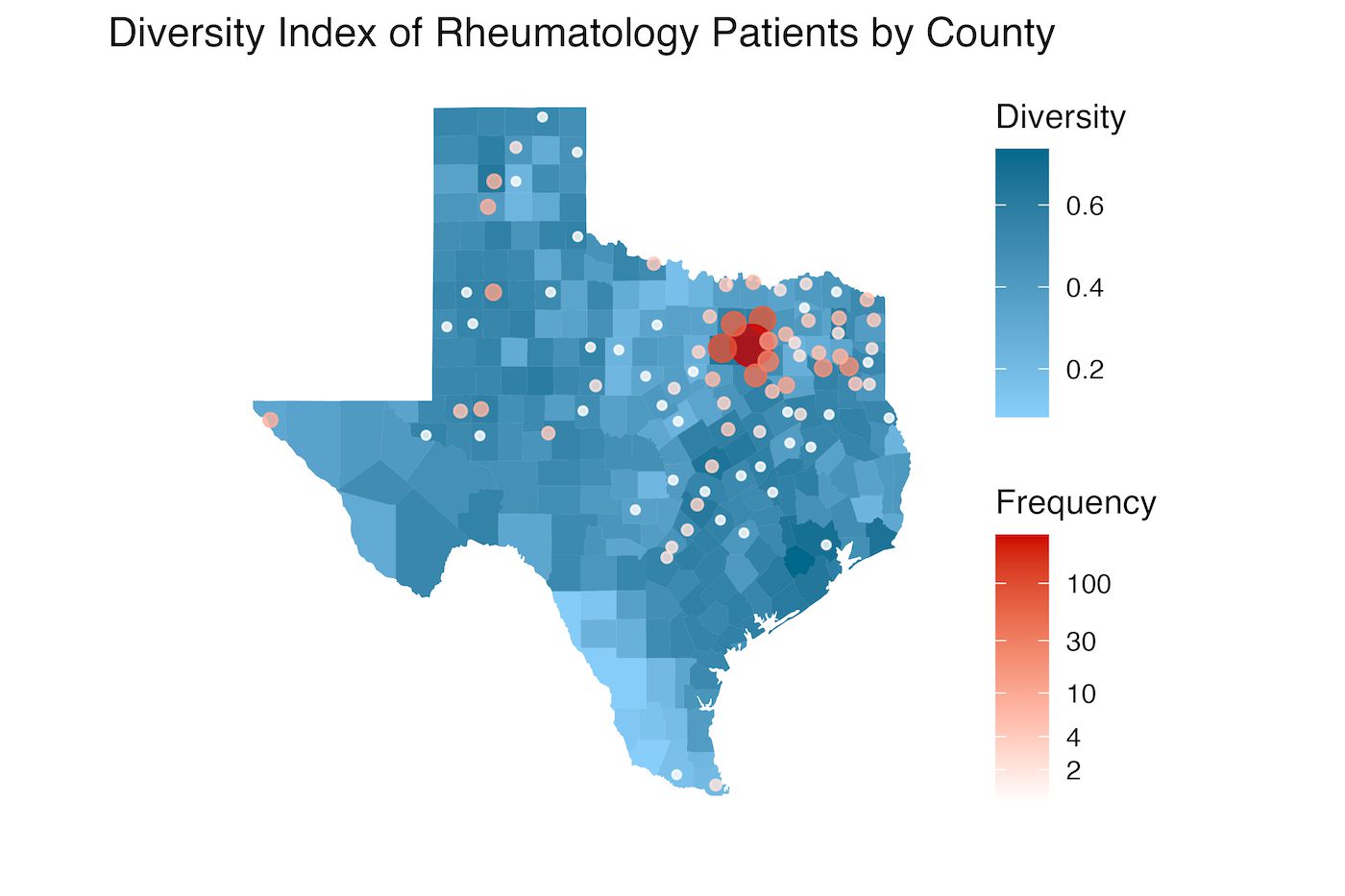 The distribution of adolescent rheumatology patients across Texas by patient frequency and county diveristy index (DI)
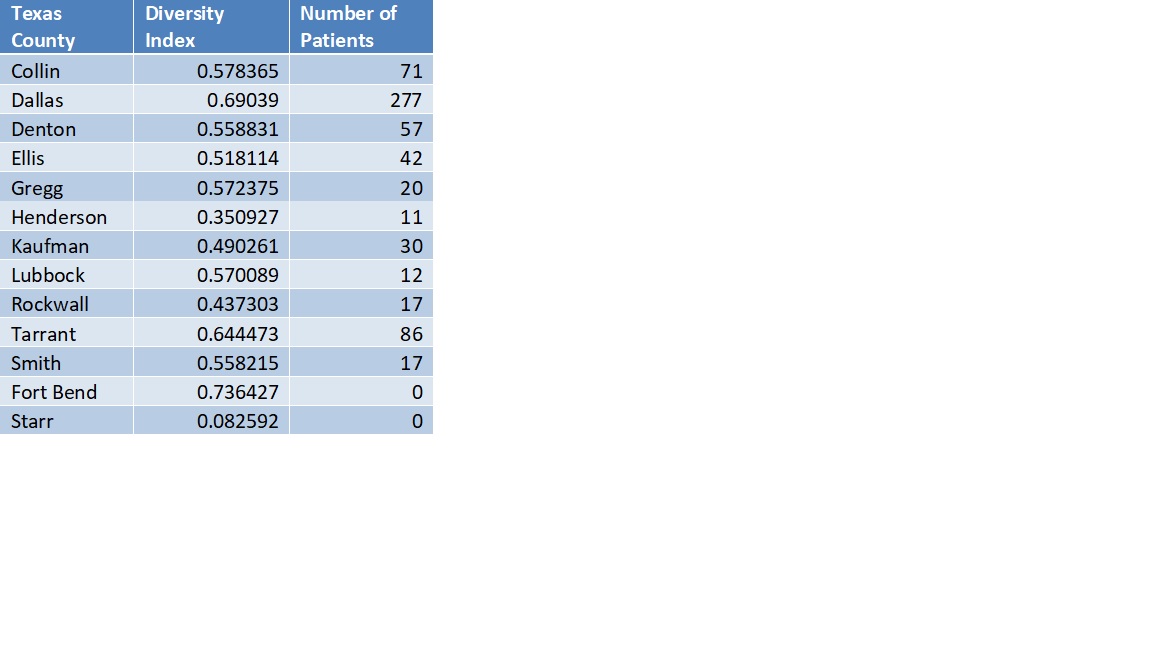 Table dipicting Texas Counties with the least and most diversity, and most patient frequency in a single center rheumatology clinic
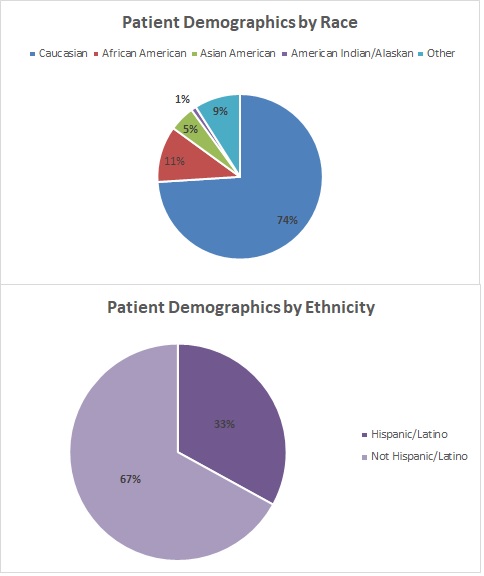 Patient demographics by race and ethnicity
To cite this abstract in AMA style:
Ciaglia K, Jo C, Ma Y, Wright T, Nassi L. Geographic Mapping of Adolescents with Rheumatic Disease: Racial and Ethnic Diversity by Texas County [abstract]. Arthritis Rheumatol. 2023; 75 (suppl 4). https://acrabstracts.org/abstract/geographic-mapping-of-adolescents-with-rheumatic-disease-racial-and-ethnic-diversity-by-texas-county/. Accessed .« Back to 2023 Pediatric Rheumatology Symposium
ACR Meeting Abstracts - https://acrabstracts.org/abstract/geographic-mapping-of-adolescents-with-rheumatic-disease-racial-and-ethnic-diversity-by-texas-county/