
Session Information
Date: Tuesday, November 9, 2021
Title: Metabolic & Crystal Arthropathies – Basic & Clinical Science Poster II (1565–1583)
Session Type: Poster Session D
Session Time: 8:30AM-10:30AM
Background/Purpose: There is clear evidence of genetic control of hyperuricemia resulting in increased gout risk, however genetic control of the transition from hyperuricemia to gout is unclear. Recent genome-wide association studies (GWAS) of this transition have used a serum urate threshold of 7 mg/dL to define hyperuricemic (HU) controls and tested for association of variants with gout under these conditions. Our goal was to investigate how modification of the serum urate threshold for HU controls influenced the estimated effects of these genetic variants on gout.
Methods: Using the UK Biobank European cohort (n > 330,000), we first performed a GWAS of HU to gout (using controls with serum urate > 7 mg/dL; gout case n = 7,131, control n = 27,018). We then took the resulting 7 common independent lead variants (p < 5 x 10⁻⁸; minor allele frequency > 0.01; independence established using PLINK LD clumping algorithm) and further investigated their association with gout when varying the definition of controls at 5 thresholds (no threshold, > 6, > 7, > 8, and > 9 mg/dL). Cases on urate lowering therapy (ULT) were not excluded as to emulate existing genetic studies of HU to gout. Additionally, we binned cases and controls based on their serum urate levels (after excluding cases on ULT; bins of 1 mg/dL ranging from 4 to > 9 mg/dL) and tested the variants for association with gout in these bins. The 7 variants were also combined into a polygenic risk score and the same models were run on this score. All models were adjusted for sex and age.
Results: We found that the effect size of each variant on gout decreased with increasing mean SU for controls (Figure 1), however, even at high control mean SU, most variants had a residual association with gout. This residual association was even more apparent when cases and controls were binned by SU level and association analysis done using individuals only in the specific bins (Figure 2).
Conclusion: The effect size of genetic variants associated with gout identified using HU controls (SU > 7 mg/dL) decreases as the serum urate threshold for defining controls increases. However, there are still residual effects on gout even at higher HU thresholds for controls. It is possible that these residual effects represent inflammatory genetic components of gout but given that all 7 variants tested have known strong effects on SU, other explanations may be more likely. One such explanation is that the observational study design (single measurements of serum urate) does not adequately capture the lifetime effects of these variants on serum urate and therefore gout, with residual gout associations perhaps indicating an effect of prolonged hyperuricemia due in part to these variants. Therefore, this study indicates the need for genetic investigations of prolonged elevated serum urate on gout. Such investigations would focus on the lifetime burden of urate exposure, including urate crystal deposits.
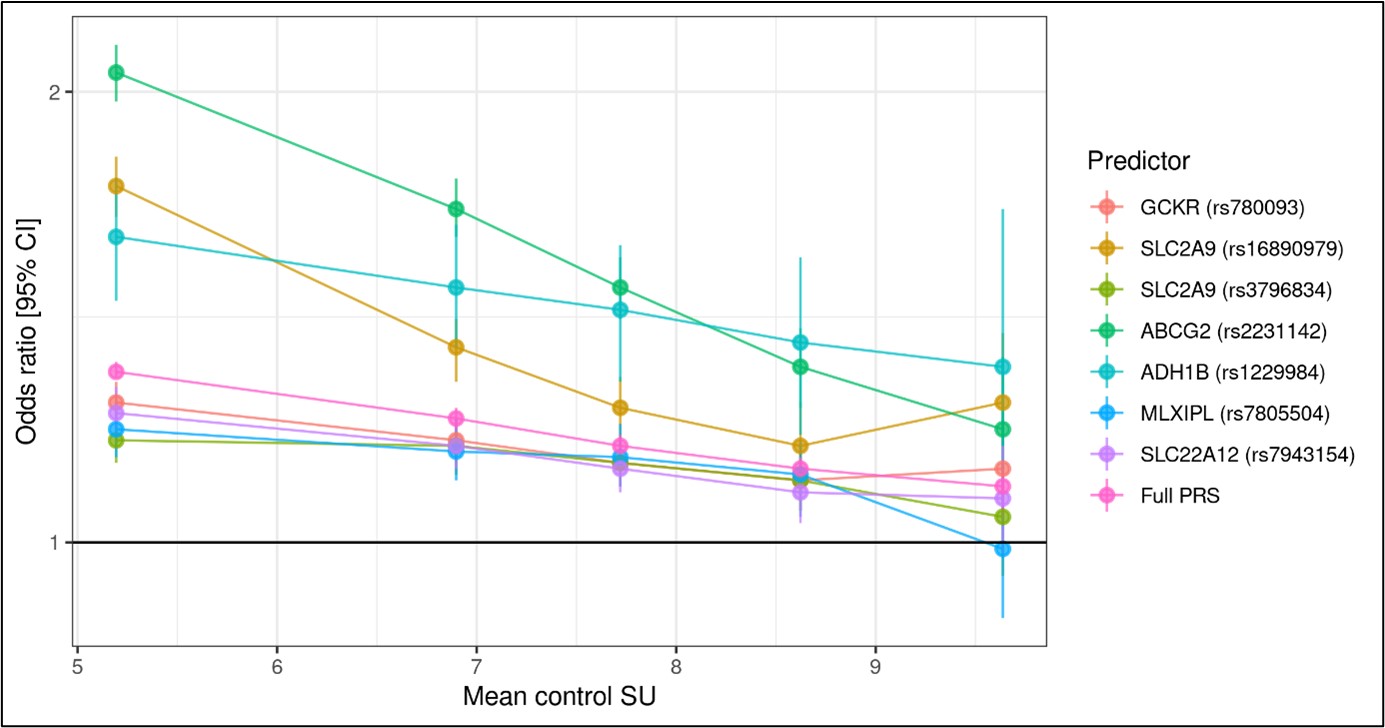 Figure 1: Effect of 7 HU to gout associated variants and their combined polygenic risk score (Full PRS) on gout with varied definitions of HU control. Y-axis shows odds ratio for gout ± 95% CI. X-axis shows mean control SU.
 Figure 2: Significant (p < 0.05) binned effects of 7 HU to gout associated variants and their combined polygenic risk score (Full PRS) on gout with binned cases and controls (after exclusion of cases on urate lowering therapy). Y-axis shows odds ratio for gout ± 95% CI. X-axis shows mean SU of bin.
To cite this abstract in AMA style:
Sumpter N, Takei R, Reynolds R, Merriman T. Genetic Effects on the Transition from Hyperuricemia to Gout [abstract]. Arthritis Rheumatol. 2021; 73 (suppl 9). https://acrabstracts.org/abstract/genetic-effects-on-the-transition-from-hyperuricemia-to-gout/. Accessed .« Back to ACR Convergence 2021
ACR Meeting Abstracts - https://acrabstracts.org/abstract/genetic-effects-on-the-transition-from-hyperuricemia-to-gout/