ACR Meeting Abstracts

ACR Meeting Abstracts

  • Meeting Abstracts
    • All Meetings
    • PRSYM 2026
    • ACR Convergence 2025
    • Download Abstract Supplements
  • Keyword Index
  • Search
  • My Favorites
    • View and print all favorites
    • Clear all favorites

Abstract Number: 0406

Gender Differences in Clinical Features and Outcomes of Systemic Sclerosis: Analysis of Reuma.pt/SSc Registry

Raquel Freitas1, Patrícia Martins2, Eduardo Dourado2, Tânia Santiago3, Francisca Guimarães4, Bruno Fernandes5, Salomé Garcia6, Beatriz Samões7, Ana Pinto8, Nuno Gonçalves9, Maria Lourenço10, Emanuel Costa11, Margarida Rocha12, Maura Couto13, Ana Catarina Duarte1, Filipe Araújo14, Inês Cordeiro2, Fátima Godinho1, Catarina Resende15, Maria Joo Salvador16, Ana Cristina Cordeiro1 and Maria José Santos17, 1Hospital Garcia de Orta, Rheumatology department, Almada, Portugal, 2Rheumatology Department, Hospital de Santa Maria, Centro Hospitalar Universitário Lisboa Norte, Lisbon Academic Medical Centre and European Reference Network on Rare Connective Tissue and Musculoskeletal Diseases Network (ERN-ReCONNET); Rheumatology Research Unit, Instituto de Medicina Molecular João Lobo Antunes, Faculdade de Medicina, Universidade de Lisboa, Lisbon, Portugal, 3Centro Hospitalar e Universitário de Coimbra, Coimbra, Portugal, 4Unidade Local de Saúde do Alto Minho, Rheumatology department, Ponte de Lima, Portugal, 5Rheumatology Department, Centro Hospitalar Universitário de São João EPE, Braga, Portugal, 6Rheumatology Department, Centro Hospitalar Universitário de São João EPE, Porto, Portugal, 7Rheumatology Department, Centro Hospitalar Vila Nova de Gaia, VIla Nova de Gaia, Portugal, 8Local Health Unit of Guarda, Portugal, Barcelos, Portugal, 9Centro Hospitalar Lisboa Ocidental, Rheumatology Department; Hospital Central do Funchal, Lisboa, Portugal, 10Hospital Egas Moniz, Barcelos, Portugal, 11Hospital de Braga, Braga, Portugal, 12Centro Hospitalar Universitário Lisboa Norte, Rheumatology Department, Faro, Portugal, 13Centro Hospitalar Tondela - Viseu, Rheumatology Department, Linda a Velha, Portugal, 14Hospital de Sant'Ana, Rheumatology and Osteoporosis department, Parede, Portugal, 15Centro Hospitalar Universitário Lisboa Norte, Rheumatology Department, Lisbon, Portugal, 16Centro Hospitalar e Universitário de Coimbra, Rheumatology Department, Coimbra, Portugal, 17Rheumatology Department, Hospital Garcia de Orta, Almada, Portugal

Meeting: ACR Convergence 2021

Keywords: gender, Systemic sclerosis

  • Tweet
  • Email a link to a friend (Opens in new window) Email
  • Print (Opens in new window) Print
Session Information

Date: Saturday, November 6, 2021

Title: Systemic Sclerosis & Related Disorders – Clinical Poster I (0387–0413)

Session Type: Poster Session A

Session Time: 8:30AM-10:30AM

Background/Purpose: Systemic sclerosis (SSc) is a rare connective tissue disease of unknown etiology, with a broad spectrum of clinical and laboratory features. Evidence for the role of sex in the clinical manifestations of SSc patients is emerging. Some multicenter cohorts have shown that male SSc patients have more severe disease [Freire M, et al. Clin Exp Rheumatol 2017; Peoples C, et al. J Scleroderma Relat Disord 2016].
Our objective was to assess the clinical manifestations and survival in the cohort of Portuguese SSc patients according to gender.

Methods: Data from adult SSc patients included in Reuma.pt database was analyzed. Demographic features, SSc subsets, main clinical and immunological features, treatments used and survival data were evaluated and compared between genders. Survival was calculated for patients included in Reuma.pt within the first two years of diagnosis. Of the 1054 patients included, 716 (68%) fulfilled ACR/EULAR 2013 criteria.

Results: In total, 1054 adult patients with SSc were included, 132 (12.5%) males. No differences in demographic features and comorbidities were found between women and men, except for a higher rate of smokers among men (64.5% vs 19.2%; p< 0.01). Diffuse cutaneous SSc subtype and anti-topoisomerase antibodies were more prevalent in males (Table 1). Raynaud’s phenomenon (RP) and skin thickening were the most frequently observed clinical manifestations, RP being more prevalent in females (84.1% vs 94%, p=0.04) and skin thickening proximal to metacarpophalangeal and metatarsophalangeal joints in males (83.2% vs 75%, p=0.03). Additionally, male patients presented significantly more myositis (13.3% vs 4.6%, p< 0.01), interstitial lung disease (38.9% vs 27.1%, p=0.03) and gastric involvement (20.4% vs 11.3%, p< 0.01). One-third of patients were treated with immunomodulators, with no differences in the pattern of drugs used between genders. During follow-up, more deaths were reported in men (12.1% vs 7.3%, p=0.04). However, the overall 1-, 3- and 5-year survival was not significantly different between men and women (96.4% vs 98.2%, 93% vs 95.9% and 83.4% vs 93.2%, p=0.08, Figure 1).

Conclusion: This study confirms the existence of gender differences in clinical and immunologic features of SSc patients. Although SSc is less common in men, they have a more severe expression of internal organ involvement. Nevertheless, no statistically significant differences were found in survival rates.
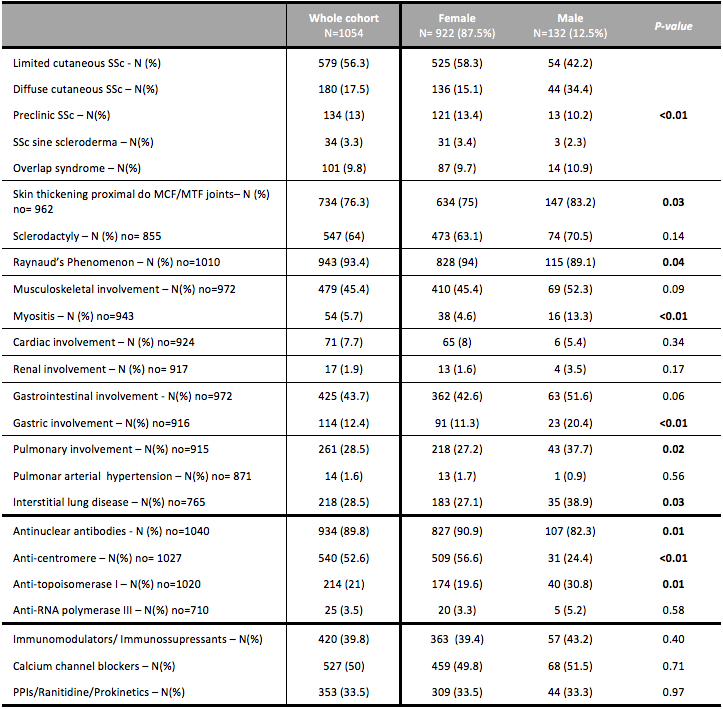
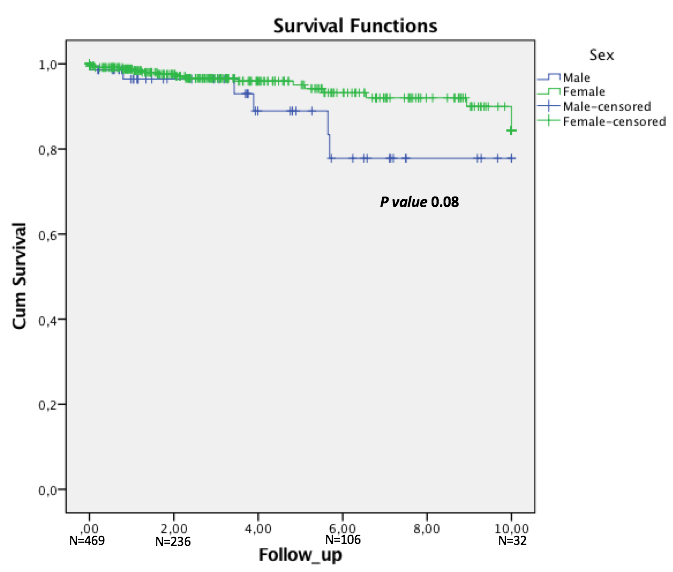
Table 1 – Cumulative clinical and immunologic features and treatments used. MCF – metacarpophalageal joints; MTF – metatarsophalangeal joints. Pulmonary arterial hypertension confirmed by right heart catheterization. Immunomodulators include Methotrexate, Leflunomide, Hydroxychloroquine; Immunosuppressants include Azathioprine, Mycophenolate Mofetil and Cyclophosphamide. P-value comparing female and male.

Figure 1 – Survival from diagnosis of patients with SSc included in the cohort in the first two years of disease (N=469). The X and Y axes represent follow-up time in years and the proportion of patients still on follow-up, respectively.


Disclosures: R. Freitas, None; P. Martins, None; E. Dourado, None; T. Santiago, None; F. Guimarães, None; B. Fernandes, None; S. Garcia, None; B. Samões, None; A. Pinto, Merck Sharp and Dohme, 6; N. Gonçalves, Nordic Pharma, 6; M. Lourenço, None; E. Costa, None; M. Rocha, None; M. Couto, None; A. Duarte, None; F. Araújo, MSD, 2; I. Cordeiro, Bristol Myers Squibb, 2, Bristol Myers Squibb, 3, Bristol Myers Squibb, 3; F. Godinho, Laboratórios Vitória, 2; C. Resende, None; M. Salvador, None; A. Cordeiro, Abbvie, 2, Boehringer Ingelheim, 2, Roche, 6; M. José Santos, Abbvie, 6, Novartis, 6, Pfizer, 6, Roche, 6.

To cite this abstract in AMA style:

Freitas R, Martins P, Dourado E, Santiago T, Guimarães F, Fernandes B, Garcia S, Samões B, Pinto A, Gonçalves N, Lourenço M, Costa E, Rocha M, Couto M, Duarte A, Araújo F, Cordeiro I, Godinho F, Resende C, Salvador M, Cordeiro A, José Santos M. Gender Differences in Clinical Features and Outcomes of Systemic Sclerosis: Analysis of Reuma.pt/SSc Registry [abstract]. Arthritis Rheumatol. 2021; 73 (suppl 9). https://acrabstracts.org/abstract/gender-differences-in-clinical-features-and-outcomes-of-systemic-sclerosis-analysis-of-reuma-pt-ssc-registry/. Accessed .
  • Tweet
  • Email a link to a friend (Opens in new window) Email
  • Print (Opens in new window) Print

« Back to ACR Convergence 2021

ACR Meeting Abstracts - https://acrabstracts.org/abstract/gender-differences-in-clinical-features-and-outcomes-of-systemic-sclerosis-analysis-of-reuma-pt-ssc-registry/

Advanced Search

My Favorites

Save and print abstracts during your browser session by clicking the “Favorite” button at the bottom of any abstract (must have cookies enabled in browser). See saved favorites.

Abstract Policies

  • ACR Convergence Abstract Embargo Policies
  • ACR Convergence Abstract Permissions & Reprints
  • PRSYM Abstract Policies

ACR Convergence. Where Rheumatology Meets

ACR Convergence 2026

Join us November 6-11 in Orlando, Florida.
See Registration Information

  • Contact ACR
  • Privacy Policy
  • ACR Policies
  • Cookie Preferences

© Copyright 2026 American College of Rheumatology